AQA · A-Level · Biology
Course version: 7402 · Version from Sept 2016
Mutagenic agents can increase the rate of gene mutation.
Full specification wording
Genetic diversity can arise as a result of mutation or during: Mutagenic agents can increase the rate of gene mutation.
Mutations occur spontaneously at a low rate, and mutagenic agents raise that rate.
Checked against the AQA 7402 specification (opens in a new tab) on .
- Point 4 of 8
- 3 key terms
Study notes
From the checked teaching notes for this specification point.
The idea
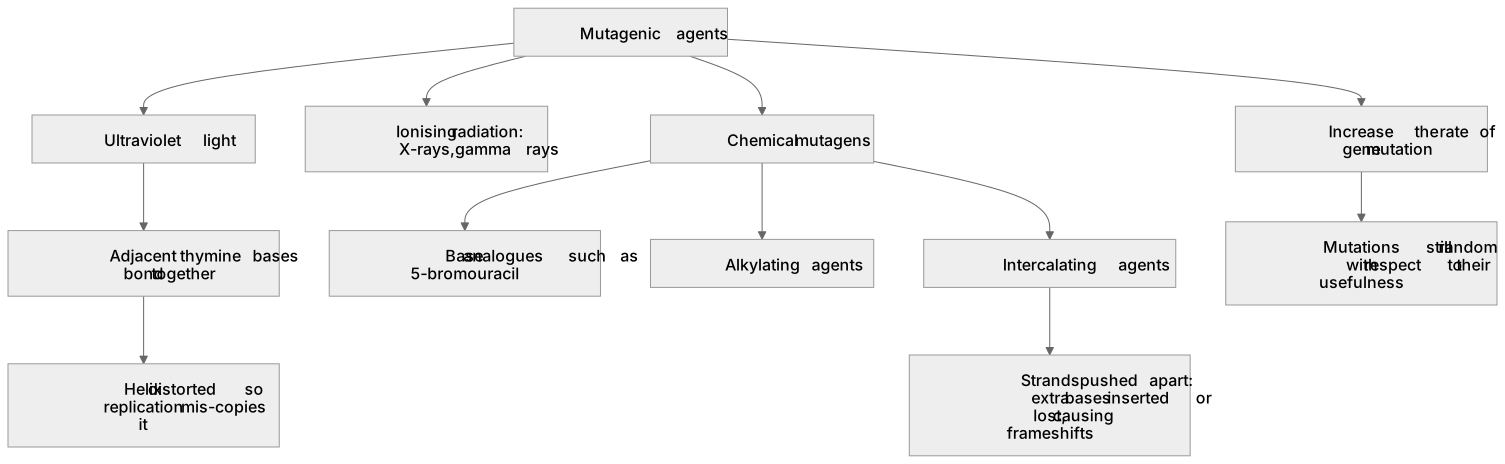
Mutations occur spontaneously at a low rate, and mutagenic agents raise that rate. Ionising radiation such as X-rays and gamma rays, and ultraviolet light, damage DNA directly; ultraviolet light makes adjacent thymine bases bond together, distorting the helix so that replication mis-copies it. Chemical mutagens work in other ways. Base analogues such as 5-bromouracil are incorporated in place of normal bases and then pair wrongly, alkylating agents add chemical groups that change base pairing, and intercalating agents slot between the bases and push the strands apart so extra bases are inserted or lost, causing frameshifts. Some mutagens, such as benzopyrene in tobacco smoke, are also carcinogens because the mutations they cause may fall in proto-oncogenes or tumour suppressor genes.
What earns the marks
- Stating that mutagenic agents increase the rate or frequency of mutation rather than causing a particular mutation.
- Naming a mutagenic agent such as ultraviolet light, ionising radiation or a named chemical.
- Describing a mechanism, such as bases being chemically altered or an agent inserting between the bases.
- Linking an increased mutation rate in proto-oncogenes or tumour suppressor genes to the development of cancer.
- Stating that the mutations produced are still random with respect to their usefulness.
Common mistakes and how to put them right
Writing that exposure to a drug, antibiotic or pathogen causes the mutation that protects against it, which AQA explicitly rejects.
Saying mutagens 'cause mutations' when the creditable point is that they increase the rate of mutation.
Claiming mutagens affect only gametes, when mutations in body cells cause cancer.
Confusing a mutagen with a carcinogen, or with an antigen.
Assuming every mutation a mutagen produces is expressed, when many are silent or lie in non-coding DNA.
Exam tips
- In any natural selection answer, put the mutation before the selection pressure in your sequence of events.
- To explain increased cancer risk, route the answer through proto-oncogenes or tumour suppressor genes and uncontrolled cell division.
- Use the words rate or frequency rather than number when describing the effect of a mutagen.
Try the lesson
The start of the Genetic diversity can arise as a result of mutation or during: Mutagenic agents can increase the rate of gene mutation. lesson, made from checked teaching notes for this specification point.
Have a go first
What name is given to an agent that increases the rate of gene mutation?
Listen
Mutations occur spontaneously at a low rate, and mutagenic agents raise that rate. Ionising radiation such as X-rays and gamma rays, and ultraviolet light, damage DNA directly; ultraviolet light makes adjacent thymine bases bond together, distorting the helix so that replication mis-copies it. Chemical mutagens work in other ways. Base analogues such as 5-bromouracil are incorporated in place of normal bases and then pair wrongly, alkylating agents add chemical groups that change base pairing, and intercalating agents slot between the bases and push the strands apart so extra bases are inserted or lost, causing frameshifts. Some mutagens, such as benzopyrene in tobacco smoke, are also carcinogens because the mutations they cause may fall in proto-oncogenes or tumour suppressor genes. A strong answer earns marks for these points. stating that mutagenic agents increase the rate or frequency of mutation rather than causing a particular mutation. naming a mutagenic agent such as ultraviolet light, ionising radiation or a named chemical. describing a mechanism, such as bases being chemically altered or an agent inserting between the bases. linking an increased mutation rate in proto-oncogenes or tumour suppressor genes to the development of cancer. Exam tip: In any natural selection answer, put the mutation before the selection pressure in your sequence of events.
See it
Key words
Say what each word means before you turn the card.
increased mutation rate
Try answering aloud or in your head before turning the card.
ionising radiation and UV
Try answering aloud or in your head before turning the card.
chemical mutagens
Try answering aloud or in your head before turning the card.
See every definition
- increased mutation rate
- Mutagenic agents raise the rate at which gene mutation occurs, rather than causing a particular mutation.
- ionising radiation and UV
- Agents that damage DNA directly; ultraviolet light makes adjacent thymine bases bond together, distorting the helix so that replication mis-copies it.
- chemical mutagens
- Agents that work in other ways, such as base analogues incorporated in place of normal bases, alkylating agents that add chemical groups, and intercalating agents that slot between the bases.
Label the diagram
Some boxes have lost their names. Pick the right name for each number.
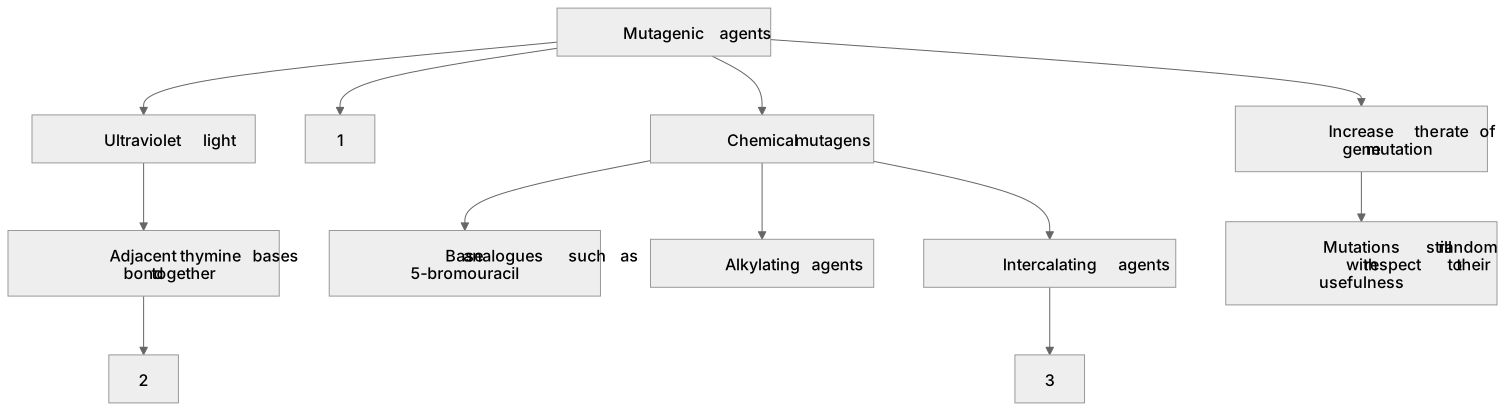
1Box 1
2Box 2
3Box 3
There is more to this lesson
The full lesson goes on to check your understanding and help you earn the marks. Create a free account to carry on, with your progress saved.
A week of Premium from your first lesson · Then the free plan continues · No card, no charge
Test your understanding of Genetic diversity can arise as a result of mutation or during: Mutagenic agents can increase the rate of gene mutation.
Active recall beats re-reading. Take an instant quiz now to test what you’ve learned and lock it into long-term memory.
A week of Premium from your first lesson · Then the free plan continues · No card, no charge