AQA · A-Level · Biology
Course version: 7402 · Version from Sept 2016
Mutations in the number of chromosomes can arise spontaneously by…
Full specification wording
Genetic diversity can arise as a result of mutation or during: Mutations in the number of chromosomes can arise spontaneously by chromosome non-disjunction during meiosis.
Chromosome mutations change the number of chromosomes rather than the base sequence.
Checked against the AQA 7402 specification (opens in a new tab) on .
- Point 5 of 8
- 3 key terms
Study notes
From the checked teaching notes for this specification point.
The idea
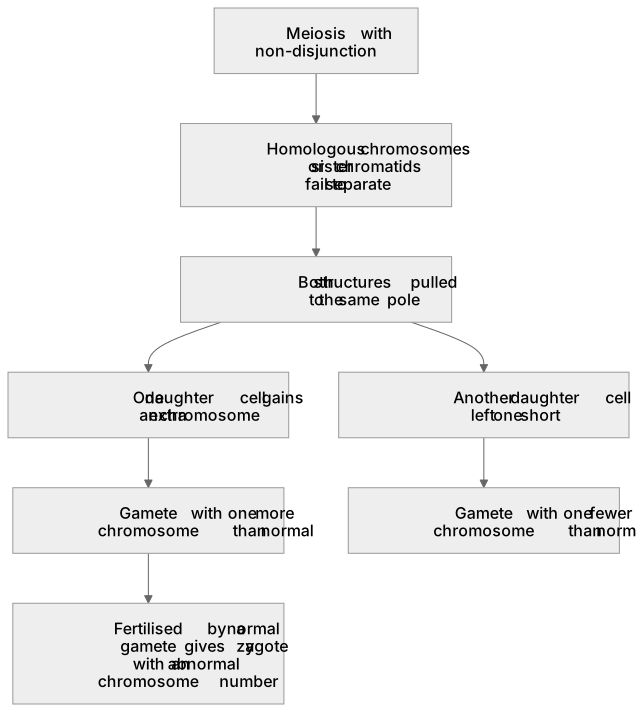
Chromosome mutations change the number of chromosomes rather than the base sequence. They arise when homologous chromosomes fail to separate at anaphase I, or when sister chromatids fail to separate at anaphase II. This is non-disjunction: both structures are pulled to the same pole, so one daughter cell gains an extra chromosome and another is left one short. A gamete with n plus one chromosomes fertilised by a normal gamete gives a zygote with forty-seven chromosomes in humans, a trisomy, as in Down's syndrome where chromosome 21 is present three times. Non-disjunction of a whole set produces polyploidy, which is common and often viable in plants but almost always lethal in animals.
What earns the marks
- Defining non-disjunction as the failure of homologous chromosomes, or of sister chromatids, to separate.
- Stating that both chromosomes or chromatids move to the same pole.
- Gametes being produced with one more, or one fewer, chromosome than normal.
- The zygote having an abnormal chromosome number after fusion with a normal gamete.
- Correctly identifying how many of the four daughter cells are affected for the division named.
Common mistakes and how to put them right
Saying non-disjunction changes the base sequence, when it changes chromosome number.
Confusing non-disjunction with crossing over or with independent segregation.
Stating that all four gametes are abnormal when non-disjunction occurs in meiosis II.
Counting chromatids instead of chromosomes when giving the chromosome content of a cell.
Describing Down's syndrome as the result of a gene mutation.
Exam tips
- In diagram questions count chromosomes, each of which has two chromatids after replication, not chromatids.
- Say both which division failed and which structures failed to separate; each can earn credit.
- Where a question says the second division proceeds normally except in one cell, track each of the four cells separately.
Try the lesson
The start of the Genetic diversity can arise as a result of mutation or during: Mutations in the number of chromosomes can arise spontaneously by chromosome non-disjunction during meiosis. lesson, made from checked teaching notes for this specification point.
Have a go first
Which statement best describes how chromosome non-disjunction during meiosis leads to a mutation in chromosome number?
Listen
Chromosome mutations change the number of chromosomes rather than the base sequence. They arise when homologous chromosomes fail to separate at anaphase I, or when sister chromatids fail to separate at anaphase II. This is non-disjunction: both structures are pulled to the same pole, so one daughter cell gains an extra chromosome and another is left one short. A gamete with n plus one chromosomes fertilised by a normal gamete gives a zygote with forty-seven chromosomes in humans, a trisomy, as in Down's syndrome where chromosome 21 is present three times. Non-disjunction of a whole set produces polyploidy, which is common and often viable in plants but almost always lethal in animals. A strong answer earns marks for these points. defining non-disjunction as the failure of homologous chromosomes, or of sister chromatids, to separate. stating that both chromosomes or chromatids move to the same pole. gametes being produced with one more, or one fewer, chromosome than normal. the zygote having an abnormal chromosome number after fusion with a normal gamete. Exam tip: In diagram questions count chromosomes, each of which has two chromatids after replication, not chromatids.
See it
Key words
Say what each word means before you turn the card.
non-disjunction
Try answering aloud or in your head before turning the card.
trisomy
Try answering aloud or in your head before turning the card.
polyploidy
Try answering aloud or in your head before turning the card.
See every definition
- non-disjunction
- Failure of homologous chromosomes to separate at anaphase I, or of sister chromatids to separate at anaphase II, so both structures are pulled to the same pole.
- trisomy
- A zygote with forty-seven chromosomes in humans, formed when a gamete with n plus one chromosomes is fertilised by a normal gamete, as in Down's syndrome.
- polyploidy
- Produced by non-disjunction of a whole set, common and often viable in plants but almost always lethal in animals.
Label the diagram
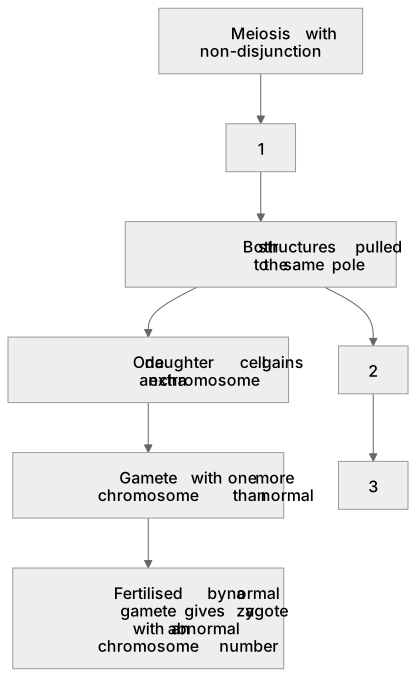
Some boxes have lost their names. Pick the right name for each number.
1Box 1
2Box 2
3Box 3
There is more to this lesson
The full lesson goes on to check your understanding and help you earn the marks. Create a free account to carry on, with your progress saved.
A week of Premium from your first lesson · Then the free plan continues · No card, no charge
Test your understanding of Genetic diversity can arise as a result of mutation or during: Mutations in the number of chromosomes can arise spontaneously by chromosome non-disjunction during meiosis.
Active recall beats re-reading. Take an instant quiz now to test what you’ve learned and lock it into long-term memory.
A week of Premium from your first lesson · Then the free plan continues · No card, no charge