AQA · A-Level · Biology
Course version: 7402 · Version from Sept 2016
The technique of genetic fingerprinting in analysing DNA fragments that…
Full specification wording
Genetic fingerprinting (A-level only): The technique of genetic fingerprinting in analysing DNA fragments that have been cloned by PCR, and its use in determining genetic relationships and in determining the genetic variability within a population.
Genetic fingerprinting analyses VNTRs to determine relationships and population variability.
Checked against the AQA 7402 specification (opens in a new tab) on .
- Point 2 of 4
- 4 key terms
Study notes
From the checked teaching notes for this specification point.
The idea
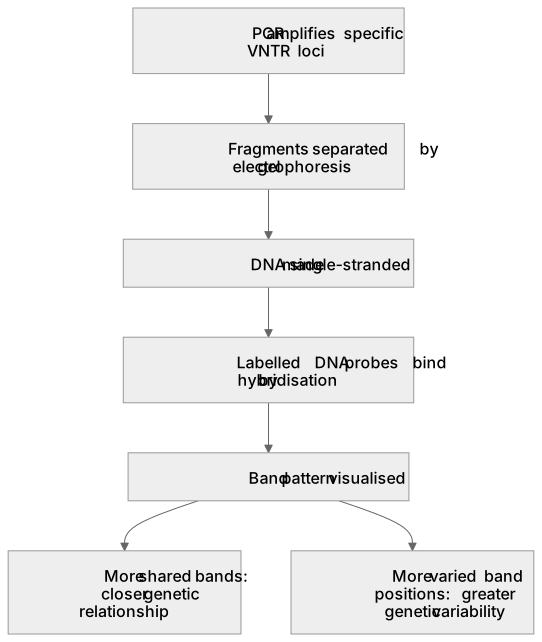
Genetic fingerprinting analyses VNTRs to determine relationships and population variability. First, PCR amplifies specific VNTR loci. Primers flanking the repeats allow Taq polymerase to create millions of fragment copies whose lengths depend on the repeat number. These fragments are separated by gel electrophoresis. Because DNA is negatively charged, it moves towards the anode; the gel sieves the fragments, so shorter ones travel further. The DNA is made single-stranded, and labelled DNA probes bind to complementary sequences by hybridisation. The band pattern is visualised (e.g. using UV for fluorescent probes). Closely related individuals share more bands, while diverse populations show a wider variety of band positions.
What earns the marks
- Using PCR to amplify specific VNTR fragments.
- Separating the DNA fragments by length using gel electrophoresis.
- Adding labelled DNA probes that bind to the fragments by complementary base pairing/DNA hybridisation.
- Identifying the bands by fluorescence or radioactivity.
- Stating that more shared bands indicate a closer genetic relationship, or that more varied band positions indicate greater genetic variability in a population.
Common mistakes and how to put them right
Stating that restriction endonucleases are used to cut the DNA after PCR amplification of VNTRs, which is unnecessary as PCR already produces fragments of the target length.
Writing only that the probe 'is complementary' without saying that it binds or hybridises to the DNA.
Stating that DNA moves towards the negative electrode, when it is negatively charged and so moves towards the positive electrode.
Leaving the DNA double stranded before adding the probe, so there is no exposed base sequence for the probe to pair with.
Exam tips
- When describing the method, follow the logical sequence: amplify using PCR, separate using electrophoresis, hybridise with a labelled probe, and visualise.
- State the label and how it is seen, for example a fluorescent probe viewed under UV or a radioactive probe exposed to X-ray film.
- To answer questions on genetic variability, explicitly link a greater number of different band positions in a sample to a larger number of alleles in the population.
Try the lesson
The start of the Genetic fingerprinting (A-level only): The technique of genetic fingerprinting in analysing DNA fragments that have been cloned by PCR, and its use in determining genetic relationships and in determining the genetic variability within a population. lesson, made from checked teaching notes for this specification point.
Have a go first
Which technique is used to produce many copies of a DNA fragment before genetic fingerprinting?
Listen
Genetic fingerprinting analyses VNTRs to determine relationships and population variability. First, PCR amplifies specific VNTR loci. Primers flanking the repeats allow Taq polymerase to create millions of fragment copies whose lengths depend on the repeat number. These fragments are separated by gel electrophoresis. Because DNA is negatively charged, it moves towards the anode; the gel sieves the fragments, so shorter ones travel further. The DNA is made single-stranded, and labelled DNA probes bind to complementary sequences by hybridisation. The band pattern is visualised (e.g. using UV for fluorescent probes). Closely related individuals share more bands, while diverse populations show a wider variety of band positions. A strong answer earns marks for these points. using PCR to amplify specific VNTR fragments. separating the DNA fragments by length using gel electrophoresis. adding labelled DNA probes that bind to the fragments by complementary base pairing/DNA hybridisation. identifying the bands by fluorescence or radioactivity. Exam tip: When describing the method, follow the logical sequence: amplify using PCR, separate using electrophoresis, hybridise with a labelled probe, and visualise.
See it
Key words
Say what each word means before you turn the card.
PCR amplification
Try answering aloud or in your head before turning the card.
gel electrophoresis
Try answering aloud or in your head before turning the card.
DNA hybridisation
Try answering aloud or in your head before turning the card.
genetic relationships
Try answering aloud or in your head before turning the card.
See every definition
- PCR amplification
- A process in which primers flanking the repeats allow Taq polymerase to create millions of fragment copies whose lengths depend on the repeat number.
- gel electrophoresis
- A method of separating DNA fragments by length, in which the negatively charged DNA moves towards the anode and the gel sieves the fragments so shorter ones travel further.
- DNA hybridisation
- The binding of labelled DNA probes to complementary sequences after the DNA has been made single-stranded.
- genetic relationships
- Judged from the number of shared bands, as closely related individuals share more bands.
Label the diagram
Some boxes have lost their names. Pick the right name for each number.
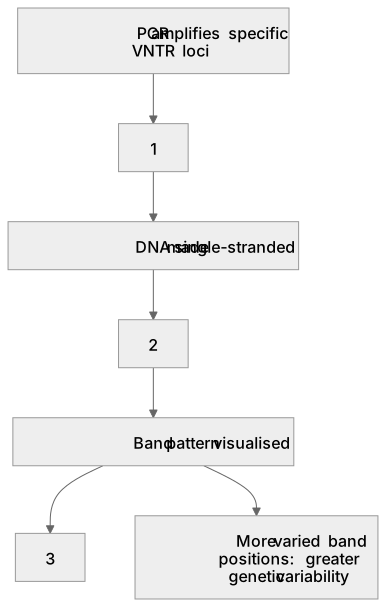
1Box 1
2Box 2
3Box 3
There is more to this lesson
The full lesson goes on to check your understanding and help you earn the marks. Create a free account to carry on, with your progress saved.
A week of Premium from your first lesson · Then the free plan continues · No card, no charge
Test your understanding of Genetic fingerprinting (A-level only): The technique of genetic fingerprinting in analysing DNA fragments that have been cloned by PCR, and its use in determining genetic relationships and in determining the genetic variability within a population.
Active recall beats re-reading. Take an instant quiz now to test what you’ve learned and lock it into long-term memory.
A week of Premium from your first lesson · Then the free plan continues · No card, no charge