AQA · A-Level · Biology
Course version: 7402 · Version from Sept 2016
The use of genetic fingerprinting in the fields of forensic science,…
Full specification wording
Genetic fingerprinting (A-level only): The use of genetic fingerprinting in the fields of forensic science, medical diagnosis, animal and plant breeding.
Genetic fingerprinting analyses Variable Number Tandem Repeats (VNTRs) to compare DNA.
Checked against the AQA 7402 specification (opens in a new tab) on .
- Point 3 of 4
- 4 key terms
Study notes
From the checked teaching notes for this specification point.
The idea
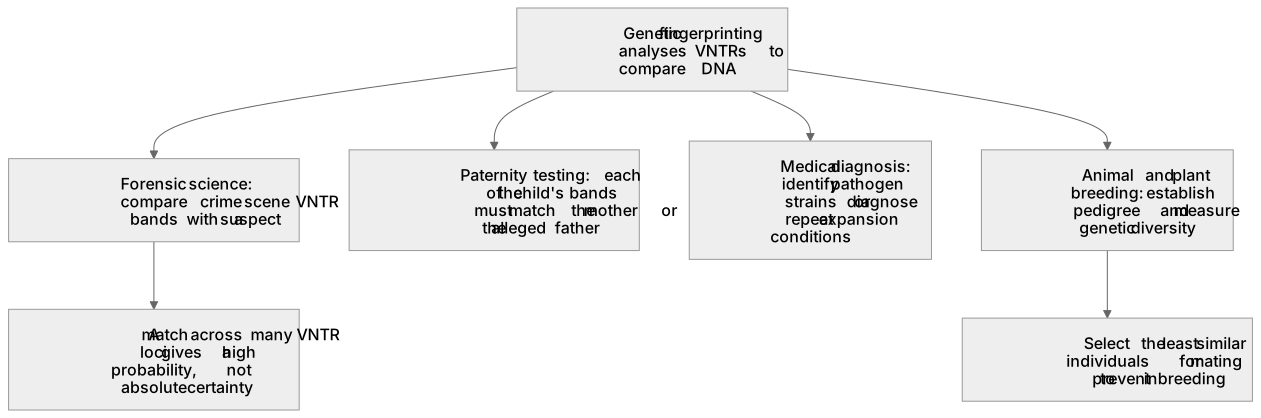
Genetic fingerprinting analyses Variable Number Tandem Repeats (VNTRs) to compare DNA. In forensics, DNA from a crime scene is amplified by PCR and separated by gel electrophoresis. A match across many VNTR loci makes it highly improbable the DNA belongs to someone else, placing them at the scene. In paternity testing, every band in a child's profile must match either the mother or the alleged father. In medical diagnosis, fingerprinting identifies specific pathogen strains or diagnoses conditions caused by repeat expansions, like Huntington's. In animal and plant breeding, it establishes pedigree and measures genetic diversity to prevent inbreeding.
What earns the marks
- A forensic use, comparing VNTR band patterns from a crime scene with a suspect to establish a high probability of presence.
- A paternity use, justifying relatedness by matching each of the child's VNTR bands to either the mother or the alleged father.
- A medical diagnosis use, such as identifying specific strains of pathogens or diagnosing conditions caused by altered tandem repeats.
- A breeding use, comparing band patterns to select the least similar individuals for mating, thereby increasing genetic diversity and preventing inbreeding.
Common mistakes and how to put them right
Confusing genetic fingerprinting (analysing VNTRs) with genetic screening (using allele-specific probes to find specific disease alleles).
Stating a fingerprint proves guilt, rather than showing a high probability that the DNA belongs to the suspect.
Treating a child's bands as a blend of parents' bands rather than discrete bands inherited whole from each parent.
Exam tips
- Always state that a forensic match provides a high probability, not absolute certainty, as identical twins share VNTR profiles.
- When explaining breeding uses, specify that comparing VNTR patterns helps identify genetically distant individuals to prevent inbreeding depression.
Try the lesson
The start of the Genetic fingerprinting (A-level only): The use of genetic fingerprinting in the fields of forensic science, medical diagnosis, animal and plant breeding. lesson, made from checked teaching notes for this specification point.
Have a go first
A DNA sample from a crime scene and a DNA sample from a suspect are both treated with the same restriction enzymes, then separated by electrophoresis. The banding patterns obtained are shown to be identical. What is the best interpretation of this result?
Listen
Genetic fingerprinting analyses Variable Number Tandem Repeats (VNTRs) to compare DNA. In forensics, DNA from a crime scene is amplified by PCR and separated by gel electrophoresis. A match across many VNTR loci makes it highly improbable the DNA belongs to someone else, placing them at the scene. In paternity testing, every band in a child's profile must match either the mother or the alleged father. In medical diagnosis, fingerprinting identifies specific pathogen strains or diagnoses conditions caused by repeat expansions, like Huntington's. In animal and plant breeding, it establishes pedigree and measures genetic diversity to prevent inbreeding. A strong answer earns marks for these points. a forensic use, comparing VNTR band patterns from a crime scene with a suspect to establish a high probability of presence. a paternity use, justifying relatedness by matching each of the child's VNTR bands to either the mother or the alleged father. a medical diagnosis use, such as identifying specific strains of pathogens or diagnosing conditions caused by altered tandem repeats. a breeding use, comparing band patterns to select the least similar individuals for mating, thereby increasing genetic diversity and preventing inbreeding. Exam tip: Always state that a forensic match provides a high probability, not absolute certainty, as identical twins share VNTR profiles.
See it
Key words
Say what each word means before you turn the card.
forensic comparison
Try answering aloud or in your head before turning the card.
paternity testing
Try answering aloud or in your head before turning the card.
pathogen identification
Try answering aloud or in your head before turning the card.
preventing inbreeding
Try answering aloud or in your head before turning the card.
See every definition
- forensic comparison
- Comparing VNTR band patterns from a crime scene with a suspect to establish a high probability of presence.
- paternity testing
- Justifying relatedness by matching each of the child's VNTR bands to either the mother or the alleged father.
- pathogen identification
- A medical diagnosis use, such as identifying specific strains of pathogens.
- preventing inbreeding
- Comparing band patterns to select the least similar individuals for mating, thereby increasing genetic diversity.
Label the diagram
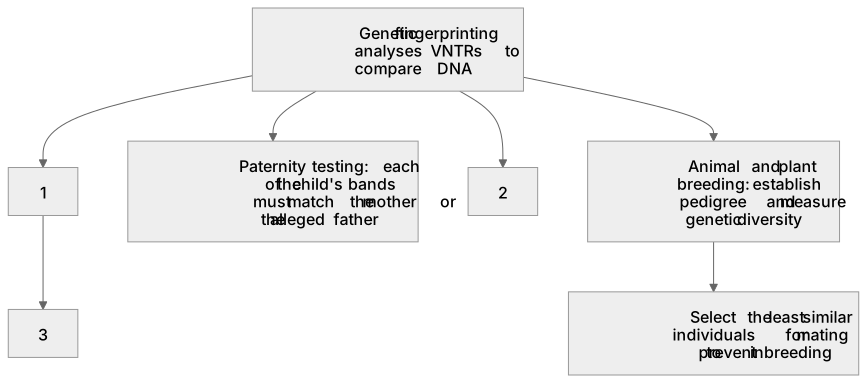
Some boxes have lost their names. Pick the right name for each number.
1Box 1
2Box 2
3Box 3
There is more to this lesson
The full lesson goes on to check your understanding and help you earn the marks. Create a free account to carry on, with your progress saved.
A week of Premium from your first lesson · Then the free plan continues · No card, no charge
Test your understanding of Genetic fingerprinting (A-level only): The use of genetic fingerprinting in the fields of forensic science, medical diagnosis, animal and plant breeding.
Active recall beats re-reading. Take an instant quiz now to test what you’ve learned and lock it into long-term memory.
A week of Premium from your first lesson · Then the free plan continues · No card, no charge