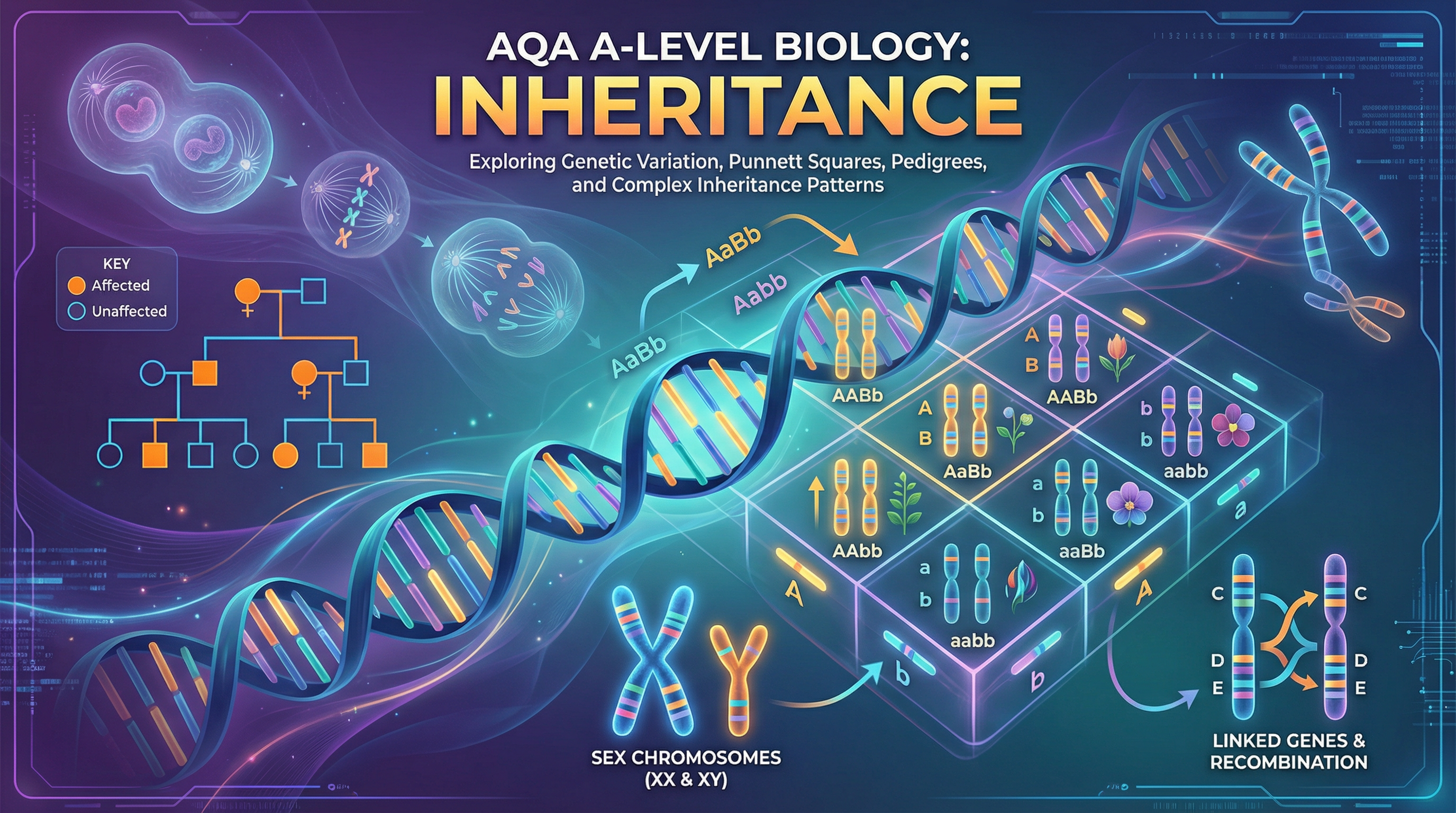
Inheritance

    AQA
    A-Level
    Biology

    Master AQA A-Level Biology Inheritance (3.2) with this comprehensive guide. We break down everything from monohybrid crosses to epistasis and the Chi-squared test, giving you the tools to tackle exam questions with confidence and secure top marks.

    5
    Min Read
    3
    Examples
    5
    Questions
    0
    Key Terms
    🎙 Podcast Episode
    Inheritance
    0:00-0:00

    Study Notes

    header_image.png

    Overview

    Inheritance is a cornerstone of A-Level Biology, exploring how genetic information is passed from one generation to the next. This topic (AQA specification 3.2) moves beyond basic genetics to cover complex interactions and statistical analysis, areas where examiners can really differentiate between candidates. You will be expected to apply your knowledge of monohybrid and dihybrid crosses, understand the nuances of sex linkage, autosomal linkage, and epistasis, and critically, use the Chi-squared test to validate your genetic diagrams. A significant portion of marks in this area are awarded for AO2 (Application), meaning you must be able to use these principles to solve problems in unfamiliar contexts. Expect questions that require you to construct detailed genetic diagrams, interpret pedigree charts, and explain why observed results might deviate from expected ratios. Mastering this topic is not just about memorising ratios; it’s about developing a deep, logical understanding of genetic principles.

    inheritance_podcast.wav

    Key Concepts

    Concept 1: Monohybrid and Dihybrid Crosses

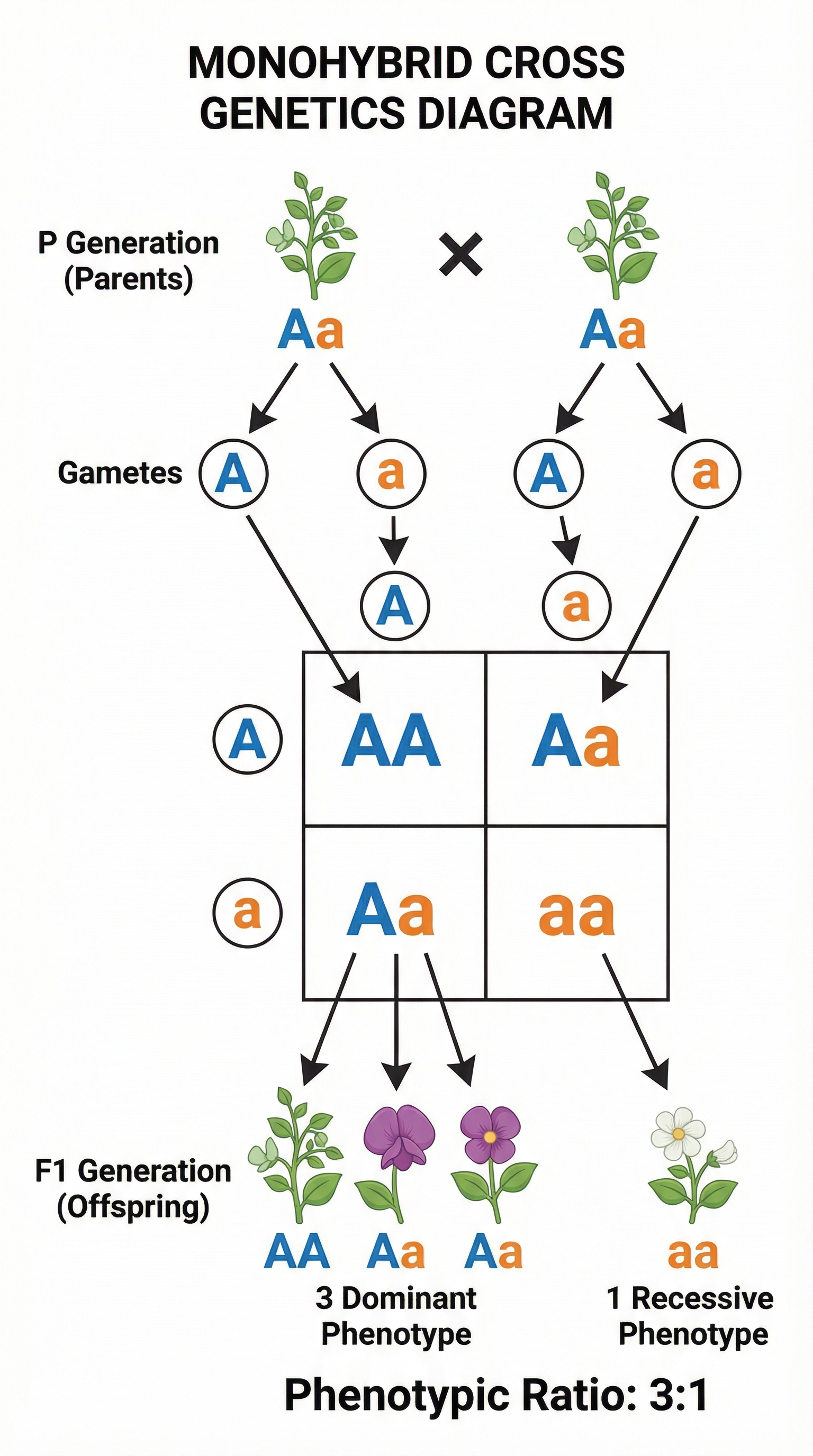
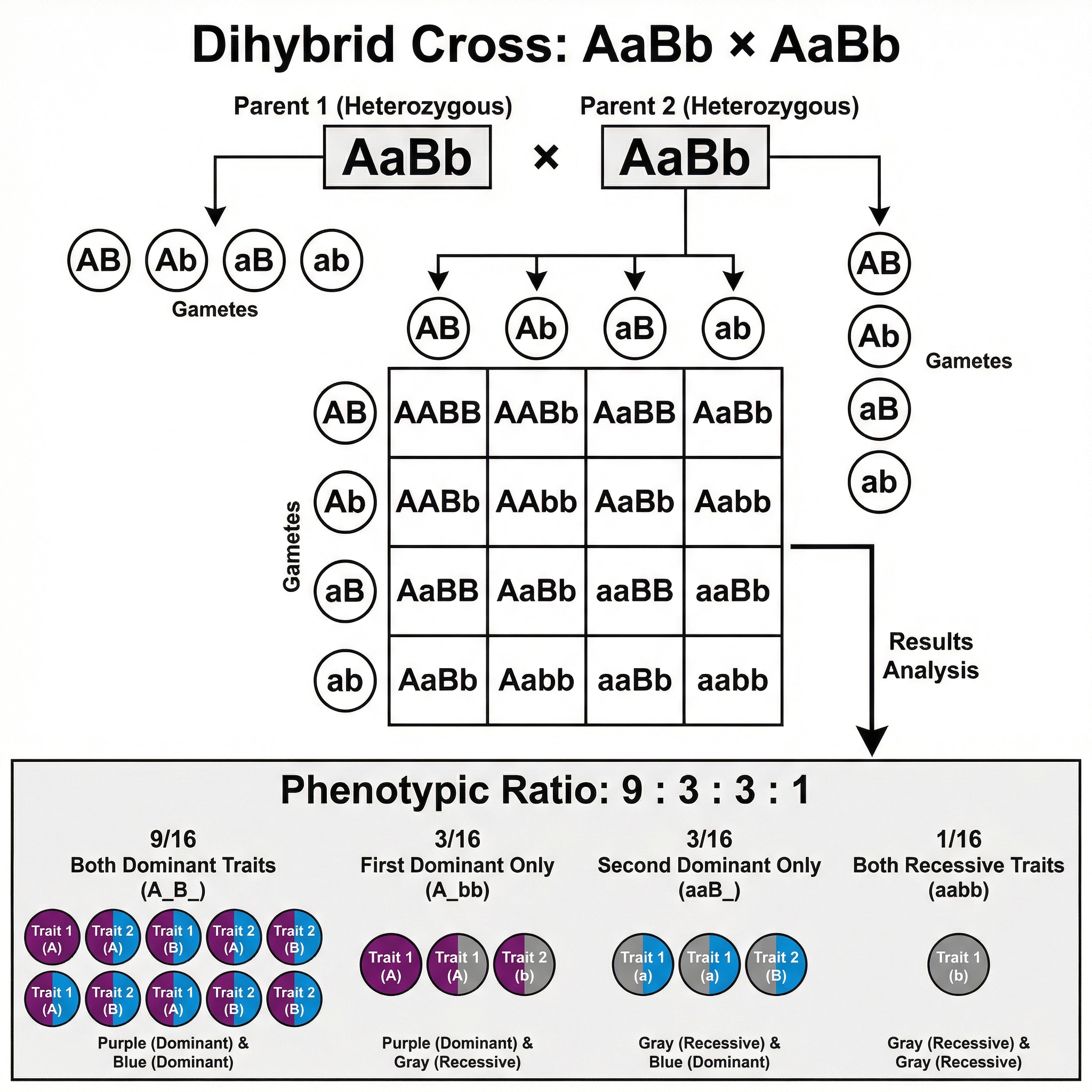
    A monohybrid cross involves the inheritance of a single gene. When crossing two heterozygous individuals (e.g., Tt x Tt), the expected phenotypic ratio in the offspring is 3:1 (dominant:recessive). A dihybrid cross involves two genes on different chromosomes. For a cross between two individuals heterozygous for both genes (e.g., RrYy x RrYy), the expected phenotypic ratio is 9:3:3:1, assuming independent assortment. It is crucial to lay out your genetic diagrams clearly, showing parental phenotypes, genotypes, gametes (circled), the Punnett square, and the resulting offspring phenotypes and their ratios. Marks are explicitly awarded for this structure.
    monohybrid_cross.png

    dihybrid_cross.png

    Concept 2: Linkage (Sex and Autosomal)

    Sex linkage refers to genes located on the sex chromosomes (X or Y). Most are on the X chromosome. Males (XY) are more likely to express recessive X-linked traits because they only have one X chromosome (hemizygous). Notation is key: use X and Y with the allele as a superscript (e.g., X^H, X^h, Y). Autosomal linkage occurs when two or more genes are located on the same autosome (non-sex chromosome). They are inherited together and do not assort independently. This results in an excess of parental phenotypes and a shortage of recombinant phenotypes compared to the expected 9:3:3:1 ratio. Crossing over can separate linked alleles, but this is a low-frequency event.

    Concept 3: Epistasis

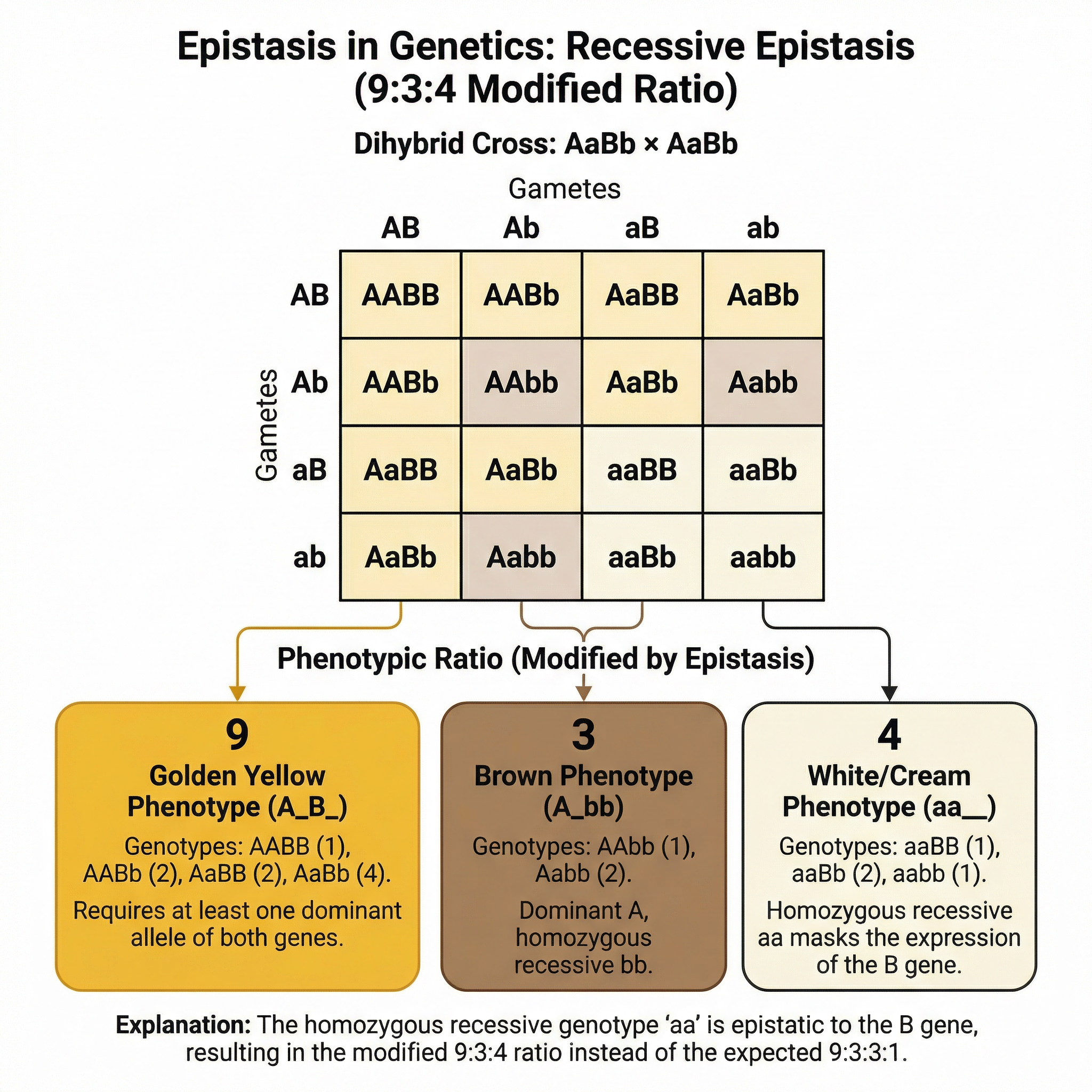
    Epistasis is a form of gene interaction where one gene locus masks or modifies the expression of another gene locus. This leads to modified dihybrid ratios. For example, in recessive epistasis, a homozygous recessive genotype at one locus (e.g., ee) masks the expression of the other gene, resulting in a 9:3:4 ratio. In dominant epistasis, a dominant allele at one locus masks the expression of the other, leading to ratios like 12:3:1 or 13:3. Recognising these non-standard ratios is a common exam challenge.
    epistasis_diagram.png

    Mathematical/Scientific Relationships

    The Chi-Squared (χ²) Test

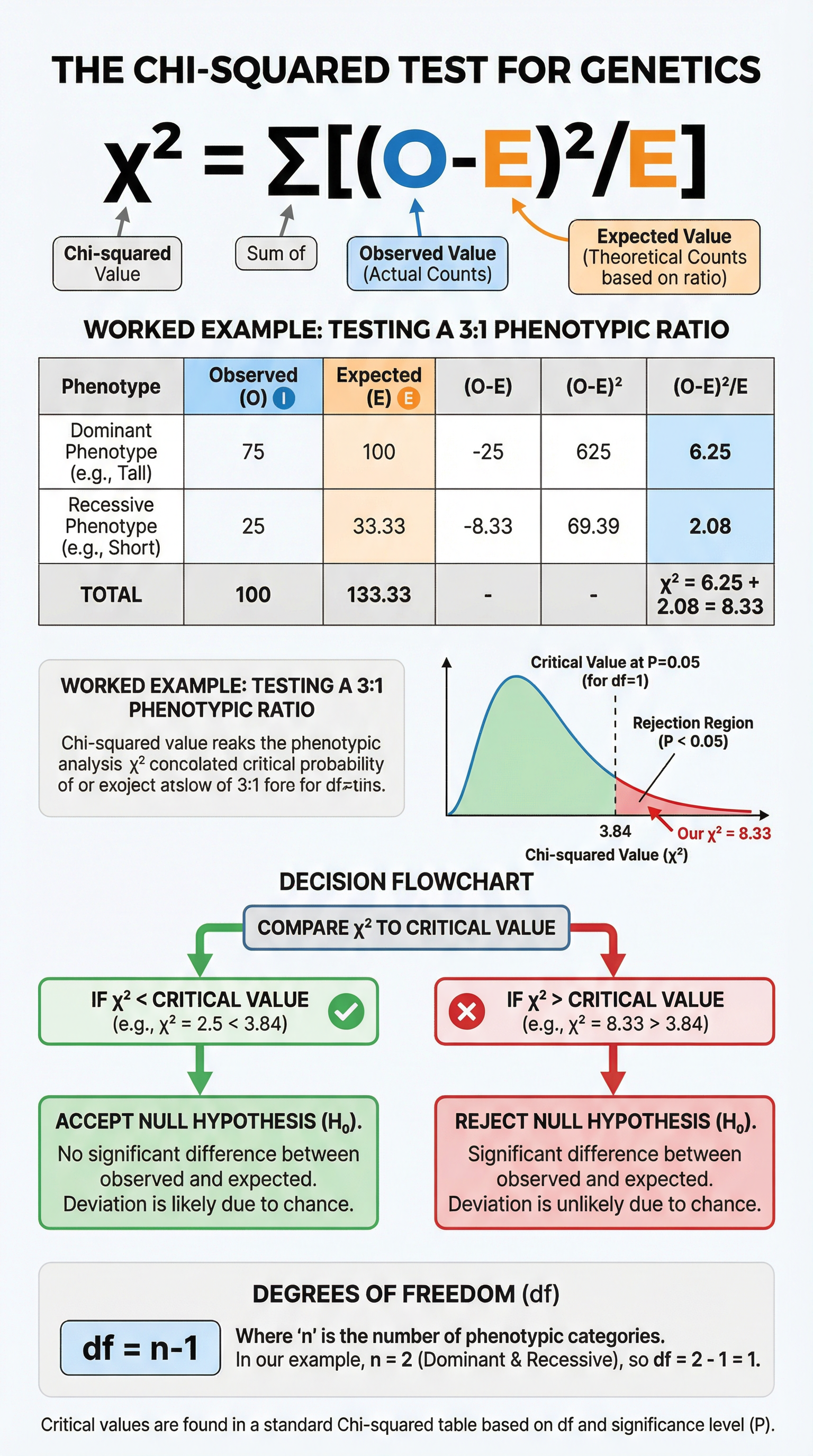
    This statistical test is used to determine if the difference between observed (O) and expected (E) results is statistically significant or due to chance. It is a critical part of this topic.

    Formula (Must memorise):
    χ² = Σ [ (O - E)² / E ]

    • Σ = Sum of
    • O = Observed frequency
    • E = Expected frequency

    **Degrees of Freedom (df):**df = n - 1
    where 'n' is the number of phenotypic categories.

    Interpretation:

    1. State the null hypothesis (H₀): 'There is no significant difference between the observed and expected frequencies.'
    2. Calculate the χ² value.
    3. Find the critical value from a table at P=0.05 for the correct degrees of freedom.
    4. Compare:
      • If χ² < critical value: Accept H₀. The probability that the difference is due to chance is greater than 5%.
      • If χ² > critical value: Reject H₀. The probability that the difference is due to chance is less than 5%. There is a significant underlying factor (e.g., linkage, epistasis).
    chi_squared_test.png

    Practical Applications

    This topic is fundamental to understanding genetic diseases (e.g., cystic fibrosis, sickle-cell anaemia), selective breeding in agriculture, and conservation genetics. Pedigree analysis, a key skill, is used in genetic counselling to advise families on the probability of inheriting genetic disorders. The principles of inheritance also underpin modern gene technologies and our understanding of evolution.

    Worked Examples

    3 detailed examples with solutions and examiner commentary

    Practice Questions

    Test your understanding — click to reveal model answers

    Q1

    In fruit flies, the gene for body colour has two alleles: grey (G) is dominant to black (g). The gene for wing shape has two alleles: normal (N) is dominant to vestigial (n). A fly heterozygous for both genes was crossed with a fly with a black body and vestigial wings. The cross produced 1500 offspring. How many offspring would you expect to have a grey body and vestigial wings?

    3 marks
    standard

    Hint: This is a dihybrid test cross. First, determine the genotypes of the parents and the gametes they can produce.

    Q2

    Explain why a man with an X-linked dominant condition will pass it on to all his daughters but none of his sons.

    3 marks
    standard
    Q3

    Two linked genes, A and B, are 10 map units apart. A heterozygous individual (Ab/aB) is test-crossed with a homozygous recessive individual (ab/ab). What percentage of the offspring are expected to be recombinant (AB or ab)?

    2 marks
    challenging

    Hint: The distance in map units is directly related to the recombination frequency.

    Q4

    Explain how epistasis can lead to a 9:3:4 phenotypic ratio.

    4 marks
    challenging
    Q5

    A student observes 73 purple-flowered plants and 27 white-flowered plants in a genetic cross. The student expected a 3:1 ratio. Is the student correct to conclude that the results are not significantly different from the expected ratio? Use a Chi-squared test to support your answer. The critical value at P=0.05 for 1 degree of freedom is 3.84.

    5 marks
    standard

    More Biology Study Guides

    View all

    Ecosystems

    OCR
    GCSE

    Unlock top marks in OCR GCSE Biology by mastering Ecosystems (7.1). This guide breaks down complex interactions, from energy flow in food webs to the vital carbon cycle, and provides examiner-approved techniques for tackling quantitative sampling questions.

    Enzymes

    OCR
    GCSE

    Unlock the secrets of enzymes, the biological catalysts essential for life. This guide for OCR GCSE Biology (1.6) breaks down the 'Lock and Key' model, factors affecting enzyme rates, and provides examiner-level insights to help you secure top marks.

    Respiration (aerobic, anaerobic)

    Edexcel
    GCSE

    This guide breaks down cellular respiration for Edexcel GCSE Biology, covering the critical differences between aerobic and anaerobic pathways. Master the key equations, understand oxygen debt, and learn how to apply your knowledge to secure top marks in the exam.

    Respiration

    WJEC
    GCSE

    This guide provides a comprehensive overview of Respiration for WJEC GCSE Biology. It covers the crucial differences between aerobic and anaerobic respiration, the equations you must know, and the practical applications that frequently appear in exams. Master this topic to secure top marks in your biology papers.

    Developing New Medicines

    AQA
    GCSE

    This guide breaks down the essential AQA GCSE Biology topic of Developing New Medicines (3.10). It covers the entire process from drug discovery to clinical trials, focusing on the key terminology and concepts you need to secure top marks in your exam.

    Levels of Organisation

    OCR
    GCSE

    Levels of Organisation is a foundational topic that establishes the biological hierarchy from sub-cellular structures to complete organisms. This topic is critical for understanding how cells, tissues, organs, and organ systems work together, and it underpins much of the rest of your GCSE Biology course. Examiners frequently test precise definitions and the ability to distinguish between similar cells forming tissues versus different tissues forming organs.