Study Notes
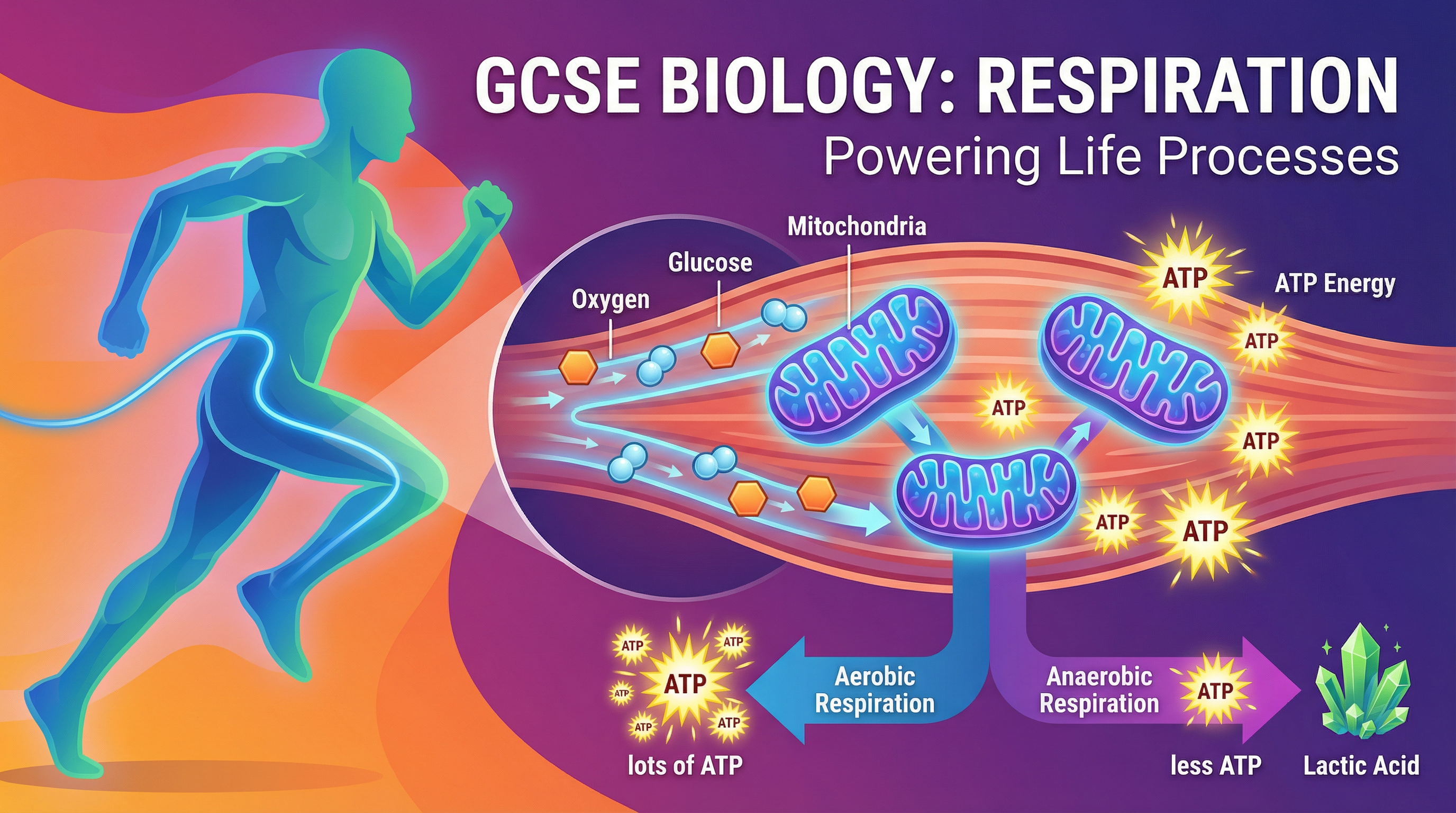
Overview
Respiration is a fundamental process of life, and a cornerstone of the Edexcel GCSE Biology specification. It is the chemical process by which living organisms release energy from their food. It's crucial to understand that respiration is not the same as breathing (ventilation). Breathing is the physical act of moving air in and out of the lungs, while respiration is the chemical reaction that happens inside every living cell. This topic is frequently tested in exams, often in the context of exercise, health, and industrial processes like baking and brewing. Expect to see a mix of short-answer questions asking for definitions and equations, as well as longer, 6-mark questions that require you to link concepts together in a logical sequence.
Key Concepts
Concept 1: The Purpose of Respiration
At its core, respiration is an exothermic reaction that occurs continuously in all living cells. The primary purpose of respiration is to release energy from glucose to produce ATP (adenosine triphosphate). ATP is the energy currency of the cell, providing the power for all life processes, including:
- Muscle contraction: for movement.
- Active transport: to move substances against a concentration gradient.
- Synthesis of molecules: to build larger molecules from smaller ones (e.g., proteins from amino acids).
- Maintaining a constant body temperature: especially in mammals and birds.
It is a common misconception that respiration creates or produces energy. This is incorrect and will lose you marks in an exam. Energy cannot be created or destroyed, only transferred from one form to another. In this case, chemical energy stored in glucose is transferred into a form the cell can use (ATP).
Concept 2: Aerobic Respiration
Aerobic respiration is the most efficient way for cells to release energy from glucose. As the name suggests, it requires oxygen. This process takes place in the mitochondria, which are often called the 'powerhouses' of the cell.
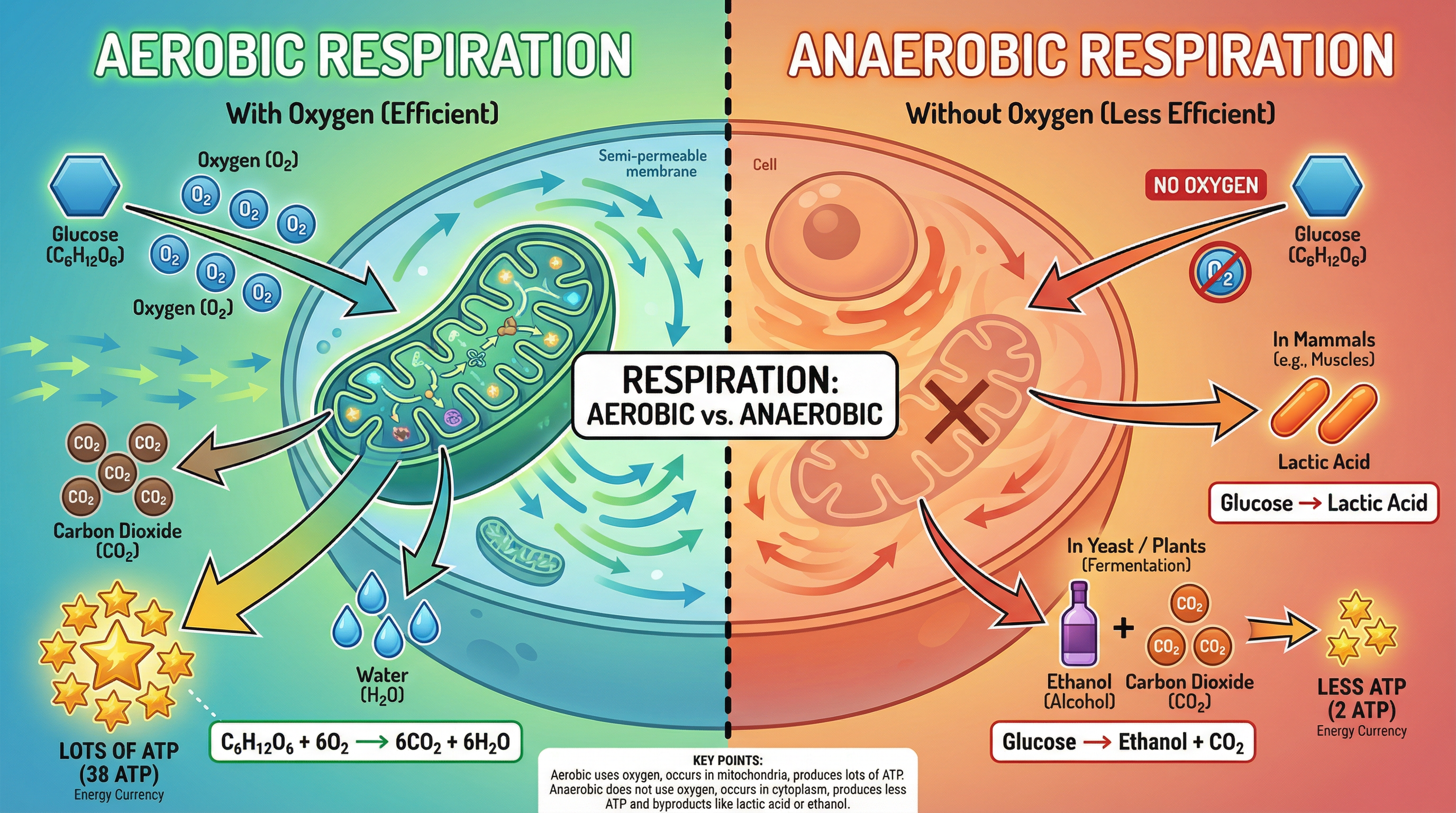
During aerobic respiration, glucose is completely broken down into carbon dioxide and water, releasing a large amount of energy (approximately 38 molecules of ATP per molecule of glucose).
Word Equation:
Glucose + Oxygen → Carbon Dioxide + Water
Balanced Symbol Equation (Higher Tier Only):
C₆H₁₂O₆ + 6O₂ → 6CO₂ + 6H₂O
Candidates must be able to recall both of these equations.
Concept 3: Anaerobic Respiration
Anaerobic respiration occurs when there is a shortage of oxygen. It is the incomplete breakdown of glucose, and it releases much less energy than aerobic respiration (only 2 molecules of ATP per molecule of glucose). This process occurs in the cytoplasm of the cell.
The products of anaerobic respiration differ between organisms.
**In Animals (including humans):**During periods of intense exercise, the heart and lungs cannot supply oxygen to the muscles fast enough. To meet the continued demand for energy, the muscle cells switch to anaerobic respiration. Glucose is converted into lactic acid.
Word Equation:
Glucose → Lactic Acid
The build-up of lactic acid in the muscles causes fatigue and a burning sensation. This is not sustainable for long periods.
**In Plants and Yeast (Fermentation):**In plant roots in waterlogged soil, or in yeast in an oxygen-deficient environment, anaerobic respiration produces ethanol and carbon dioxide. This process is known as fermentation.
Word Equation:
Glucose → Ethanol + Carbon Dioxide
This process is economically important. In baking, the carbon dioxide produced by yeast makes bread rise. In brewing, the ethanol produced by yeast is the alcohol in beer and wine.
Concept 4: Oxygen Debt
After a period of intense exercise, you will continue to breathe heavily, even after you have stopped. This is because your body is in oxygen debt. The lactic acid that has built up in the muscles needs to be broken down, and this requires oxygen. The extra oxygen you breathe in is used to oxidise the lactic acid back to carbon dioxide and water, primarily in the liver.
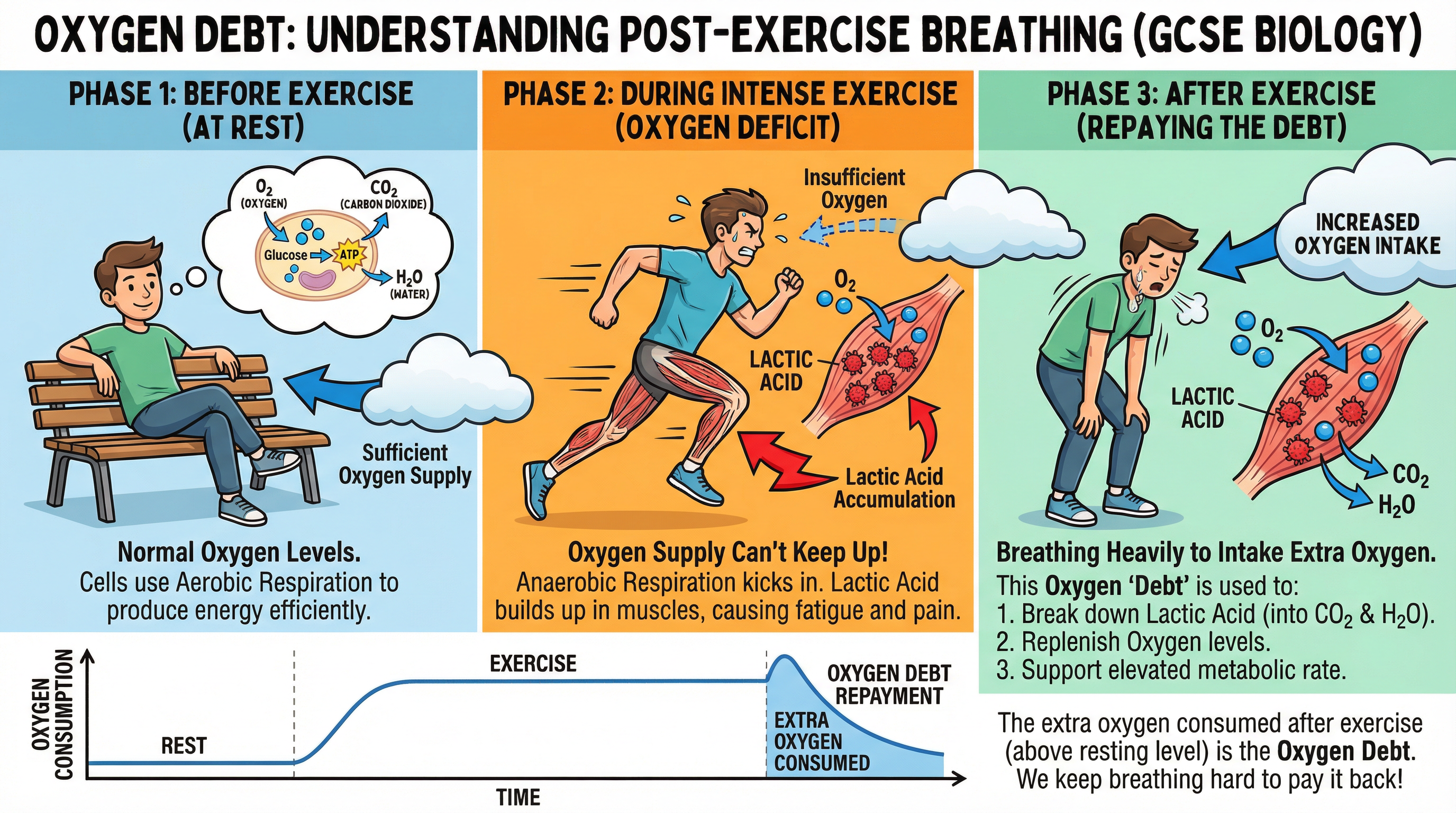
An examiner would expect you to define oxygen debt as: the amount of extra oxygen the body needs after exercise to react with the accumulated lactic acid and remove it from the cells.
Mathematical/Scientific Relationships
- Aerobic Respiration Equation (Higher Tier): C₆H₁₂O₆ + 6O₂ → 6CO₂ + 6H₂O (Must memorise)
- Anaerobic Respiration (Animals): Glucose → Lactic Acid (Must memorise)
- Anaerobic Respiration (Plants/Yeast): Glucose → Ethanol + Carbon Dioxide (Must memorise)
Practical Applications
Core Practical: Investigate the rate of respiration in living organisms
This practical often involves using a respirometer to measure the rate of oxygen consumption by small invertebrates (like woodlice or maggots) or germinating seeds. A typical setup involves two tubes: one containing the living organisms and a chemical that absorbs carbon dioxide (like soda lime), and a control tube with no organisms. As the organisms respire, they consume oxygen, causing a coloured fluid in a capillary tube to move. The distance the fluid moves over a set period of time can be used to calculate the rate of respiration.
Apparatus:
- Respirometer (boiling tubes, bungs with capillary tubes, syringe)
- Soda lime (to absorb CO₂)
- Gauze
- Water bath
- Stopwatch
- Small organisms (e.g., maggots, woodlice) or germinating seeds
Method:
- Place a known mass of organisms on gauze in a boiling tube.
- Place soda lime beneath the gauze to absorb the CO₂ produced.
- Assemble the respirometer and place it in a water bath to maintain a constant temperature.
- Allow the apparatus to equilibrate for 5 minutes.
- Introduce a drop of coloured liquid into the capillary tube using the syringe.
- Record the starting position of the liquid.
- Start the stopwatch and record the distance moved by the liquid in a set time (e.g., 10 minutes).
- Calculate the volume of oxygen consumed (using the formula for the volume of a cylinder, πr²l, where r is the radius of the capillary tube and l is the distance moved).
- Calculate the rate of respiration (volume of O₂ consumed / time / mass of organisms).
- Repeat the experiment to obtain a mean result.
Common Errors:
- Not allowing the apparatus to equilibrate.
- Leaks in the apparatus.
- Changes in temperature affecting the volume of gas.
Examiners test this practical by asking about the function of the soda lime, the purpose of the control tube, how to calculate the rate, and variables to control (temperature, mass of organisms).
{{asset:respiration_podcast.mp3