AQA · A-Level · Biology
Course version: 7402 · Version from Sept 2016
Alleles may be dominant, recessive or codominant.
Full specification wording
Inheritance (A-level only): Alleles may be dominant, recessive or codominant.
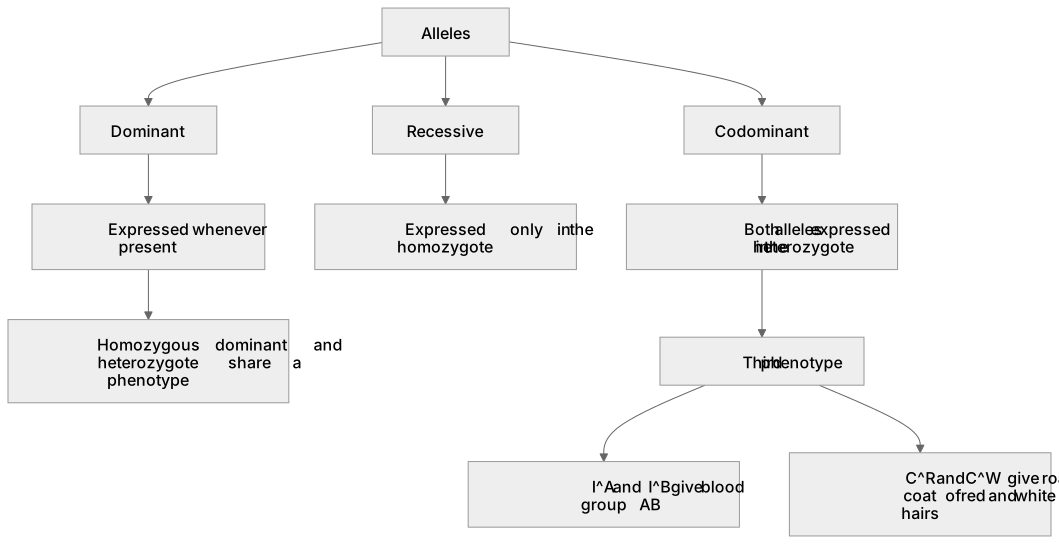
A dominant allele is expressed whenever it is present, so the homozygous dominant and the heterozygote share a phenotype.
Checked against the AQA 7402 specification (opens in a new tab) on .
- Point 4 of 7
- 4 key terms
Study notes
From the checked teaching notes for this specification point.
The idea
A dominant allele is expressed whenever it is present, so the homozygous dominant and the heterozygote share a phenotype. A recessive allele is expressed only in the homozygote, which is why a recessive characteristic can skip generations and reappear when two heterozygous carriers have children. Codominant alleles are both expressed in the heterozygote, producing a third phenotype: I^A and I^B together give blood group AB, and in cattle C^R and C^W together give a roan coat of red and white hairs. Codominance is not blending, because both proteins are made and both characteristics appear rather than an average. Dominance is a relationship between alleles, not a measure of how common an allele is, so a dominant allele can be rare and a recessive allele common.
What earns the marks
- Defining dominance as the allele expressed in the heterozygote, and recessiveness as the allele expressed only when homozygous, with the heterozygote showing the dominant phenotype.
- Explaining codominance as both alleles being expressed in the heterozygote, giving a third phenotype, illustrated by I^A I^B blood group AB or C^R C^W roan cattle.
- Using correct notation: a capital and lower-case letter for a dominant/recessive pair, and a shared capital with superscripts for codominant alleles, such as C^R and C^W.
- Distinguishing codominance from multiple alleles: ABO shows both, but codominance concerns expression in the heterozygote while multiple alleles means more than two alleles exist in the population.
- Explaining that dominance does not determine allele frequency, so a dominant allele may be rare and a recessive allele common in a population.
Common mistakes and how to put them right
Arguing from how common a characteristic is; a characteristic can be common because the allele is frequent, not because it is dominant. Correction: dominance describes expression in the heterozygote, not population frequency.
Describing codominance as blending, so predicting an intermediate colour instead of patches of both colours.
Put it right: Both alleles are expressed, so both characteristics appear, as in roan cattle with red and white hairs.
Writing codominant alleles as a capital and a lower-case letter, which implies one is recessive.
Put it right: Use a shared capital letter with superscripts, such as C^R and C^W.
Confusing codominance with multiple alleles.
Put it right: Codominance is about both alleles being expressed in the heterozygote; multiple alleles means more than two alleles exist for the gene in the population.
Claiming that two parents with the same phenotype producing a different offspring proves dominance.
Put it right: This pattern can also arise with codominance, for example two roan parents producing red and white offspring, so codominance must be excluded first.
Exam tips
- To infer dominance from a family tree, first check that codominance is excluded; then two parents with the same phenotype producing a different offspring indicates the parents are heterozygous and the offspring homozygous recessive.
- For codominant alleles use the board's notation, one common capital letter carrying superscripts, such as C^R and C^W, and write them clearly.
- Do not write anything you are unsure of next to your correct evidence, because a wrong statement can cancel the mark.
Try the lesson
The start of the Inheritance (A-level only): Alleles may be dominant, recessive or codominant. lesson, made from checked teaching notes for this specification point.
Have a go first
Which term describes an allele that is only expressed in the phenotype when two copies are present?
Listen
A dominant allele is expressed whenever it is present, so the homozygous dominant and the heterozygote share a phenotype. A recessive allele is expressed only in the homozygote, which is why a recessive characteristic can skip generations and reappear when two heterozygous carriers have children. Codominant alleles are both expressed in the heterozygote, producing a third phenotype: I^A and I^B together give blood group AB, and in cattle C^R and C^W together give a roan coat of red and white hairs. Codominance is not blending, because both proteins are made and both characteristics appear rather than an average. Dominance is a relationship between alleles, not a measure of how common an allele is, so a dominant allele can be rare and a recessive allele common. A strong answer earns marks for these points. Defining dominance as the allele expressed in the heterozygote, and recessiveness as the allele expressed only when homozygous, with the heterozygote showing the dominant phenotype. Explaining codominance as both alleles being expressed in the heterozygote, giving a third phenotype, illustrated by I^A I^B blood group AB or C^R C^W roan cattle. Using correct notation: a capital and lower-case letter for a dominant/recessive pair, and a shared capital with superscripts for codominant alleles, such as C^R and C^W. Distinguishing codominance from multiple alleles: ABO shows both, but codominance concerns expression in the heterozygote while multiple alleles means more than two alleles exist in the population. A common slip: Arguing from how common a characteristic is; a characteristic can be common because the allele is frequent, not because it is dominant. Instead, dominance describes expression in the heterozygote, not population frequency. Exam tip: To infer dominance from a family tree, first check that codominance is excluded; then two parents with the same phenotype producing a different offspring indicates the parents are heterozygous and the offspring homozygous recessive.
See it
Key words
Say what each word means before you turn the card.
dominant
Try answering aloud or in your head before turning the card.
recessive
Try answering aloud or in your head before turning the card.
codominance
Try answering aloud or in your head before turning the card.
heterozygous carrier
Try answering aloud or in your head before turning the card.
See every definition
- dominant
- An allele that is expressed whenever it is present, so the homozygous dominant and the heterozygote share a phenotype.
- recessive
- An allele expressed only in the homozygote, which is why a recessive characteristic can skip generations and reappear when two heterozygous carriers have children.
- codominance
- Both alleles are expressed in the heterozygote, producing a third phenotype, and both proteins are made so both characteristics appear rather than an average.
- heterozygous carrier
- A heterozygote for a recessive allele, so two of them having children allows a recessive characteristic to reappear.
Label the diagram
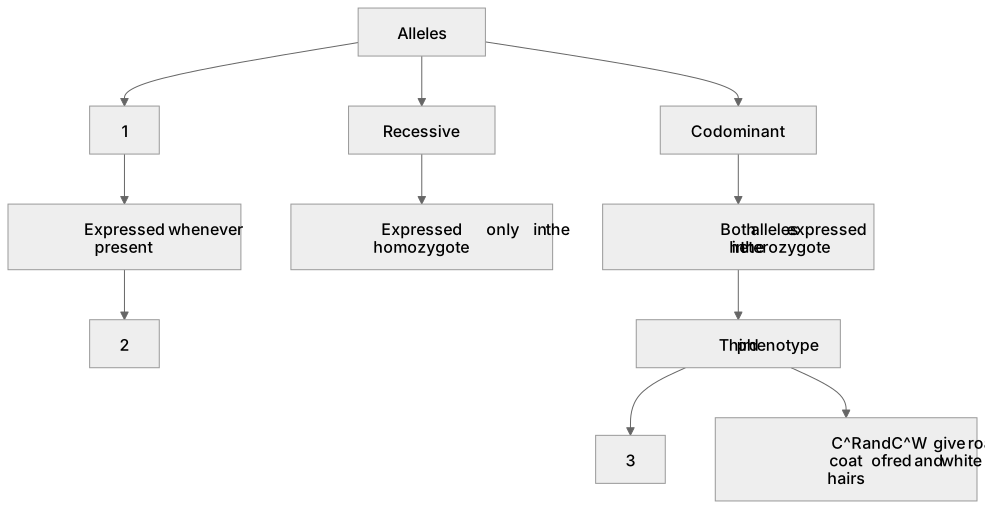
Some boxes have lost their names. Pick the right name for each number.
1Box 1
2Box 2
3Box 3
There is more to this lesson
The full lesson goes on to check your understanding and help you earn the marks. Create a free account to carry on, with your progress saved.
A week of Premium from your first lesson · Then the free plan continues · No card, no charge
Test your understanding of Inheritance (A-level only): Alleles may be dominant, recessive or codominant.
Active recall beats re-reading. Take an instant quiz now to test what you’ve learned and lock it into long-term memory.
A week of Premium from your first lesson · Then the free plan continues · No card, no charge