AQA · A-Level · Biology
Course version: 7402 · Version from Sept 2016
In a diploid organism, the alleles at a specific locus may be either…
Full specification wording
Inheritance (A-level only): In a diploid organism, the alleles at a specific locus may be either homozygous or heterozygous.
In a diploid organism, homologous chromosomes carry the same genes at the same loci.
Checked against the AQA 7402 specification (opens in a new tab) on .
- Point 5 of 7
- 4 key terms
Study notes
From the checked teaching notes for this specification point.
The idea
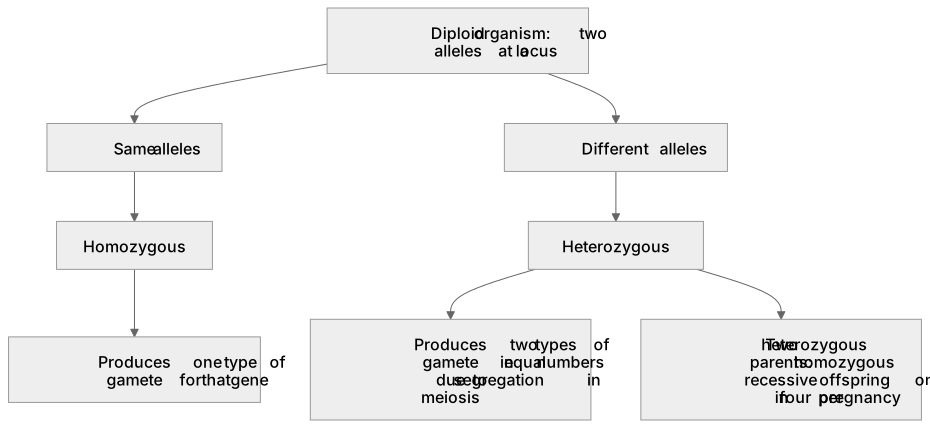
In a diploid organism, homologous chromosomes carry the same genes at the same loci. For autosomal genes, there are two alleles. If they are the same, the organism is homozygous at that locus; if different, it is heterozygous. A homozygous organism produces one type of gamete for that gene. A heterozygote produces two types of gamete in equal numbers due to segregation in meiosis. Two heterozygous parents produce homozygous recessive offspring a quarter of the time. This is a one in four risk per pregnancy for autosomal recessive conditions like cystic fibrosis. Note that males have only one allele for most X-linked genes, so they are not diploid for those loci and cannot be described as homozygous or heterozygous.
What earns the marks
- Defining homozygous as two identical alleles and heterozygous as two different alleles at the same locus on homologous chromosomes.
- Stating that a homozygous organism produces one type of gamete for that gene, while a heterozygote produces two types in equal proportions because of segregation in meiosis.
- Explaining that two heterozygous parents can produce a homozygous recessive offspring, with a one in four probability for each pregnancy.
- Applying the terms to a named gene rather than an organism as a whole, for example stating that a person is heterozygous for the CFTR gene, not that they are heterozygous.
- Recognising that the terms apply to autosomal loci in a diploid organism, and that males have only one allele for most X-linked genes.
Common mistakes and how to put them right
Describing an organism as homozygous or heterozygous overall, when the terms apply only to a named gene.
Put it right: State the gene or locus, for example homozygous for the CFTR allele.
Treating the one in four as a guarantee, so assuming that in a family of four children exactly one will be affected.
Put it right: Each pregnancy carries a one in four chance independently.
Using heterozygous to mean carrier in a condition caused by a dominant allele, where the heterozygote is affected.
Put it right: A carrier is heterozygous for a recessive allele and is unaffected.
Writing pure bred or hybrid instead of homozygous and heterozygous in an A-level answer.
Put it right: Use the correct genetic terminology.
Forgetting that a male has only one allele for most X-linked genes, so he cannot be described as homozygous or heterozygous for those loci.
Put it right: Refer to hemizygous or state that only one allele is present.
Exam tips
- When a question compares two families, check whether the pattern fits nuclear inheritance from heterozygous parents. Remember that terms like homozygous and heterozygous apply to diploid loci, not to most X-linked genes in males.
- Write homozygous recessive or homozygous dominant in full, because homozygous on its own rarely scores.
- Probability resets with every pregnancy, so write a one in four chance for each child.
Try the lesson
The start of the Inheritance (A-level only): In a diploid organism, the alleles at a specific locus may be either homozygous or heterozygous. lesson, made from checked teaching notes for this specification point.
Have a go first
In a diploid organism, what term describes the condition in which the two alleles present at a specific locus are different from each other?
Listen
In a diploid organism, homologous chromosomes carry the same genes at the same loci. For autosomal genes, there are two alleles. If they are the same, the organism is homozygous at that locus; if different, it is heterozygous. A homozygous organism produces one type of gamete for that gene. A heterozygote produces two types of gamete in equal numbers due to segregation in meiosis. Two heterozygous parents produce homozygous recessive offspring a quarter of the time. This is a one in four risk per pregnancy for autosomal recessive conditions like cystic fibrosis. Note that males have only one allele for most X-linked genes, so they are not diploid for those loci and cannot be described as homozygous or heterozygous. A strong answer earns marks for these points. Defining homozygous as two identical alleles and heterozygous as two different alleles at the same locus on homologous chromosomes. Stating that a homozygous organism produces one type of gamete for that gene, while a heterozygote produces two types in equal proportions because of segregation in meiosis. Explaining that two heterozygous parents can produce a homozygous recessive offspring, with a one in four probability for each pregnancy. Applying the terms to a named gene rather than an organism as a whole, for example stating that a person is heterozygous for the CFTR gene, not that they are heterozygous. A common slip: Describing an organism as homozygous or heterozygous overall, when the terms apply only to a named gene. Instead, state the gene or locus, for example homozygous for the CFTR allele. Exam tip: When a question compares two families, check whether the pattern fits nuclear inheritance from heterozygous parents. Remember that terms like homozygous and heterozygous apply to diploid loci, not to most X-linked genes in males.
See it
Key words
Say what each word means before you turn the card.
homozygous
Try answering aloud or in your head before turning the card.
heterozygous
Try answering aloud or in your head before turning the card.
locus
Try answering aloud or in your head before turning the card.
one in four risk
Try answering aloud or in your head before turning the card.
See every definition
- homozygous
- Describes an organism with two identical alleles at a specific locus on homologous chromosomes.
- heterozygous
- Describes an organism with two different alleles at the same locus on homologous chromosomes.
- locus
- The specific position on homologous chromosomes where the alleles of a gene are found.
- one in four risk
- The probability per pregnancy that two heterozygous parents produce a homozygous recessive offspring.
Label the diagram
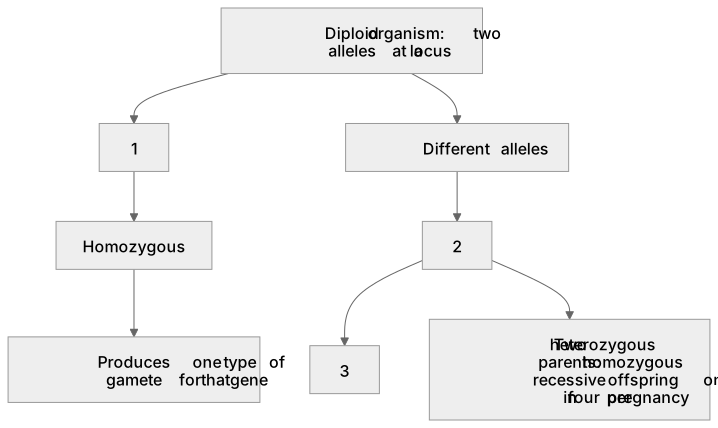
Some boxes have lost their names. Pick the right name for each number.
1Box 1
2Box 2
3Box 3
There is more to this lesson
The full lesson goes on to check your understanding and help you earn the marks. Create a free account to carry on, with your progress saved.
A week of Premium from your first lesson · Then the free plan continues · No card, no charge
Test your understanding of Inheritance (A-level only): In a diploid organism, the alleles at a specific locus may be either homozygous or heterozygous.
Active recall beats re-reading. Take an instant quiz now to test what you’ve learned and lock it into long-term memory.
A week of Premium from your first lesson · Then the free plan continues · No card, no charge