AQA · A-Level · Biology
Course version: 7402 · Version from Sept 2016
The use of fully labelled genetic diagrams to interpret, or predict, the…
Full specification wording
Inheritance (A-level only): The use of fully labelled genetic diagrams to interpret, or predict, the results of: monohybrid and dihybrid crosses involving dominant, recessive and codominant alleles crosses involving sex-linkage, autosomal linkage, multiple alleles and epistasis.
A fully labelled genetic diagram shows parental phenotypes and genotypes, gametes, offspring genotypes in a Punnett square, phenotypes and expected ratios.
Checked against the AQA 7402 specification (opens in a new tab) on .
- Point 6 of 7
- 2 key terms
Study notes
From the checked teaching notes for this specification point.
The idea
A fully labelled genetic diagram shows parental phenotypes and genotypes, gametes, offspring genotypes in a Punnett square, phenotypes and expected ratios. A monohybrid cross (Aa x Aa) gives a 3:1 ratio for complete dominance, but 1:2:1 for codominant alleles. A dihybrid cross (unlinked, complete dominance) gives 9:3:3:1. Multiple alleles (e.g. blood groups) involve more than two alleles at a locus. Epistasis occurs when one gene masks another, altering the 9:3:3:1 ratio (e.g. to 9:3:4). Sex-linked genes lie on sex chromosomes (usually X); males carry one X-linked allele. Autosomal linkage puts two genes on the same chromosome; only crossing over produces recombinants, yielding fewer than expected.
What earns the marks
- The correct gametes from each parent, including the Y-carrying gamete in a sex-linked cross.
- The offspring genotypes, which can still be earned by carrying forward incorrect parental gametes correctly.
- All the offspring phenotypes named in words together with the expected ratio.
- Using the allele symbols given in the question and writing sex-linked alleles on the X chromosome.
Common mistakes and how to put them right
Leaving the gametes out and jumping straight to the offspring genotypes, which throws away an easy mark.
Writing sex-linked genotypes as GB or Gg with no X and Y, so the linkage cannot be seen.
Giving male offspring two alleles of an X-linked gene.
Quoting the ratio actually counted in a small sample instead of the expected ratio.
Assuming a 9:3:3:1 ratio when the two genes are linked on the same chromosome or interact via epistasis.
Exam tips
- Set the diagram out in the same order every time: parental phenotypes, parental genotypes, gametes, Punnett square, offspring genotypes, offspring phenotypes, ratio.
- If you get the gametes wrong, keep going, because the offspring genotype mark can still be awarded from your own gametes.
Try the lesson
The start of the Inheritance (A-level only): The use of fully labelled genetic diagrams to interpret, or predict, the results of: monohybrid and dihybrid crosses involving dominant, recessive and codominant alleles crosses involving sex-linkage, autosomal linkage, multiple alleles and epistasis. lesson, made from checked teaching notes for this specification point.
Have a go first
In a monohybrid cross between two heterozygous parents with genotype Gg, what proportion of the offspring is expected to show the recessive phenotype?
Listen
A fully labelled genetic diagram shows parental phenotypes and genotypes, gametes, offspring genotypes in a Punnett square, phenotypes and expected ratios. A monohybrid cross (Aa x Aa) gives a 3:1 ratio for complete dominance, but 1:2:1 for codominant alleles. A dihybrid cross (unlinked, complete dominance) gives 9:3:3:1. Multiple alleles (e.g. blood groups) involve more than two alleles at a locus. Epistasis occurs when one gene masks another, altering the 9:3:3:1 ratio (e.g. to 9:3:4). Sex-linked genes lie on sex chromosomes (usually X); males carry one X-linked allele. Autosomal linkage puts two genes on the same chromosome; only crossing over produces recombinants, yielding fewer than expected. A strong answer earns marks for these points. the correct gametes from each parent, including the Y-carrying gamete in a sex-linked cross. the offspring genotypes, which can still be earned by carrying forward incorrect parental gametes correctly. all the offspring phenotypes named in words together with the expected ratio. using the allele symbols given in the question and writing sex-linked alleles on the X chromosome. Exam tip: Set the diagram out in the same order every time: parental phenotypes, parental genotypes, gametes, Punnett square, offspring genotypes, offspring phenotypes, ratio.
See it
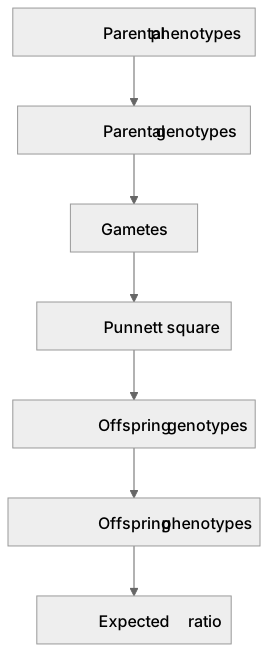
Put it in order
Put these steps in the order they happen.
- 1. Expected ratio
- 2. Offspring phenotypes
- 3. Gametes
- 4. Offspring genotypes
- 5. Parental phenotypes
- 6. Parental genotypes
- 7. Punnett square
Key words
Say what each word means before you turn the card.
sex linkage
Try answering aloud or in your head before turning the card.
epistasis
Try answering aloud or in your head before turning the card.
See every definition
- sex linkage
- Genes lying on sex chromosomes, usually X, where males carry one X-linked allele.
- epistasis
- When one gene masks another, altering the 9:3:3:1 ratio, for example to 9:3:4.
Label the diagram
Some boxes have lost their names. Pick the right name for each number.
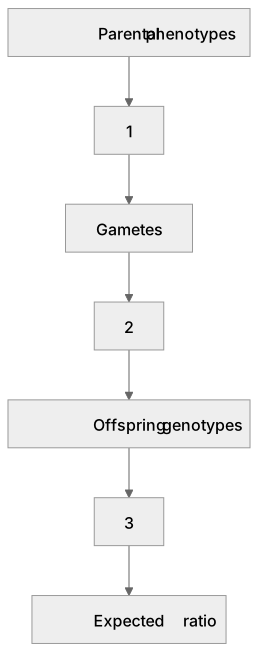
1Box 1
2Box 2
3Box 3
There is more to this lesson
The full lesson goes on to check your understanding and help you earn the marks. Create a free account to carry on, with your progress saved.
A week of Premium from your first lesson · Then the free plan continues · No card, no charge
Test your understanding of Inheritance (A-level only): The use of fully labelled genetic diagrams to interpret, or predict, the results of: monohybrid and dihybrid crosses involving dominant, recessive and codominant alleles crosses involving sex-linkage, autosomal linkage, multiple alleles and epistasis.
Active recall beats re-reading. Take an instant quiz now to test what you’ve learned and lock it into long-term memory.
A week of Premium from your first lesson · Then the free plan continues · No card, no charge