AQA · A-Level · Biology
Course version: 7402 · Version from Sept 2016
A condensation reaction between glycerol and a fatty acid (RCOOH) forms an…
Full specification wording
Lipids: A condensation reaction between glycerol and a fatty acid (RCOOH) forms an ester bond.
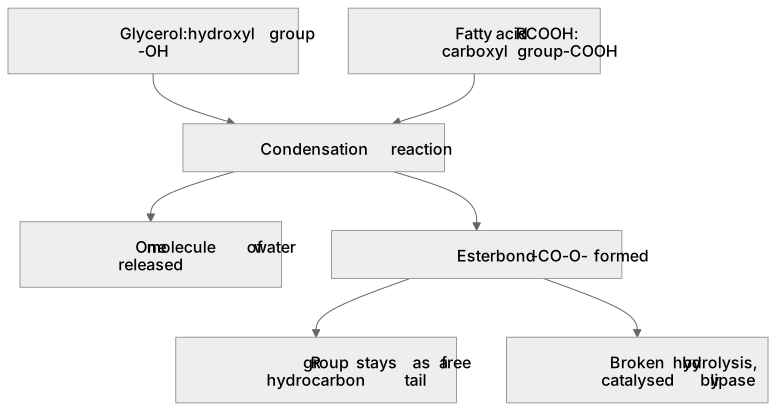
An ester bond forms between the carboxyl group of a fatty acid, written -COOH, and one hydroxyl group of glycerol.
Checked against the AQA 7402 specification (opens in a new tab) on .
- Point 3 of 8
Study notes
From the checked teaching notes for this specification point.
The idea
An ester bond forms between the carboxyl group of a fatty acid, written -COOH, and one hydroxyl group of glycerol. The -OH from the carboxyl group and the -H from the hydroxyl group leave together as a molecule of water, and the remaining oxygen bridges the two molecules, giving the -CO-O- linkage. It is a condensation reaction, so exactly one water molecule leaves for each ester bond formed, and a triglyceride with three of them releases three. Naming matters here: a glycosidic bond joins sugars, a peptide bond joins amino acids, and an ester bond joins glycerol to a fatty acid, so the wrong name loses the mark even when the rest of the description is right. The R group of the fatty acid takes no part in the bond at all; it stays as a free hydrocarbon tail, which is why it is the R group and not the ester bond that decides whether a lipid behaves as a fat or an oil.
What earns the marks
- Identifying the reaction between glycerol and a fatty acid as a condensation reaction.
- Naming the bond formed as an ester bond.
- Stating that one molecule of water is released per ester bond formed.
- Identifying the groups involved as the carboxyl group of the fatty acid and a hydroxyl group of glycerol.
- Stating that the ester bond is broken by hydrolysis, catalysed by lipase.
Common mistakes and how to put them right
Calling the bond a glycosidic or peptide bond in a lipid question.
Saying the ester bond forms between two fatty acids rather than between glycerol and a fatty acid.
Stating that the R group of the fatty acid forms the bond with glycerol.
Writing that water is added when the ester bond forms.
Spelling or describing the carboxyl group as a carbonyl group.
Exam tips
- Name the two functional groups involved, carboxyl and hydroxyl, rather than describing them as 'the ends' of the molecules.
- Set out condensation and hydrolysis as a pair in your revision notes so you can answer either direction with the same three facts.
- If the question supplies RCOOH, use that notation in your answer to show which part of the fatty acid reacts.
Try the lesson
The start of the Lipids: A condensation reaction between glycerol and a fatty acid (RCOOH) forms an ester bond. lesson, made from checked teaching notes for this specification point.
Have a go first
Which type of bond is formed when glycerol reacts with a fatty acid in a condensation reaction?
Listen
An ester bond forms between the carboxyl group of a fatty acid, written -COOH, and one hydroxyl group of glycerol. The -OH from the carboxyl group and the -H from the hydroxyl group leave together as a molecule of water, and the remaining oxygen bridges the two molecules, giving the -CO-O- linkage. It is a condensation reaction, so exactly one water molecule leaves for each ester bond formed, and a triglyceride with three of them releases three. Naming matters here: a glycosidic bond joins sugars, a peptide bond joins amino acids, and an ester bond joins glycerol to a fatty acid, so the wrong name loses the mark even when the rest of the description is right. The R group of the fatty acid takes no part in the bond at all; it stays as a free hydrocarbon tail, which is why it is the R group and not the ester bond that decides whether a lipid behaves as a fat or an oil. A strong answer earns marks for these points. identifying the reaction between glycerol and a fatty acid as a condensation reaction. naming the bond formed as an ester bond. stating that one molecule of water is released per ester bond formed. identifying the groups involved as the carboxyl group of the fatty acid and a hydroxyl group of glycerol. Exam tip: Name the two functional groups involved, carboxyl and hydroxyl, rather than describing them as 'the ends' of the molecules.
See it
Label the diagram
Some boxes have lost their names. Pick the right name for each number.
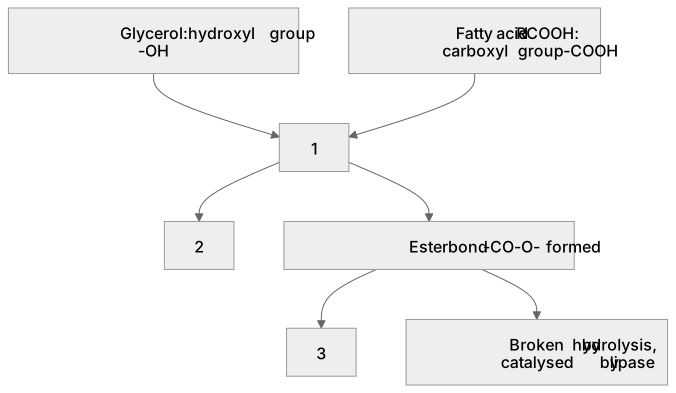
1Box 1
2Box 2
3Box 3
There is more to this lesson
The full lesson goes on to check your understanding and help you earn the marks. Create a free account to carry on, with your progress saved.
A week of Premium from your first lesson · Then the free plan continues · No card, no charge
Test your understanding of Lipids: A condensation reaction between glycerol and a fatty acid (RCOOH) forms an ester bond.
Active recall beats re-reading. Take an instant quiz now to test what you’ve learned and lock it into long-term memory.
A week of Premium from your first lesson · Then the free plan continues · No card, no charge