AQA · A-Level · Biology
Course version: 7402 · Version from Sept 2016
Lipids: The R-group of a fatty acid may be saturated or unsaturated.
The R group of a fatty acid is a hydrocarbon chain, and the question is always whether it contains any carbon-carbon double bonds.
Checked against the AQA 7402 specification (opens in a new tab) on .
- Point 4 of 8
- 3 key terms
Study notes
From the checked teaching notes for this specification point.
The idea
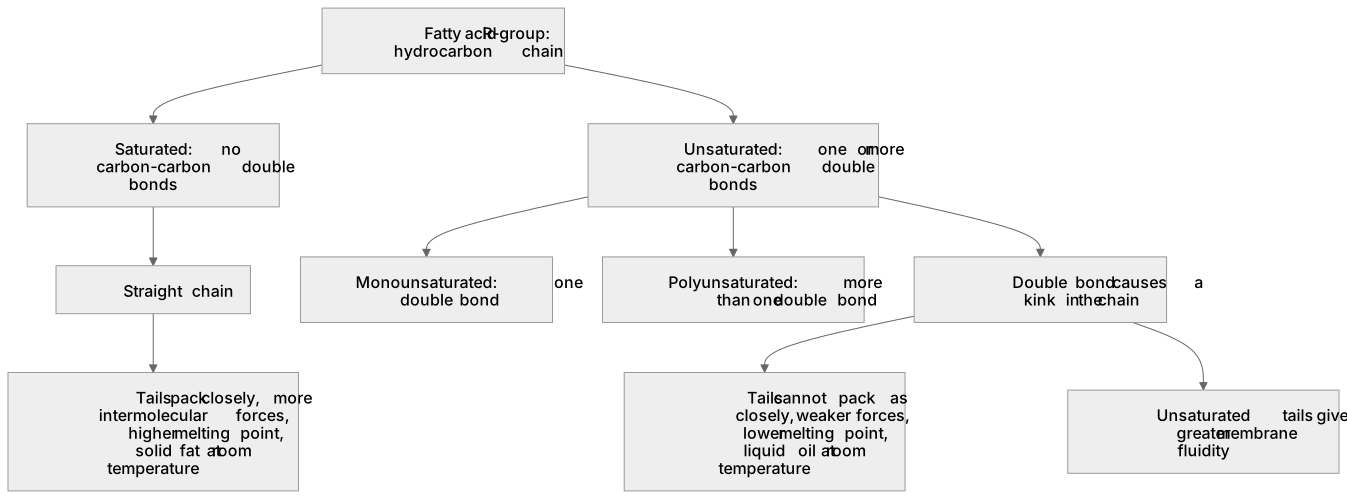
The R group of a fatty acid is a hydrocarbon chain, and the question is always whether it contains any carbon-carbon double bonds. A saturated fatty acid has none: every carbon carries the maximum possible number of hydrogen atoms, so the chain is straight. An unsaturated fatty acid has one or more C=C double bonds - monounsaturated with one, polyunsaturated with more than one - and each double bond puts a kink in the chain. That geometry is what matters. Straight saturated tails pack closely together, so more intermolecular forces form between neighbouring molecules and more energy is needed to separate them: the melting point is higher and the lipid is a solid fat at room temperature, typical of animals. Kinked unsaturated tails cannot pack as closely, the forces between molecules are weaker, the melting point is lower and the lipid is a liquid oil, typical of plants and fish.
What earns the marks
- Saturated meaning no carbon-carbon double bonds and the maximum number of hydrogen atoms.
- Unsaturated meaning one or more carbon-carbon double bonds present.
- The double bond causing a kink or bend in the hydrocarbon chain.
- Kinked chains packing less closely, so the melting point is lower and the lipid is liquid at room temperature.
- Linking unsaturated fatty acid tails to greater membrane fluidity.
Common mistakes and how to put them right
Defining unsaturated as having fewer carbon atoms rather than fewer hydrogen atoms.
Saying that double bonds break the fatty acid chain rather than bending it.
Confusing saturation of a fatty acid with a saturated solution.
Stating that saturated fats melt at lower temperatures than unsaturated oils.
Answering about health effects of saturated fat when the question asks about structure and properties.
Exam tips
- Look only for C=C double bonds when identifying saturation from a diagram; ignore the C=O in the carboxyl group.
- Always convert the structural point into a consequence - kink, less close packing, lower melting point, liquid at room temperature.
- Carry this idea forward to membranes, where unsaturated tails are the standard answer for maintaining fluidity in the cold.
Try the lesson
The start of the Lipids: The R-group of a fatty acid may be saturated or unsaturated. lesson, made from checked teaching notes for this specification point.
Have a go first
What is meant by an unsaturated fatty acid?
Listen
The R group of a fatty acid is a hydrocarbon chain, and the question is always whether it contains any carbon-carbon double bonds. A saturated fatty acid has none: every carbon carries the maximum possible number of hydrogen atoms, so the chain is straight. An unsaturated fatty acid has one or more C=C double bonds - monounsaturated with one, polyunsaturated with more than one - and each double bond puts a kink in the chain. That geometry is what matters. Straight saturated tails pack closely together, so more intermolecular forces form between neighbouring molecules and more energy is needed to separate them: the melting point is higher and the lipid is a solid fat at room temperature, typical of animals. Kinked unsaturated tails cannot pack as closely, the forces between molecules are weaker, the melting point is lower and the lipid is a liquid oil, typical of plants and fish. A strong answer earns marks for these points. saturated meaning no carbon-carbon double bonds and the maximum number of hydrogen atoms. unsaturated meaning one or more carbon-carbon double bonds present. the double bond causing a kink or bend in the hydrocarbon chain. kinked chains packing less closely, so the melting point is lower and the lipid is liquid at room temperature. Exam tip: Look only for C=C double bonds when identifying saturation from a diagram; ignore the C=O in the carboxyl group.
See it
Key words
Say what each word means before you turn the card.
saturated fatty acids
Try answering aloud or in your head before turning the card.
unsaturated fatty acids
Try answering aloud or in your head before turning the card.
kinks and packing
Try answering aloud or in your head before turning the card.
See every definition
- saturated fatty acids
- Fatty acids with no carbon-carbon double bonds, so every carbon carries the maximum possible number of hydrogen atoms and the chain is straight.
- unsaturated fatty acids
- Fatty acids with one or more carbon-carbon double bonds, each of which puts a kink in the chain.
- kinks and packing
- Each double bond puts a kink in the chain, so kinked unsaturated tails cannot pack as closely as straight saturated tails.
Label the diagram
Some boxes have lost their names. Pick the right name for each number.
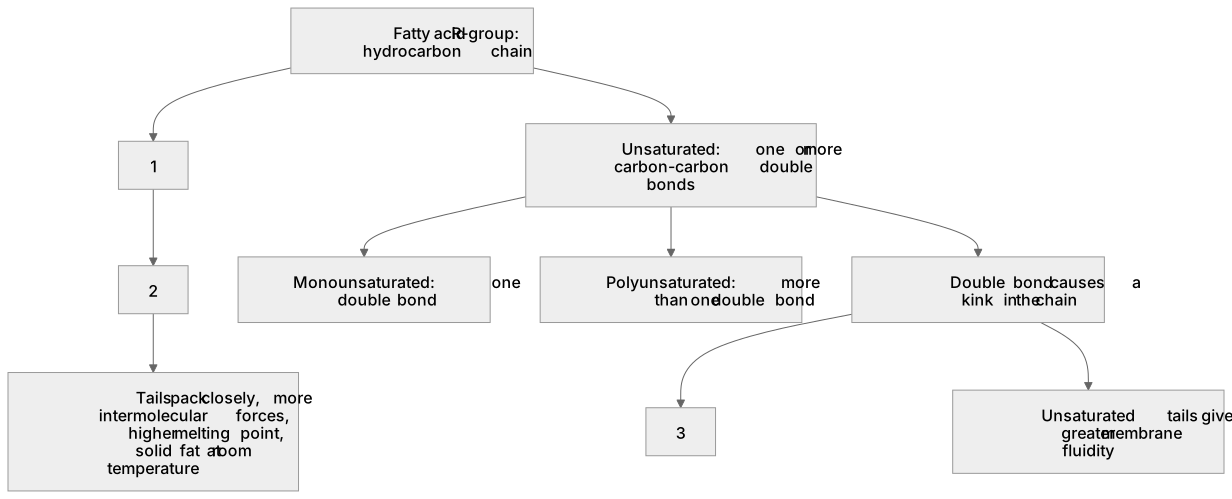
1Box 1
2Box 2
3Box 3
There is more to this lesson
The full lesson goes on to check your understanding and help you earn the marks. Create a free account to carry on, with your progress saved.
A week of Premium from your first lesson · Then the free plan continues · No card, no charge
Test your understanding of Lipids: The R-group of a fatty acid may be saturated or unsaturated.
Active recall beats re-reading. Take an instant quiz now to test what you’ve learned and lock it into long-term memory.
A week of Premium from your first lesson · Then the free plan continues · No card, no charge