AQA · A-Level · Biology
Course version: 7402 · Version from Sept 2016
In phospholipids, one of the fatty acids of a triglyceride is substituted…
Full specification wording
Lipids: In phospholipids, one of the fatty acids of a triglyceride is substituted by a phosphate-containing group.
A phospholipid is a triglyceride in which one of the three fatty acids has been replaced by a phosphate-containing group.
Checked against the AQA 7402 specification (opens in a new tab) on .
- Point 5 of 8
- 4 key terms
Study notes
From the checked teaching notes for this specification point.
The idea
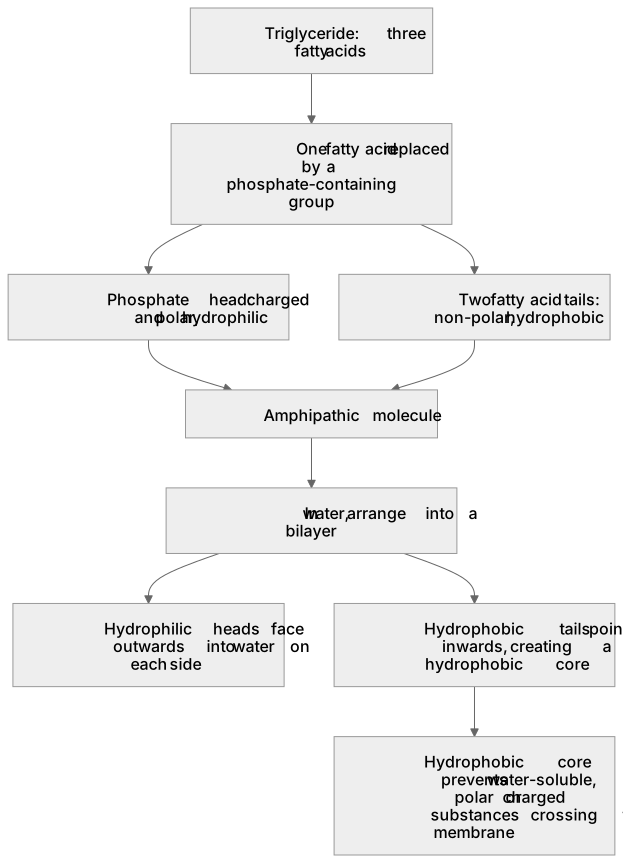
A phospholipid is a triglyceride in which one of the three fatty acids has been replaced by a phosphate-containing group. That single substitution splits the molecule into two halves that behave in opposite ways. The phosphate head is charged and polar, so it is hydrophilic and interacts with water; the two remaining fatty acid tails are non-polar, so they are hydrophobic and are repelled by water. A molecule with both properties is described as amphipathic. In water, phospholipids therefore arrange themselves automatically into a bilayer, with the hydrophilic heads facing outwards into the aqueous cytoplasm and tissue fluid on each side and the hydrophobic tails pointing inwards, away from the water, creating a hydrophobic core.
What earns the marks
- One fatty acid of the triglyceride being replaced by a phosphate-containing group.
- The phosphate head being polar or charged, and therefore hydrophilic.
- The two fatty acid tails being non-polar and therefore hydrophobic.
- The molecules forming a bilayer with hydrophilic heads facing the water and hydrophobic tails facing inwards.
- The hydrophobic core preventing water-soluble, polar or charged substances from crossing the membrane.
Common mistakes and how to put them right
Saying the phosphate group replaces the glycerol rather than one fatty acid.
Describing the fatty acid tails as hydrophilic and the phosphate head as hydrophobic.
Stating that phospholipids form a single layer in a cell-surface membrane.
Explaining hydrophobic as 'hates water' without linking it to being non-polar or repelled by water.
Forgetting that the heads face the watery cytoplasm on the inside as well as the tissue fluid on the outside.
Exam tips
- Use the terms hydrophilic and hydrophobic explicitly, then say why - polar or charged versus non-polar.
- When explaining how a protein sits in a membrane, mirror the phospholipid logic: hydrophobic R groups face the tails, hydrophilic R groups face the water or line a channel.
- Say 'phosphate-containing group' rather than just 'phosphate' when describing the structure, matching the specification wording.
Try the lesson
The start of the Lipids: In phospholipids, one of the fatty acids of a triglyceride is substituted by a phosphate-containing group. lesson, made from checked teaching notes for this specification point.
Have a go first
In a phospholipid, how many of the fatty acids of a triglyceride are substituted by a phosphate-containing group?
Listen
A phospholipid is a triglyceride in which one of the three fatty acids has been replaced by a phosphate-containing group. That single substitution splits the molecule into two halves that behave in opposite ways. The phosphate head is charged and polar, so it is hydrophilic and interacts with water; the two remaining fatty acid tails are non-polar, so they are hydrophobic and are repelled by water. A molecule with both properties is described as amphipathic. In water, phospholipids therefore arrange themselves automatically into a bilayer, with the hydrophilic heads facing outwards into the aqueous cytoplasm and tissue fluid on each side and the hydrophobic tails pointing inwards, away from the water, creating a hydrophobic core. A strong answer earns marks for these points. one fatty acid of the triglyceride being replaced by a phosphate-containing group. the phosphate head being polar or charged, and therefore hydrophilic. the two fatty acid tails being non-polar and therefore hydrophobic. the molecules forming a bilayer with hydrophilic heads facing the water and hydrophobic tails facing inwards. Exam tip: Use the terms hydrophilic and hydrophobic explicitly, then say why - polar or charged versus non-polar.
See it
Key words
Say what each word means before you turn the card.
hydrophilic head
Try answering aloud or in your head before turning the card.
hydrophobic tails
Try answering aloud or in your head before turning the card.
amphipathic and bilayer formation
Try answering aloud or in your head before turning the card.
hydrophobic core as a barrier
Try answering aloud or in your head before turning the card.
See every definition
- hydrophilic head
- The phosphate head is charged and polar, so it interacts with water.
- hydrophobic tails
- The two remaining fatty acid tails are non-polar, so they are repelled by water.
- amphipathic and bilayer formation
- A molecule with both hydrophilic and hydrophobic properties is amphipathic, so in water phospholipids arrange themselves automatically into a bilayer.
- hydrophobic core as a barrier
- The tails point inwards away from the water, creating a hydrophobic core that prevents water-soluble, polar or charged substances from crossing the membrane.
Label the diagram
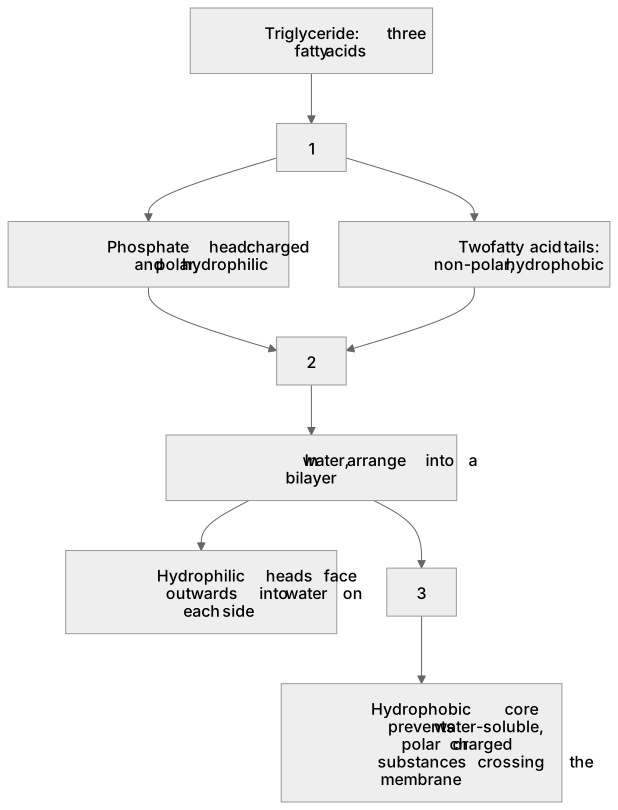
Some boxes have lost their names. Pick the right name for each number.
1Box 1
2Box 2
3Box 3
There is more to this lesson
The full lesson goes on to check your understanding and help you earn the marks. Create a free account to carry on, with your progress saved.
A week of Premium from your first lesson · Then the free plan continues · No card, no charge
Test your understanding of Lipids: In phospholipids, one of the fatty acids of a triglyceride is substituted by a phosphate-containing group.
Active recall beats re-reading. Take an instant quiz now to test what you’ve learned and lock it into long-term memory.
A week of Premium from your first lesson · Then the free plan continues · No card, no charge