AQA · A-Level · Biology
Course version: 7402 · Version from Sept 2016
Each enzyme lowers the activation energy of the reaction it catalyses.
Full specification wording
Many proteins are enzymes: Each enzyme lowers the activation energy of the reaction it catalyses.
Reactions require an initial energy input, the activation energy, to break bonds and reach the transition state.
Checked against the AQA 7402 specification (opens in a new tab) on .
- Point 1 of 6
- 2 key terms
Study notes
From the checked teaching notes for this specification point.
The idea
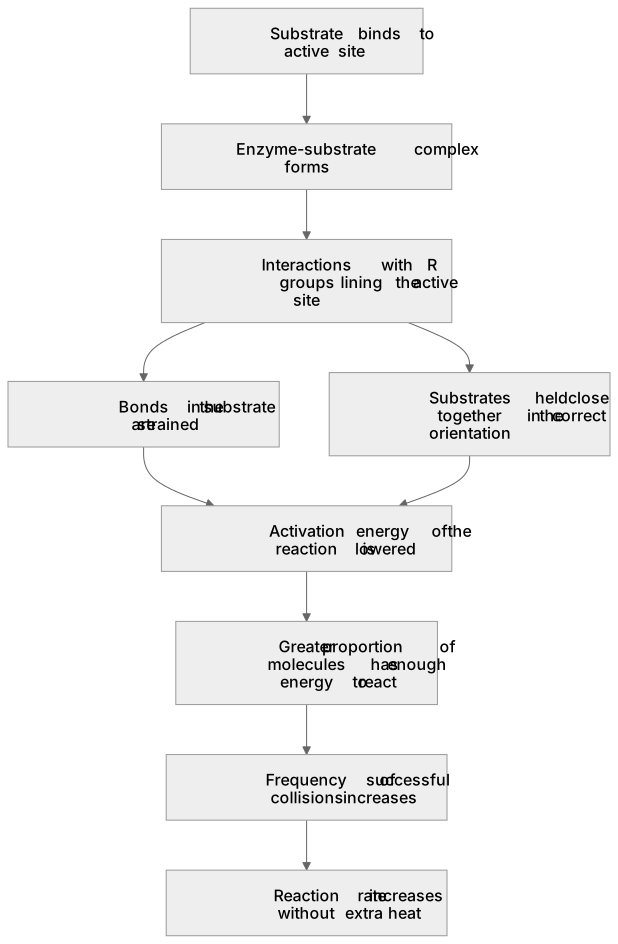
Reactions require an initial energy input, the activation energy, to break bonds and reach the transition state. Enzymes provide an alternative pathway with a lower activation energy. When a substrate binds to the active site, an enzyme-substrate complex forms. Interactions with specific R groups (charged, polar, or hydrophobic) lining the active site can strain bonds in the substrate. Alternatively, the active site holds multiple substrates close together in the correct orientation. Consequently, less energy is needed. At a given temperature, a greater proportion of molecules possesses kinetic energy greater than or equal to this lowered activation energy, increasing the frequency of successful collisions and raising the reaction rate without needing extra heat.
What earns the marks
- State that the enzyme lowers the activation energy of the reaction.
- Describe the substrate binding to the active site to form an enzyme-substrate complex.
- Explain that bonds in the substrate are strained or distorted, or substrates are held in the correct orientation, so bonds break or form more readily.
- Note the consequence that a greater proportion of molecules now has enough energy to react, so the rate increases at a lower temperature.
- Note that the enzyme is unchanged and reused, and that the energy difference between substrate and product is unaltered.
Common mistakes and how to put them right
Writing that the enzyme gives energy to the reaction or supplies the activation energy, instead of lowering it.
Saying the enzyme lowers 'its own' activation energy rather than that of the reaction it catalyses.
Claiming the enzyme produces more product, when it only changes how quickly the same amount of product forms.
Labelling the active site on the substrate rather than on the enzyme.
Stating that the enzyme is used up, so more must be added as the reaction proceeds.
Exam tips
- On an energy level diagram, draw a lower peak for the catalysed route but keep the substrate and product levels exactly where they were.
- For 'explain', write the chain in order: substrate binds to active site, enzyme-substrate complex forms, bonds strained, activation energy lowered, rate increases.
- Never use the word 'energy' on its own in an enzyme answer; say activation energy, and say whether it goes up or down.
Try the lesson
The start of the Many proteins are enzymes: Each enzyme lowers the activation energy of the reaction it catalyses. lesson, made from checked teaching notes for this specification point.
Have a go first
What is meant by the activation energy of a reaction?
Listen
Reactions require an initial energy input, the activation energy, to break bonds and reach the transition state. Enzymes provide an alternative pathway with a lower activation energy. When a substrate binds to the active site, an enzyme-substrate complex forms. Interactions with specific R groups (charged, polar, or hydrophobic) lining the active site can strain bonds in the substrate. Alternatively, the active site holds multiple substrates close together in the correct orientation. Consequently, less energy is needed. At a given temperature, a greater proportion of molecules possesses kinetic energy greater than or equal to this lowered activation energy, increasing the frequency of successful collisions and raising the reaction rate without needing extra heat. A strong answer earns marks for these points. State that the enzyme lowers the activation energy of the reaction. Describe the substrate binding to the active site to form an enzyme-substrate complex. Explain that bonds in the substrate are strained or distorted, or substrates are held in the correct orientation, so bonds break or form more readily. Note the consequence that a greater proportion of molecules now has enough energy to react, so the rate increases at a lower temperature. Exam tip: On an energy level diagram, draw a lower peak for the catalysed route but keep the substrate and product levels exactly where they were.
See it
Key words
Say what each word means before you turn the card.
activation energy
Try answering aloud or in your head before turning the card.
enzyme-substrate complex
Try answering aloud or in your head before turning the card.
See every definition
- activation energy
- The initial energy input needed to break bonds and reach the transition state, which each enzyme lowers for the reaction it catalyses.
- enzyme-substrate complex
- The complex formed when a substrate binds to the active site of an enzyme.
Label the diagram
Some boxes have lost their names. Pick the right name for each number.
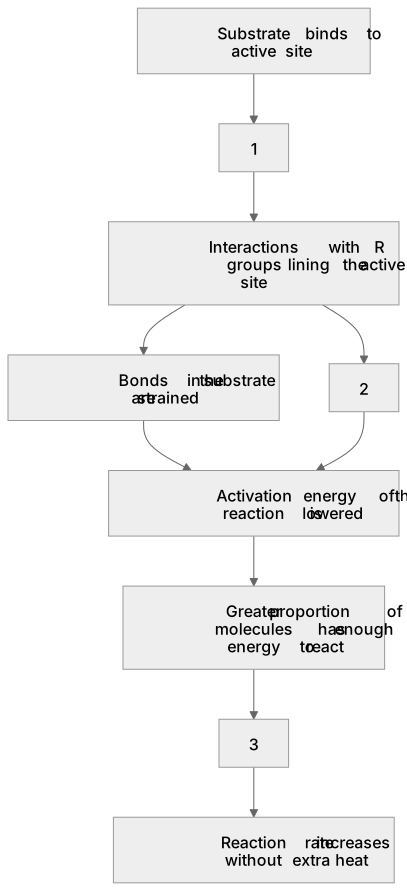
1Box 1
2Box 2
3Box 3
There is more to this lesson
The full lesson goes on to check your understanding and help you earn the marks. Create a free account to carry on, with your progress saved.
A week of Premium from your first lesson · Then the free plan continues · No card, no charge
Test your understanding of Many proteins are enzymes: Each enzyme lowers the activation energy of the reaction it catalyses.
Active recall beats re-reading. Take an instant quiz now to test what you’ve learned and lock it into long-term memory.
A week of Premium from your first lesson · Then the free plan continues · No card, no charge