AQA · A-Level · Biology
Course version: 7402 · Version from Sept 2016
Many proteins are enzymes: The induced-fit model of enzyme action.
In the older lock-and-key model the active site is a rigid shape that exactly matches the substrate.
Checked against the AQA 7402 specification (opens in a new tab) on .
- Point 2 of 6
- 3 key terms
Study notes
From the checked teaching notes for this specification point.
The idea
In the older lock-and-key model the active site is a rigid shape that exactly matches the substrate. The induced-fit model replaces that rigidity with flexibility: before binding, the substrate is only approximately complementary to the active site. As it enters, the tertiary structure of the enzyme changes so the active site moulds itself around the substrate, becoming fully complementary. This conformational change puts strain on bonds in the substrate, which lowers the activation energy. It also explains observations a rigid model cannot: why some enzymes accept a small range of similar substrates, and why a non-competitive inhibitor binding away from the active site can still alter the active site's shape.
What earns the marks
- Stating that the active site, not the substrate, changes shape as the substrate binds.
- Explaining that the substrate is only partly complementary at first and becomes fully complementary as the enzyme moulds around it.
- Describing this process as a change in the tertiary structure of the enzyme or active site.
- Linking the shape change to strain on bonds in the substrate and the subsequent lowering of activation energy.
- Noting that the active site returns to its original shape after the products leave.
Common mistakes and how to put them right
Describing the substrate as changing shape to fit the active site, when it is the enzyme that changes.
Writing that the substrate has an active site, which is a fundamental misunderstanding of enzyme action.
Using lock-and-key wording such as 'exact fit' or 'rigid' while claiming to describe induced fit.
Saying the enzyme changes shape and is therefore denatured, confusing a reversible conformational change with denaturation.
Exam tips
- When describing the induced-fit model, use terms like 'moulds' or 'changes shape as the substrate binds' to clearly distinguish it from the lock-and-key model.
- Say 'complementary to', never 'the same shape as', when describing substrate and active site.
- When comparing the two models, write both halves of each comparison in the same sentence to make the contrast explicit.
Try the lesson
The start of the Many proteins are enzymes: The induced-fit model of enzyme action. lesson, made from checked teaching notes for this specification point.
Have a go first
According to the induced-fit model, what happens to the active site when a substrate binds to an enzyme?
Listen
In the older lock-and-key model the active site is a rigid shape that exactly matches the substrate. The induced-fit model replaces that rigidity with flexibility: before binding, the substrate is only approximately complementary to the active site. As it enters, the tertiary structure of the enzyme changes so the active site moulds itself around the substrate, becoming fully complementary. This conformational change puts strain on bonds in the substrate, which lowers the activation energy. It also explains observations a rigid model cannot: why some enzymes accept a small range of similar substrates, and why a non-competitive inhibitor binding away from the active site can still alter the active site's shape. A strong answer earns marks for these points. stating that the active site, not the substrate, changes shape as the substrate binds. explaining that the substrate is only partly complementary at first and becomes fully complementary as the enzyme moulds around it. describing this process as a change in the tertiary structure of the enzyme or active site. linking the shape change to strain on bonds in the substrate and the subsequent lowering of activation energy. Exam tip: When describing the induced-fit model, use terms like 'moulds' or 'changes shape as the substrate binds' to clearly distinguish it from the lock-and-key model.
See it
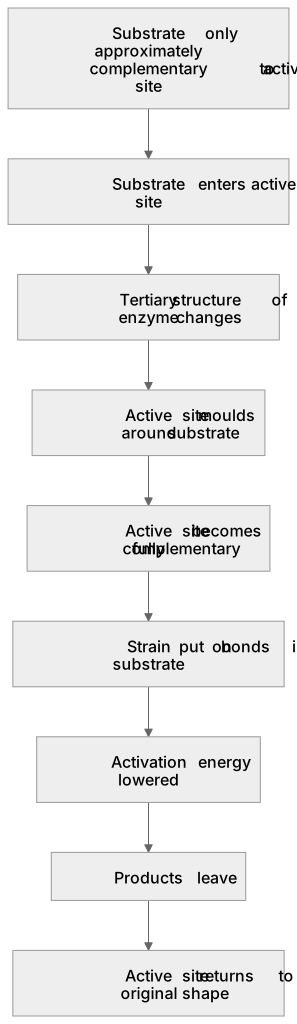
Key words
Say what each word means before you turn the card.
induced fit
Try answering aloud or in your head before turning the card.
lock and key
Try answering aloud or in your head before turning the card.
conformational change
Try answering aloud or in your head before turning the card.
See every definition
- induced fit
- A model in which the active site moulds itself around the substrate as it enters, becoming fully complementary.
- lock and key
- An older model in which the active site is a rigid shape that exactly matches the substrate.
- conformational change
- A change in the tertiary structure of the enzyme that puts strain on bonds in the substrate and lowers the activation energy.
Label the diagram
Some boxes have lost their names. Pick the right name for each number.
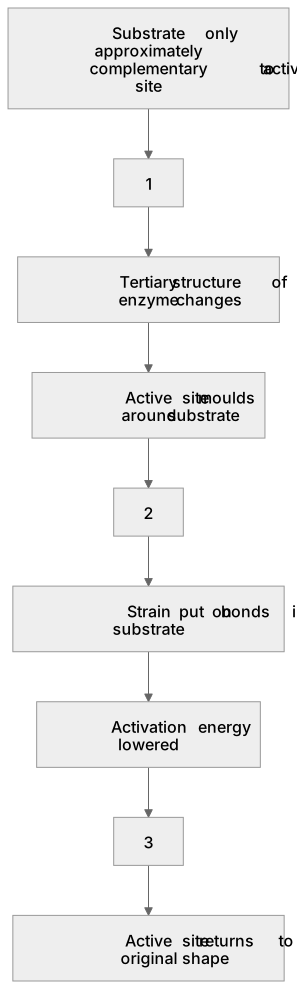
1Box 1
2Box 2
3Box 3
There is more to this lesson
The full lesson goes on to check your understanding and help you earn the marks. Create a free account to carry on, with your progress saved.
A week of Premium from your first lesson · Then the free plan continues · No card, no charge
Test your understanding of Many proteins are enzymes: The induced-fit model of enzyme action.
Active recall beats re-reading. Take an instant quiz now to test what you’ve learned and lock it into long-term memory.
A week of Premium from your first lesson · Then the free plan continues · No card, no charge