AQA · A-Level · Biology
Course version: 7402 · Version from Sept 2016
The properties of an enzyme relate to the tertiary structure of its active…
Full specification wording
Many proteins are enzymes: The properties of an enzyme relate to the tertiary structure of its active site and its ability to combine with complementary substrate(s) to form an enzyme-substrate complex.
An enzyme is a globular protein, and its active site is a small depression formed when the polypeptide folds.
Checked against the AQA 7402 specification (opens in a new tab) on .
- Point 3 of 6
- 4 key terms
Study notes
From the checked teaching notes for this specification point.
The idea
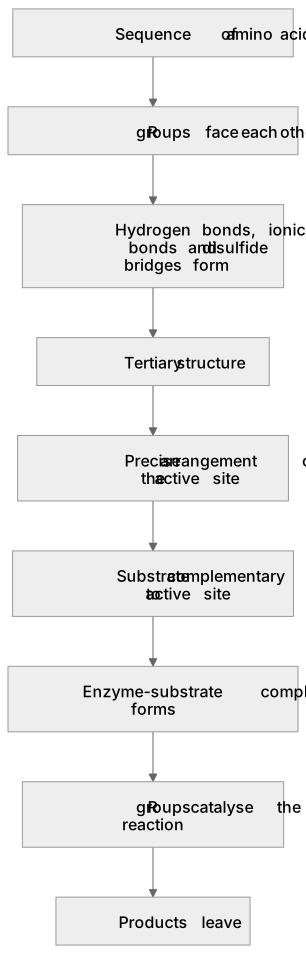
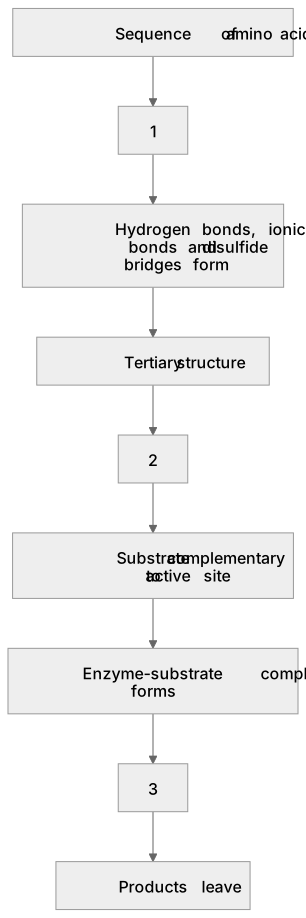
An enzyme is a globular protein, and its active site is a small depression formed when the polypeptide folds. The sequence of amino acids, the primary structure, determines which R groups face each other and therefore which hydrogen bonds, ionic bonds and disulfide bridges form. This determines the tertiary structure and the precise arrangement of the active site. Only a substrate with a complementary shape and complementary charges can bind there, forming an enzyme-substrate complex. The R groups then catalyse the reaction and the products leave. Because it is the tertiary structure of the site that matters, two enzymes with completely different amino acid sequences elsewhere can theoretically catalyse the same reaction if their active sites share a similar tertiary structure.
What earns the marks
- Stating that the active site has a specific tertiary structure, determined by the sequence of amino acids.
- Explaining that the substrate is complementary to the active site, allowing it to bind.
- Describing the successful binding as the formation of an enzyme-substrate complex.
- Explaining that two enzymes with different amino acid sequences can bind the same substrate if their active sites share a similar tertiary structure.
- Noting that a change in tertiary structure leaves the active site no longer complementary, preventing enzyme-substrate complexes from forming.
Common mistakes and how to put them right
Relying solely on 'shape' rather than specifying 'tertiary structure' when explaining active site conformation.
Saying the substrate is 'the same shape as' the active site rather than complementary to it.
Assuming that two enzymes with different primary structures must always catalyse different reactions.
Using abbreviations like ESC without first defining them as enzyme-substrate complex.
Carrying active site language into antibody, receptor or transport protein answers, where binding site is the correct term.
Exam tips
- Trace the chain in this order every time: gene, base sequence, amino acid sequence, tertiary structure, active site, complementary substrate.
- Write enzyme-substrate complex in full at least once before using any abbreviations.
- If a question says two enzymes catalyse the same reaction, focus your answer on the active site's tertiary structure, not the rest of the molecule.
Try the lesson
The start of the Many proteins are enzymes: The properties of an enzyme relate to the tertiary structure of its active site and its ability to combine with complementary substrate(s) to form an enzyme-substrate complex. lesson, made from checked teaching notes for this specification point.
Have a go first
What determines the shape of an enzyme's active site?
Listen
An enzyme is a globular protein, and its active site is a small depression formed when the polypeptide folds. The sequence of amino acids, the primary structure, determines which R groups face each other and therefore which hydrogen bonds, ionic bonds and disulfide bridges form. This determines the tertiary structure and the precise arrangement of the active site. Only a substrate with a complementary shape and complementary charges can bind there, forming an enzyme-substrate complex. The R groups then catalyse the reaction and the products leave. Because it is the tertiary structure of the site that matters, two enzymes with completely different amino acid sequences elsewhere can theoretically catalyse the same reaction if their active sites share a similar tertiary structure. A strong answer earns marks for these points. stating that the active site has a specific tertiary structure, determined by the sequence of amino acids. explaining that the substrate is complementary to the active site, allowing it to bind. describing the successful binding as the formation of an enzyme-substrate complex. explaining that two enzymes with different amino acid sequences can bind the same substrate if their active sites share a similar tertiary structure. Exam tip: Trace the chain in this order every time: gene, base sequence, amino acid sequence, tertiary structure, active site, complementary substrate.
See it
Key words
Say what each word means before you turn the card.
tertiary structure
Try answering aloud or in your head before turning the card.
active site
Try answering aloud or in your head before turning the card.
complementary shape
Try answering aloud or in your head before turning the card.
enzyme-substrate complex
Try answering aloud or in your head before turning the card.
See every definition
- tertiary structure
- The folding of the polypeptide that determines the precise arrangement of the active site.
- active site
- A small depression formed when the polypeptide folds, with a specific tertiary structure determined by the sequence of amino acids.
- complementary shape
- The property of a substrate that allows it to bind to the active site, along with complementary charges.
- enzyme-substrate complex
- Formed when a substrate with a complementary shape and complementary charges binds to the active site.
Label the diagram
Some boxes have lost their names. Pick the right name for each number.
1Box 1
2Box 2
3Box 3
There is more to this lesson
The full lesson goes on to check your understanding and help you earn the marks. Create a free account to carry on, with your progress saved.
A week of Premium from your first lesson · Then the free plan continues · No card, no charge
Test your understanding of Many proteins are enzymes: The properties of an enzyme relate to the tertiary structure of its active site and its ability to combine with complementary substrate(s) to form an enzyme-substrate complex.
Active recall beats re-reading. Take an instant quiz now to test what you’ve learned and lock it into long-term memory.
A week of Premium from your first lesson · Then the free plan continues · No card, no charge