AQA · A-Level · Biology
Course version: 7402 · Version from Sept 2016
The haemoglobins are a group of chemically similar molecules found in many…
Full specification wording
Mass transport in animals: The haemoglobins are a group of chemically similar molecules found in many different organisms. Haemoglobin is a protein with a quaternary structure.
Haemoglobin is a globular protein with quaternary structure: four polypeptide chains, two alpha and two beta in adult humans, each folded into its own tertiary structure and each holding one haem…
Checked against the AQA 7402 specification (opens in a new tab) on .
- Point 1 of 14
- 4 key terms
Study notes
From the checked teaching notes for this specification point.
The idea
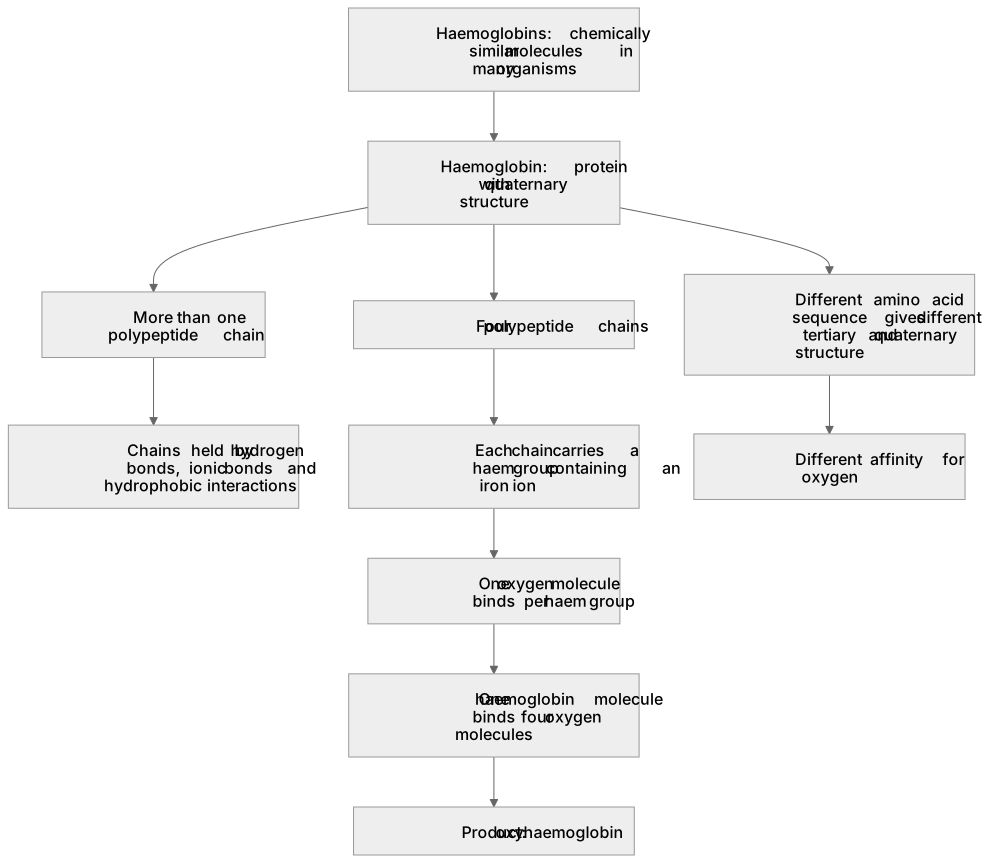
Haemoglobin is a globular protein with quaternary structure: four polypeptide chains, two alpha and two beta in adult humans, each folded into its own tertiary structure and each holding one haem group containing an iron ion. Quaternary structure means more than one polypeptide chain, held together by interactions between the chains such as hydrogen bonds, ionic bonds and hydrophobic interactions. Because each haem group binds one oxygen molecule, one haemoglobin molecule carries four oxygen molecules, and the product is called oxyhaemoglobin. The plural in the haemoglobins matters: the same basic architecture appears across many organisms and at different life stages, but the primary structure of the globin chains differs. A different amino acid sequence gives a different tertiary and quaternary structure, and so a different affinity for oxygen.
What earns the marks
- Quaternary structure means more than one polypeptide chain, held together by bonds or interactions between the chains, such as hydrogen bonds, ionic bonds and hydrophobic interactions.
- Four polypeptide chains, each carrying a haem group containing an iron ion, so one haemoglobin molecule binds four oxygen molecules.
- Name the product formed when oxygen binds as oxyhaemoglobin.
- State that a different amino acid sequence gives a different tertiary and quaternary structure.
- Link that structural difference to a different affinity for oxygen, e.g. in organisms living at different oxygen concentrations.
- Deduce the number of oxygen molecules carried from a stated number of haemoglobin molecules, using four oxygen molecules per haemoglobin.
Common mistakes and how to put them right
Describing quaternary structure as the three-dimensional shape.
Put it right: That is tertiary structure; quaternary means more than one polypeptide chain.
Writing that haemoglobin carries four oxygen atoms.
Put it right: It carries four oxygen molecules, one per haem group.
Saying oxygen binds to the polypeptide chain.
Put it right: Oxygen binds to the haem group and its iron ion.
Calling oxygen binding a permanent chemical change.
Put it right: It is reversible binding, forming oxyhaemoglobin.
Listing disulfide bridges as the main interactions holding haemoglobin subunits together.
Put it right: The subunits are held mainly by hydrophobic interactions, hydrogen bonds and ionic bonds.
Exam tips
- Define quaternary structure as more than one polypeptide chain, and name a type of bond or interaction holding the chains together.
- Write haemoglobin and oxyhaemoglobin in full rather than relying on the abbreviation Hb.
- For questions about chemically similar haemoglobins, compare primary structures first, then explain the consequence for oxygen affinity.
Try the lesson
The start of the Mass transport in animals: The haemoglobins are a group of chemically similar molecules found in many different organisms. Haemoglobin is a protein with a quaternary structure. lesson, made from checked teaching notes for this specification point.
Have a go first
Which level of protein structure describes a haemoglobin molecule that consists of more than one polypeptide chain?
Listen
Haemoglobin is a globular protein with quaternary structure: four polypeptide chains, two alpha and two beta in adult humans, each folded into its own tertiary structure and each holding one haem group containing an iron ion. Quaternary structure means more than one polypeptide chain, held together by interactions between the chains such as hydrogen bonds, ionic bonds and hydrophobic interactions. Because each haem group binds one oxygen molecule, one haemoglobin molecule carries four oxygen molecules, and the product is called oxyhaemoglobin. The plural in the haemoglobins matters: the same basic architecture appears across many organisms and at different life stages, but the primary structure of the globin chains differs. A different amino acid sequence gives a different tertiary and quaternary structure, and so a different affinity for oxygen. A strong answer earns marks for these points. Quaternary structure means more than one polypeptide chain, held together by bonds or interactions between the chains, such as hydrogen bonds, ionic bonds and hydrophobic interactions. Four polypeptide chains, each carrying a haem group containing an iron ion, so one haemoglobin molecule binds four oxygen molecules. Name the product formed when oxygen binds as oxyhaemoglobin. State that a different amino acid sequence gives a different tertiary and quaternary structure. A common slip: Describing quaternary structure as the three-dimensional shape. Instead, that is tertiary structure; quaternary means more than one polypeptide chain. Exam tip: Define quaternary structure as more than one polypeptide chain, and name a type of bond or interaction holding the chains together.
See it
Key words
Say what each word means before you turn the card.
quaternary structure
Try answering aloud or in your head before turning the card.
four polypeptide chains
Try answering aloud or in your head before turning the card.
haem group and iron
Try answering aloud or in your head before turning the card.
oxyhaemoglobin
Try answering aloud or in your head before turning the card.
See every definition
- quaternary structure
- More than one polypeptide chain, held together by interactions between the chains such as hydrogen bonds, ionic bonds and hydrophobic interactions.
- four polypeptide chains
- Each folded into its own tertiary structure and each holding one haem group containing an iron ion.
- haem group and iron
- Each haem group binds one oxygen molecule, so one haemoglobin molecule carries four oxygen molecules.
- oxyhaemoglobin
- The product formed when oxygen binds to haemoglobin.
Label the diagram
Some boxes have lost their names. Pick the right name for each number.
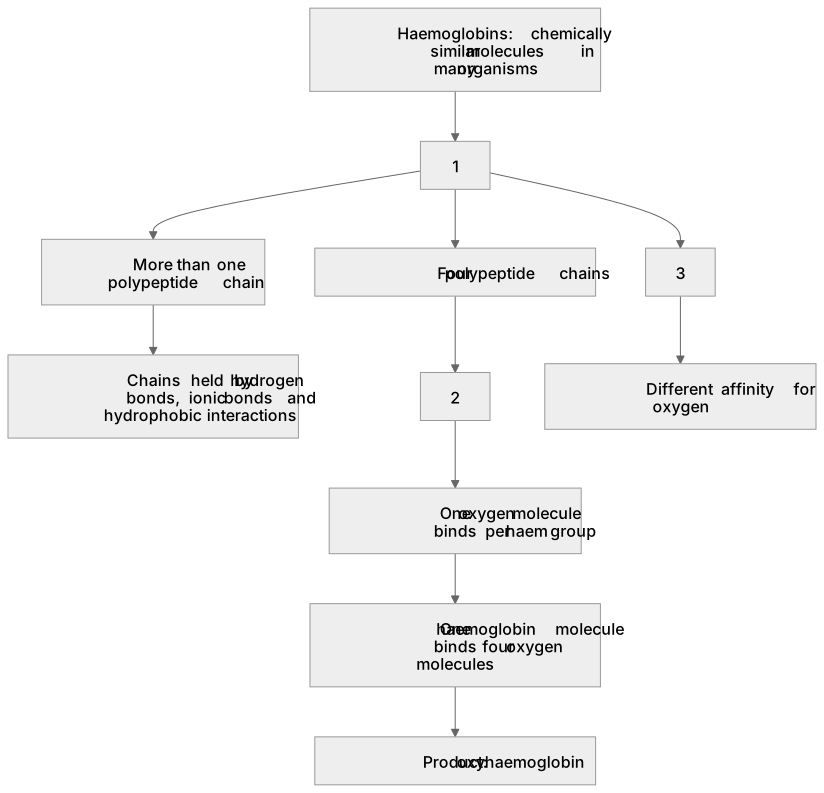
1Box 1
2Box 2
3Box 3
There is more to this lesson
The full lesson goes on to check your understanding and help you earn the marks. Create a free account to carry on, with your progress saved.
A week of Premium from your first lesson · Then the free plan continues · No card, no charge
Test your understanding of Mass transport in animals: The haemoglobins are a group of chemically similar molecules found in many different organisms. Haemoglobin is a protein with a quaternary structure.
Active recall beats re-reading. Take an instant quiz now to test what you’ve learned and lock it into long-term memory.
A week of Premium from your first lesson · Then the free plan continues · No card, no charge