AQA · A-Level · Biology
Course version: 7402 · Version from Sept 2016
The role of haemoglobin and red blood cells in the transport of oxygen.
Full specification wording
Mass transport in animals: The role of haemoglobin and red blood cells in the transport of oxygen.
A mature mammalian red blood cell is essentially a bag of haemoglobin, and its structure fits that job.
Checked against the AQA 7402 specification (opens in a new tab) on .
- Point 2 of 14
- 4 key terms
Study notes
From the checked teaching notes for this specification point.
The idea
A mature mammalian red blood cell is essentially a bag of haemoglobin, and its structure fits that job. It is a biconcave disc, giving a large surface area to volume ratio so oxygen diffuses in and out rapidly. It has no nucleus and no other organelles, leaving more room for haemoglobin; this is why a stain that binds DNA will not show it, and why a stain that binds haemoglobin is needed instead. The cells are small and flexible, so they pass through capillaries in single file, keeping the diffusion distance short. In the lungs the partial pressure of oxygen is high, so haemoglobin associates with, or loads, oxygen to form oxyhaemoglobin. In respiring tissues the partial pressure of oxygen is low, so oxyhaemoglobin dissociates and unloads its oxygen. Note that fish and other non-mammalian red blood cells do have a nucleus.
What earns the marks
- A mature mammalian red blood cell has no nucleus and no other organelles, leaving more space for haemoglobin; a DNA-binding stain therefore fails to show it, whereas a stain binding haemoglobin does.
- The biconcave shape gives a large surface area to volume ratio, so oxygen diffuses in and out rapidly; the small, flexible cell also passes through capillaries in single file, keeping the diffusion distance short.
- In the lungs the partial pressure of oxygen is high, so haemoglobin associates with, or loads, oxygen to form oxyhaemoglobin.
- In respiring tissues the partial pressure of oxygen is low, so oxyhaemoglobin dissociates and unloads its oxygen.
- Answers should link each structural feature to the rate of oxygen uptake or release, rather than merely listing features; for example, no nucleus means more haemoglobin per cell, so more oxygen can be carried per cell.
- Credit depends on the wording of the actual question; the points above are teaching guidance, not an official question-specific mark scheme.
Common mistakes and how to put them right
Saying red blood cells have no organelles at all and then referring to their mitochondria.
Put it right: Mature mammalian red blood cells lack mitochondria and respire anaerobically.
Assuming every red blood cell lacks a nucleus.
Put it right: Fish and other non-mammalian red blood cells have one.
Saying haemoglobin carries oxygen to cells and gives them energy.
Put it right: Haemoglobin transports oxygen, and cells release energy by respiration.
Confusing loading with unloading, so dissociation is described as happening in the lungs.
Put it right: Loading occurs in the lungs and unloading in respiring tissues.
Writing Hb without first giving the full name, which risks the abbreviation not being credited.
Exam tips
- Use loads or associates and unloads or dissociates; these are the terms generally credited.
- Tie every statement to the partial pressure of oxygen rather than to how much oxygen there is.
- In a comparison with fish blood, the presence of a nucleus is a feature examiners commonly look for, but check what the question actually asks.
Try the lesson
The start of the Mass transport in animals: The role of haemoglobin and red blood cells in the transport of oxygen. lesson, made from checked teaching notes for this specification point.
Have a go first
In which part of a red blood cell does oxygen bind to haemoglobin?
Listen
A mature mammalian red blood cell is essentially a bag of haemoglobin, and its structure fits that job. It is a biconcave disc, giving a large surface area to volume ratio so oxygen diffuses in and out rapidly. It has no nucleus and no other organelles, leaving more room for haemoglobin; this is why a stain that binds DNA will not show it, and why a stain that binds haemoglobin is needed instead. The cells are small and flexible, so they pass through capillaries in single file, keeping the diffusion distance short. In the lungs the partial pressure of oxygen is high, so haemoglobin associates with, or loads, oxygen to form oxyhaemoglobin. In respiring tissues the partial pressure of oxygen is low, so oxyhaemoglobin dissociates and unloads its oxygen. Note that fish and other non-mammalian red blood cells do have a nucleus. A strong answer earns marks for these points. A mature mammalian red blood cell has no nucleus and no other organelles, leaving more space for haemoglobin; a DNA-binding stain therefore fails to show it, whereas a stain binding haemoglobin does. The biconcave shape gives a large surface area to volume ratio, so oxygen diffuses in and out rapidly; the small, flexible cell also passes through capillaries in single file, keeping the diffusion distance short. In the lungs the partial pressure of oxygen is high, so haemoglobin associates with, or loads, oxygen to form oxyhaemoglobin. In respiring tissues the partial pressure of oxygen is low, so oxyhaemoglobin dissociates and unloads its oxygen. Exam tip: Use loads or associates and unloads or dissociates; these are the terms generally credited.
See it
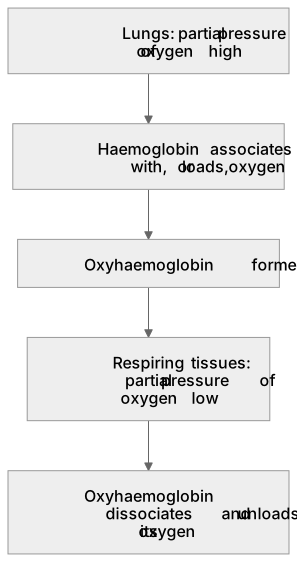
Put it in order
Put these steps in the order they happen.
- 1. Haemoglobin associates with, or loads, oxygen
- 2. Oxyhaemoglobin formed
- 3. Lungs: partial pressure of oxygen high
- 4. Oxyhaemoglobin dissociates and unloads its oxygen
- 5. Respiring tissues: partial pressure of oxygen low
Key words
Say what each word means before you turn the card.
biconcave disc
Try answering aloud or in your head before turning the card.
absence of a nucleus
Try answering aloud or in your head before turning the card.
partial pressure of oxygen
Try answering aloud or in your head before turning the card.
oxyhaemoglobin
Try answering aloud or in your head before turning the card.
See every definition
- biconcave disc
- The shape of a mature mammalian red blood cell, giving a large surface area to volume ratio so oxygen diffuses in and out rapidly.
- absence of a nucleus
- A feature of mature mammalian red blood cells, with no other organelles, leaving more room for haemoglobin.
- partial pressure of oxygen
- High in the lungs so haemoglobin loads oxygen, and low in respiring tissues so oxyhaemoglobin dissociates and unloads its oxygen.
- oxyhaemoglobin
- Formed when haemoglobin associates with, or loads, oxygen in the lungs, and it dissociates and unloads its oxygen in respiring tissues.
Label the diagram
Some boxes have lost their names. Pick the right name for each number.
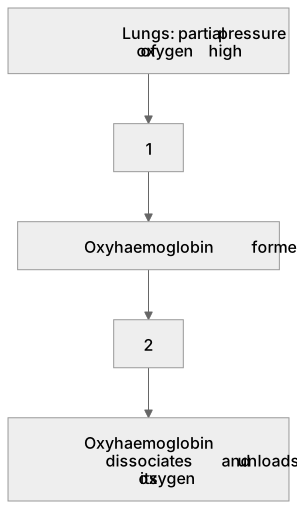
1Box 1
2Box 2
There is more to this lesson
The full lesson goes on to check your understanding and help you earn the marks. Create a free account to carry on, with your progress saved.
A week of Premium from your first lesson · Then the free plan continues · No card, no charge
Test your understanding of Mass transport in animals: The role of haemoglobin and red blood cells in the transport of oxygen.
Active recall beats re-reading. Take an instant quiz now to test what you’ve learned and lock it into long-term memory.
A week of Premium from your first lesson · Then the free plan continues · No card, no charge