AQA · A-Level · Biology
Course version: 7402 · Version from Sept 2016
Phloem as the tissue that transports organic substances in plants.
Full specification wording
Mass transport in plants: Phloem as the tissue that transports organic substances in plants.
Phloem is living tissue.
Checked against the AQA 7402 specification (opens in a new tab) on .
- Point 2 of 4
- 4 key terms
Study notes
From the checked teaching notes for this specification point.
The idea
Phloem is living tissue. It is made of sieve tube elements joined end to end through perforated sieve plates; each element has lost its nucleus and most organelles, and is kept alive by an adjacent companion cell packed with mitochondria. Phloem carries assimilates, chiefly sucrose but also amino acids, from sources to sinks. A source is anywhere assimilates are made or released, such as a photosynthesising leaf or a storage organ mobilising its reserves; a sink is anywhere they are used or stored, such as respiring cells, root and shoot tips, developing fruits and seeds. Sucrose is the transport sugar because it is soluble but metabolically fairly inert. Loading is active: the companion cell uses ATP to pump hydrogen ions out, and sucrose re-enters with those hydrogen ions through a co-transporter protein.
What earns the marks
- Sucrose being actively transported, or co-transported with hydrogen ions, into the phloem or sieve tube.
- Naming the companion or transfer cell as the site at which loading occurs.
- Movement from source to sink, with a named sink such as respiring cells, a storage organ, a root tip or a developing fruit.
- Sucrose being unloaded at the sink by active transport or by facilitated diffusion.
- Naming sieve tube elements and sieve plates as the structures through which transport occurs.
Common mistakes and how to put them right
Saying phloem transports glucose when the sugar carried is sucrose.
Describing phloem as dead tissue, which confuses it with xylem.
Assuming transport is always downwards from the leaves.
Omitting the companion cell, so the answer contains no source of ATP for loading.
Writing transports food where the mark requires a named organic substance.
Exam tips
- Name sucrose every time, and name a specific sink rather than saying the rest of the plant.
- Contrast phloem with xylem in one line: living against dead, two-way against one-way, sucrose against water and mineral ions.
- Sieve tube and sieve element are both accepted for phloem cell, so use whichever term you are confident with.
Try the lesson
The start of the Mass transport in plants: Phloem as the tissue that transports organic substances in plants. lesson, made from checked teaching notes for this specification point.
Have a go first
Which tissue transports organic substances such as sucrose in a plant?
Listen
Phloem is living tissue. It is made of sieve tube elements joined end to end through perforated sieve plates; each element has lost its nucleus and most organelles, and is kept alive by an adjacent companion cell packed with mitochondria. Phloem carries assimilates, chiefly sucrose but also amino acids, from sources to sinks. A source is anywhere assimilates are made or released, such as a photosynthesising leaf or a storage organ mobilising its reserves; a sink is anywhere they are used or stored, such as respiring cells, root and shoot tips, developing fruits and seeds. Sucrose is the transport sugar because it is soluble but metabolically fairly inert. Loading is active: the companion cell uses ATP to pump hydrogen ions out, and sucrose re-enters with those hydrogen ions through a co-transporter protein. A strong answer earns marks for these points. sucrose being actively transported, or co-transported with hydrogen ions, into the phloem or sieve tube. naming the companion or transfer cell as the site at which loading occurs. movement from source to sink, with a named sink such as respiring cells, a storage organ, a root tip or a developing fruit. sucrose being unloaded at the sink by active transport or by facilitated diffusion. Exam tip: Name sucrose every time, and name a specific sink rather than saying the rest of the plant.
See it
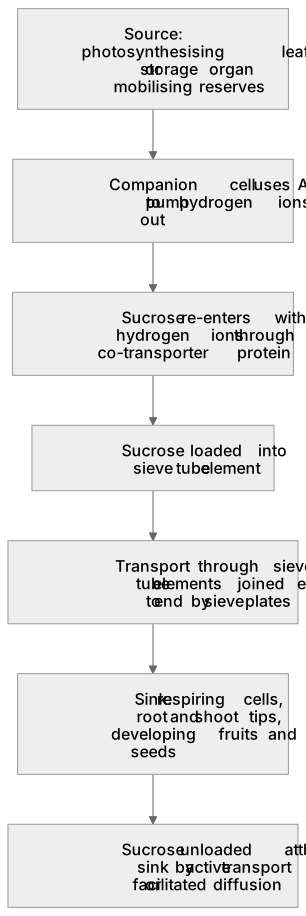
Put it in order
Put these steps in the order they happen.
- 1. Sucrose unloaded at the sink by active transport or facilitated diffusion
- 2. Sink: respiring cells, root and shoot tips, developing fruits and seeds
- 3. Sucrose re-enters with hydrogen ions through a co-transporter protein
- 4. Transport through sieve tube elements joined end to end by sieve plates
- 5. Source: photosynthesising leaf or storage organ mobilising reserves
- 6. Companion cell uses ATP to pump hydrogen ions out
- 7. Sucrose loaded into sieve tube element
Key words
Say what each word means before you turn the card.
sieve tube elements and sieve plates
Try answering aloud or in your head before turning the card.
companion cells
Try answering aloud or in your head before turning the card.
sucrose as the transport sugar
Try answering aloud or in your head before turning the card.
source to sink
Try answering aloud or in your head before turning the card.
See every definition
- sieve tube elements and sieve plates
- Living cells joined end to end through perforated plates, each element having lost its nucleus and most organelles.
- companion cells
- Cells adjacent to sieve tube elements, packed with mitochondria, that keep the elements alive and use ATP to pump hydrogen ions out.
- sucrose as the transport sugar
- The sugar carried by phloem because it is soluble but metabolically fairly inert.
- source to sink
- Movement of assimilates from anywhere they are made or released to anywhere they are used or stored.
Label the diagram
Some boxes have lost their names. Pick the right name for each number.
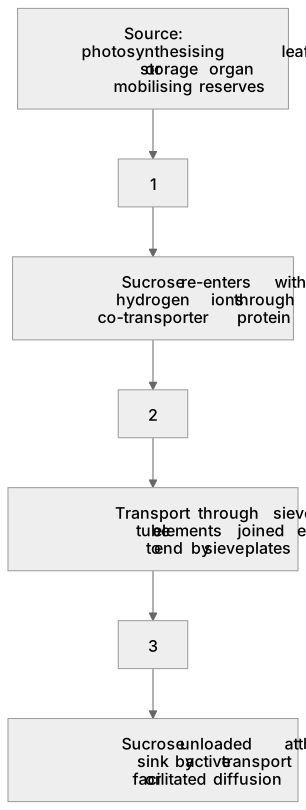
1Box 1
2Box 2
3Box 3
There is more to this lesson
The full lesson goes on to check your understanding and help you earn the marks. Create a free account to carry on, with your progress saved.
A week of Premium from your first lesson · Then the free plan continues · No card, no charge
Test your understanding of Mass transport in plants: Phloem as the tissue that transports organic substances in plants.
Active recall beats re-reading. Take an instant quiz now to test what you’ve learned and lock it into long-term memory.
A week of Premium from your first lesson · Then the free plan continues · No card, no charge