AQA · A-Level · Biology
Course version: 7402 · Version from Sept 2016
The mass flow hypothesis for the mechanism of translocation in plants. The…
Full specification wording
Mass transport in plants: The mass flow hypothesis for the mechanism of translocation in plants. The use of tracers and ringing experiments to investigate transport in plants.
The mass flow hypothesis explains translocation as bulk flow driven by a hydrostatic pressure gradient.
Checked against the AQA 7402 specification (opens in a new tab) on .
- Point 3 of 4
- 4 key terms
Study notes
From the checked teaching notes for this specification point.
The idea
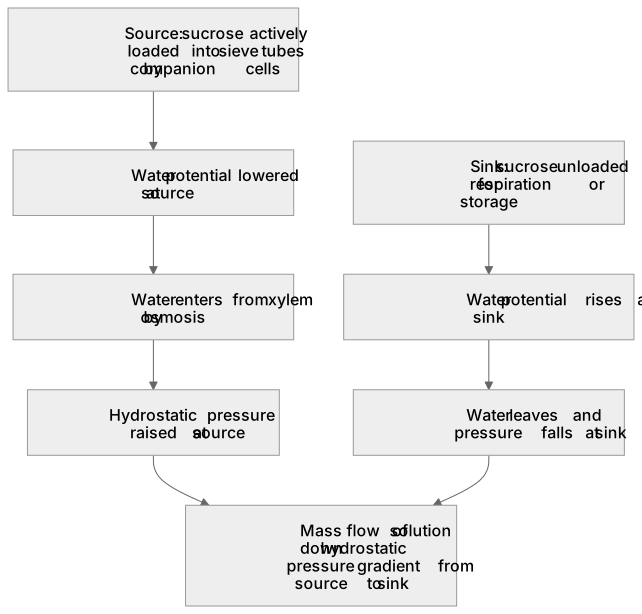
The mass flow hypothesis explains translocation as bulk flow driven by a hydrostatic pressure gradient. At the source, sucrose is actively loaded into sieve tubes by companion cells. This lowers water potential, so water enters from the xylem by osmosis, raising hydrostatic pressure. At the sink, sucrose is unloaded for respiration or storage. Water potential rises, water leaves, and pressure falls, driving flow from source to sink. Evidence includes ringing experiments: removing a ring of phloem-containing bark causes swelling above the ring as sugars accumulate. Tracer experiments also support this: plants supplied with radioactive 14CO2 incorporate 14C into sugars, which are tracked moving through the phloem using autoradiography.
What earns the marks
- Describe active loading of sucrose into the phloem at the source, which lowers the water potential.
- Explain that water enters the phloem from the xylem by osmosis, raising the hydrostatic pressure at the source.
- State that unloading of sucrose at the sink raises water potential, causing water to leave and pressure to fall.
- Explain that mass flow of solution occurs down the hydrostatic pressure gradient from source to sink.
- Describe evidence from tracer experiments, such as tracking radioactive 14C-labelled sugars in the phloem using autoradiography.
Common mistakes and how to put them right
Describing the driving force as a concentration gradient of sucrose.
Put it right: Specify that it is a hydrostatic pressure gradient that drives the bulk flow of sap.
Stating that water enters the phloem by active transport.
Put it right: Water always moves by osmosis down a water potential gradient.
Predicting swelling below the ring in a ringing experiment.
Put it right: Swelling occurs above the ring because the downward flow of sugars is interrupted.
Claiming a tracer experiment proves mass flow.
Put it right: Tracers only prove that the phloem carries the labelled organic compounds, not the mechanism of flow itself.
Exam tips
- Always use the term 'hydrostatic pressure' rather than just 'pressure', and clearly state which end is high and which is low.
- In ringing experiment questions, remember that the xylem remains intact, so the upward transport of water is unaffected.
- When evaluating evidence for mass flow, clearly distinguish between what the data shows and what it fails to rule out.
Try the lesson
The start of the Mass transport in plants: The mass flow hypothesis for the mechanism of translocation in plants. The use of tracers and ringing experiments to investigate transport in plants. lesson, made from checked teaching notes for this specification point.
Have a go first
According to the mass flow hypothesis, what is the main driving force that moves sugars through the phloem?
Listen
The mass flow hypothesis explains translocation as bulk flow driven by a hydrostatic pressure gradient. At the source, sucrose is actively loaded into sieve tubes by companion cells. This lowers water potential, so water enters from the xylem by osmosis, raising hydrostatic pressure. At the sink, sucrose is unloaded for respiration or storage. Water potential rises, water leaves, and pressure falls, driving flow from source to sink. Evidence includes ringing experiments: removing a ring of phloem-containing bark causes swelling above the ring as sugars accumulate. Tracer experiments also support this: plants supplied with radioactive 14CO2 incorporate 14C into sugars, which are tracked moving through the phloem using autoradiography. A strong answer earns marks for these points. Describe active loading of sucrose into the phloem at the source, which lowers the water potential. Explain that water enters the phloem from the xylem by osmosis, raising the hydrostatic pressure at the source. State that unloading of sucrose at the sink raises water potential, causing water to leave and pressure to fall. Explain that mass flow of solution occurs down the hydrostatic pressure gradient from source to sink. A common slip: Describing the driving force as a concentration gradient of sucrose. Instead, specify that it is a hydrostatic pressure gradient that drives the bulk flow of sap. Exam tip: Always use the term 'hydrostatic pressure' rather than just 'pressure', and clearly state which end is high and which is low.
See it
Key words
Say what each word means before you turn the card.
Mass flow hypothesis
Try answering aloud or in your head before turning the card.
Hydrostatic pressure gradients
Try answering aloud or in your head before turning the card.
Ringing experiments
Try answering aloud or in your head before turning the card.
Tracer experiments
Try answering aloud or in your head before turning the card.
See every definition
- Mass flow hypothesis
- Explains translocation as bulk flow driven by a hydrostatic pressure gradient, with sucrose actively loaded at the source and unloaded at the sink.
- Hydrostatic pressure gradients
- Loading sucrose at the source lowers water potential so water enters by osmosis, raising pressure, while unloading at the sink causes water to leave and pressure to fall.
- Ringing experiments
- Removing a ring of phloem-containing bark causes swelling above the ring as sugars accumulate, providing evidence for translocation.
- Tracer experiments
- Plants supplied with radioactive 14CO2 incorporate 14C into sugars, which are tracked moving through the phloem using autoradiography.
Label the diagram
Some boxes have lost their names. Pick the right name for each number.
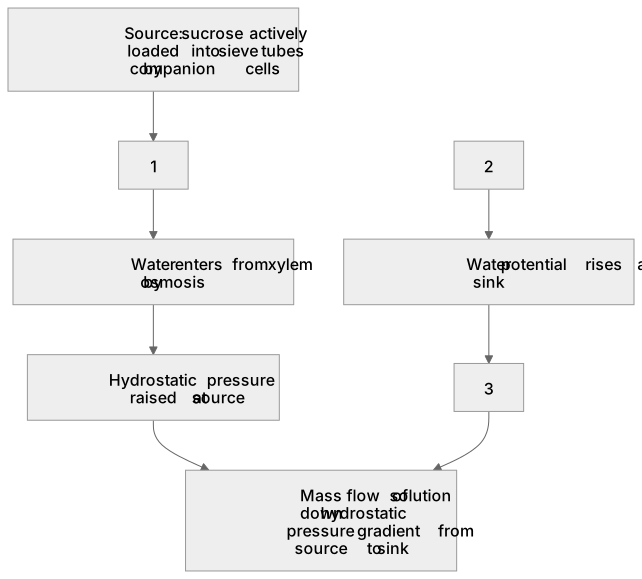
1Box 1
2Box 2
3Box 3
There is more to this lesson
The full lesson goes on to check your understanding and help you earn the marks. Create a free account to carry on, with your progress saved.
A week of Premium from your first lesson · Then the free plan continues · No card, no charge
Test your understanding of Mass transport in plants: The mass flow hypothesis for the mechanism of translocation in plants. The use of tracers and ringing experiments to investigate transport in plants.
Active recall beats re-reading. Take an instant quiz now to test what you’ve learned and lock it into long-term memory.
A week of Premium from your first lesson · Then the free plan continues · No card, no charge