AQA · A-Level · Biology
Course version: 7402 · Version from Sept 2016
Polymers are molecules made from a large number of monomers joined together.
Full specification wording
Monomers and polymers: Polymers are molecules made from a large number of monomers joined together.
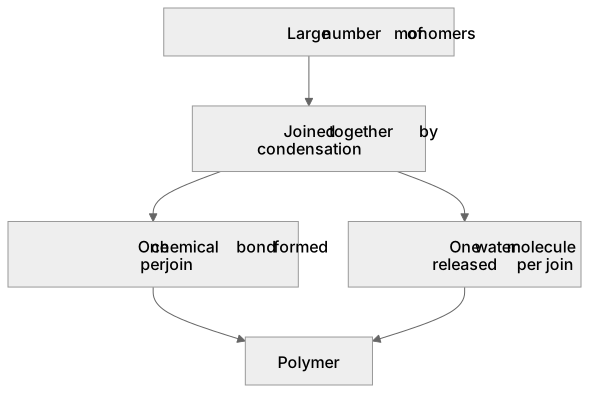
A polymer is a large molecule made of many monomers joined in a chain by condensation reactions, one chemical bond and one released water molecule per join.
Checked against the AQA 7402 specification (opens in a new tab) on .
- Point 3 of 6
- 4 key terms
Study notes
From the checked teaching notes for this specification point.
The idea
A polymer is a large molecule made of many monomers joined in a chain by condensation reactions, one chemical bond and one released water molecule per join. Starch, glycogen and cellulose are polymers of glucose; polypeptides are polymers of amino acids; DNA and RNA are polynucleotides. What gives a polymer its properties is not only which monomer it uses but how the chain is arranged. Cellulose and chitin chains are straight and unbranched, because alternate beta monomers are flipped through 180 degrees so their hydroxyl groups can line up, and hydrogen bonds then form between neighbouring chains. Amylopectin and glycogen carry 1,6 branch points, while amylose coils into a helix. When a question supplies a diagram of an unfamiliar polymer, read the monomer, the bond and the chain shape directly from the figure rather than recalling a memorised example.
What earns the marks
- State that a polymer is many monomers joined together, formed by condensation, with one water molecule released per bond formed.
- Name the bond between the monomers in a named example, such as glycosidic bonds in a polysaccharide or peptide bonds in a polypeptide.
- Describe the chain as straight, linear or unbranched where the diagram shows it, and identify 1,4 linkages in the backbone.
- Note that alternate monomers are flipped, rotated or inverted through 180 degrees, as in cellulose and chitin, allowing hydrogen bonds to form between chains.
- Identify 1,6 linkages only where branching is shown, and explain that branching produces a more compact molecule with more free ends for rapid hydrolysis.
Common mistakes and how to put them right
Offering that both polymers contain carbon, hydrogen and oxygen as a structural similarity, which is ignored when the question asks about structure.
Stating that a straight, unbranched polymer such as cellulose or chitin contains 1,6 bonds, which is rejected.
Put it right: 1,6 bonds occur only at branch points.
Saying both molecules are polysaccharides when the question has already told you that, so it gains nothing.
Calling a triglyceride a polymer of fatty acids.
Put it right: Triglycerides are not polymers because no repeating chain is formed.
Describing a polymer as 'lots of molecules stuck together' without naming the bond or the condensation reaction.
Exam tips
- When a question says 'use Figure 1', every point you make must be visible in the figure - the flipped monomer and the straight chain are there to be seen.
- Check the branching before you mention 1,6 bonds; if the drawn chain is straight, a 1,6 bond is a marked error.
- Structure means monomer, bond, chain shape and chain interactions - not the elements the molecule contains.
Try the lesson
The start of the Monomers and polymers: Polymers are molecules made from a large number of monomers joined together. lesson, made from checked teaching notes for this specification point.
Have a go first
Which statement describes a polymer?
Listen
A polymer is a large molecule made of many monomers joined in a chain by condensation reactions, one chemical bond and one released water molecule per join. Starch, glycogen and cellulose are polymers of glucose; polypeptides are polymers of amino acids; DNA and RNA are polynucleotides. What gives a polymer its properties is not only which monomer it uses but how the chain is arranged. Cellulose and chitin chains are straight and unbranched, because alternate beta monomers are flipped through 180 degrees so their hydroxyl groups can line up, and hydrogen bonds then form between neighbouring chains. Amylopectin and glycogen carry 1,6 branch points, while amylose coils into a helix. When a question supplies a diagram of an unfamiliar polymer, read the monomer, the bond and the chain shape directly from the figure rather than recalling a memorised example. A strong answer earns marks for these points. State that a polymer is many monomers joined together, formed by condensation, with one water molecule released per bond formed. Name the bond between the monomers in a named example, such as glycosidic bonds in a polysaccharide or peptide bonds in a polypeptide. Describe the chain as straight, linear or unbranched where the diagram shows it, and identify 1,4 linkages in the backbone. Note that alternate monomers are flipped, rotated or inverted through 180 degrees, as in cellulose and chitin, allowing hydrogen bonds to form between chains. Exam tip: When a question says 'use Figure 1', every point you make must be visible in the figure - the flipped monomer and the straight chain are there to be seen.
See it
Watch it explained
Use Figure 1 to describe the structure of the polymer shown.
Read the described scene instead
Welcome to this A-Level AQA Biology breakdown on monomers and polymers. A polymer is a large molecule made from many monomers joined together in a chain. The joins are made by condensation reactions, with one chemical bond formed and one water molecule released per join. In this video we will connect the monomer, the bond and the chain arrangement, then apply that to exam figures involving polysaccharides, polypeptides and polynucleotides. Think of polymer structure as a concept map. At the centre are monomers—many small units. They join by condensation to form a polymer chain. The guide gives three named families: starch, glycogen and cellulose are polymers of glucose; polypeptides are polymers of amino acids; DNA and RNA are polynucleotides. But the monomer alone does not determine properties. Chain arrangement matters too: straight versus branched, 1,4 backbone linkages, 1,6 branch points, and alternate beta monomers flipped through 180 degrees. Core notes: always state that a polymer is many monomers joined together, formed by condensation, with one water molecule released per bond formed. Name the bond in a named example—glycosidic bonds in a polysaccharide, or peptide bonds in a polypeptide. Describe the chain as straight, linear or unbranched where the diagram shows it, and identify 1,4 linkages in the backbone. Cellulose and chitin chains are straight and unbranched because alternate beta monomers are flipped through 180 degrees, so their hydroxyl groups line up and hydrogen bonds form between neighbouring chains. Now follow the assembly process. Monomers are brought together, and a condensation reaction joins them into a chain, releasing one water molecule for each bond formed. The resulting backbone may show 1,4 linkages. If alternate beta monomers are rotated or inverted through 180 degrees, their hydroxyl groups can line up, letting hydrogen bonds form between neighbouring straight chains—as in cellulose and chitin. Branching is different: amylopectin and glycogen carry 1,6 branch points, while amylose coils into a helix. Branching produces a more compact molecule with more free ends for rapid hydrolysis. Let’s work through an exam-style figure question. The question says: use Figure 1 to describe the structure of the polymer shown. Step one: read the monomer directly from the figure. Step two: identify the bond—glycosidic if it is a polysaccharide, peptide if it is a polypeptide. Step three: describe the chain shape as straight, linear or unbranched if that is what the drawing shows, and identify 1,4 linkages in the backbone. Step four: check for flipped monomers—alternate beta monomers rotated 180 degrees—and for hydrogen bonds between neighbouring chains. Step five: mention 1,6 linkages only if branch points are visible. A strong answer uses the figure, not a memorised example. Watch for common pitfalls. Do not offer that both polymers contain carbon, hydrogen and oxygen as a structural similarity—structure means monomer, bond, chain shape and chain interactions. Do not state that a straight, unbranched polymer such as cellulose or chitin contains 1,6 bonds; 1,6 bonds occur only at branch points. Do not say both molecules are polysaccharides when the question has already told you that. Do not call a triglyceride a polymer of fatty acids—triglycerides are not polymers because no repeating chain is formed. And never describe a polymer as 'lots of molecules stuck together' without naming the bond or the condensation reaction. When a question says use Figure 1, every point must be visible in the figure. To recap: a polymer is many monomers joined by condensation, with one water molecule released per bond. Name the bond—glycosidic in a polysaccharide, peptide in a polypeptide. Describe the chain as straight, linear or unbranched where shown, and identify 1,4 linkages in the backbone. Note alternate monomers flipped 180 degrees in cellulose and chitin, allowing hydrogen bonds between chains. Mention 1,6 linkages only where branching is shown; branching makes a more compact molecule with more free ends for rapid hydrolysis. And when you meet an unfamiliar polymer diagram, read the monomer, the bond and the chain shape directly from the figure.
Key words
Say what each word means before you turn the card.
condensation
Try answering aloud or in your head before turning the card.
glycosidic bonds
Try answering aloud or in your head before turning the card.
straight versus branched chains
Try answering aloud or in your head before turning the card.
alternate monomers rotated 180 degrees
Try answering aloud or in your head before turning the card.
See every definition
- condensation
- A reaction in which monomers are joined together, with one water molecule released per bond formed.
- glycosidic bonds
- The bonds between the monomers in a polysaccharide.
- straight versus branched chains
- A chain described as straight, linear or unbranched where the diagram shows it, or carrying 1,6 branch points where branching is shown.
- alternate monomers rotated 180 degrees
- A feature of cellulose and chitin chains, where alternate beta monomers are flipped through 180 degrees so their hydroxyl groups can line up and hydrogen bonds form between neighbouring chains.
Label the diagram
Some boxes have lost their names. Pick the right name for each number.
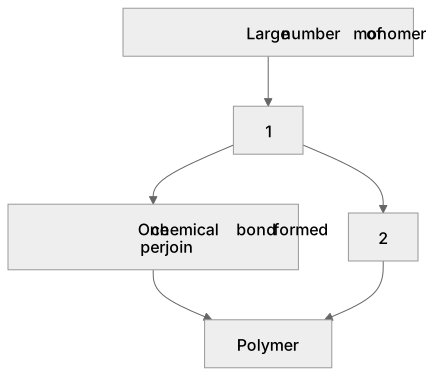
1Box 1
2Box 2
There is more to this lesson
The full lesson goes on to check your understanding and help you earn the marks. Create a free account to carry on, with your progress saved.
A week of Premium from your first lesson · Then the free plan continues · No card, no charge
Test your understanding of Monomers and polymers: Polymers are molecules made from a large number of monomers joined together.
Active recall beats re-reading. Take an instant quiz now to test what you’ve learned and lock it into long-term memory.
A week of Premium from your first lesson · Then the free plan continues · No card, no charge