AQA · A-Level · Biology
Course version: 7402 · Version from Sept 2016
Monomers are the smaller units from which larger molecules are made.
Full specification wording
Monomers and polymers: Monomers are the smaller units from which larger molecules are made.
A monomer is the small, repeating unit from which a much larger molecule is built.
Checked against the AQA 7402 specification (opens in a new tab) on .
- Point 2 of 6
- 3 key terms
Study notes
From the checked teaching notes for this specification point.
The idea
A monomer is the small, repeating unit from which a much larger molecule is built. The word only means anything in relation to the polymer it forms, so a full definition has two halves: the smaller units, and the larger molecule they are joined into. Monomers join by condensation, each join forming one named chemical bond and releasing one molecule of water, and the polymer is taken apart again by hydrolysis. Glucose is the monomer of starch, glycogen and cellulose; an amino acid is the monomer of a polypeptide; a nucleotide is the monomer of DNA and RNA. The monomers in one polymer need not be identical - a polypeptide is built from twenty different amino acids - but they are all joined by the same type of bond. Not every large biological molecule is a polymer: triglycerides are built from glycerol and fatty acids, but these are not monomers because no repeating chain is formed.
What earns the marks
- Define a monomer as a smaller or repeating unit from which a larger molecule is made, naming both the small unit and the larger molecule in one sentence.
- Identify the repeating monomer from a diagram of an unfamiliar polymer, for example N-acetylglucosamine in chitin or beta-glucose in cellulose.
- Name the bond that joins the monomers in a named example, such as a glycosidic bond between glucose units or a peptide bond between amino acids.
- State that monomers are joined by condensation, releasing water, and separated by hydrolysis, which uses water.
- Explain why glycerol and fatty acids are not monomers even though a triglyceride is a large molecule, because no repeating chain is formed.
Common mistakes and how to put them right
Defining a monomer as just a small molecule, with no reference to the larger molecule it builds.
Put it right: A full definition needs both halves.
Calling a disaccharide such as maltose a monomer because it is smaller than starch.
Put it right: It is a dimer, not a monomer.
Naming glycerol or a fatty acid as a monomer of a triglyceride, when lipids are not polymers.
Saying the monomers of DNA are bases rather than nucleotides.
Put it right: The monomer is the nucleotide, which contains a base, sugar and phosphate.
Answering with the elements present, carbon, hydrogen and oxygen, when asked to identify a repeating unit.
Exam tips
- Read the monomer off the diagram you are given - a question about an unfamiliar polymer like chitin is testing whether you can spot the repeating unit, not whether you have memorised it.
- Pair every monomer with its polymer and bond when you revise: glucose-polysaccharide-glycosidic, amino acid-polypeptide-peptide, nucleotide-polynucleotide-phosphodiester.
- In a definition question write both halves of the idea in one sentence: the small repeating unit and the larger molecule it builds.
Try the lesson
The start of the Monomers and polymers: Monomers are the smaller units from which larger molecules are made. lesson, made from checked teaching notes for this specification point.
Have a go first
Which of the following is the best definition of a monomer?
Listen
A monomer is the small, repeating unit from which a much larger molecule is built. The word only means anything in relation to the polymer it forms, so a full definition has two halves: the smaller units, and the larger molecule they are joined into. Monomers join by condensation, each join forming one named chemical bond and releasing one molecule of water, and the polymer is taken apart again by hydrolysis. Glucose is the monomer of starch, glycogen and cellulose; an amino acid is the monomer of a polypeptide; a nucleotide is the monomer of DNA and RNA. The monomers in one polymer need not be identical - a polypeptide is built from twenty different amino acids - but they are all joined by the same type of bond. Not every large biological molecule is a polymer: triglycerides are built from glycerol and fatty acids, but these are not monomers because no repeating chain is formed. A strong answer earns marks for these points. Define a monomer as a smaller or repeating unit from which a larger molecule is made, naming both the small unit and the larger molecule in one sentence. Identify the repeating monomer from a diagram of an unfamiliar polymer, for example N-acetylglucosamine in chitin or beta-glucose in cellulose. Name the bond that joins the monomers in a named example, such as a glycosidic bond between glucose units or a peptide bond between amino acids. State that monomers are joined by condensation, releasing water, and separated by hydrolysis, which uses water. Exam tip: Read the monomer off the diagram you are given - a question about an unfamiliar polymer like chitin is testing whether you can spot the repeating unit, not whether you have memorised it.
See it
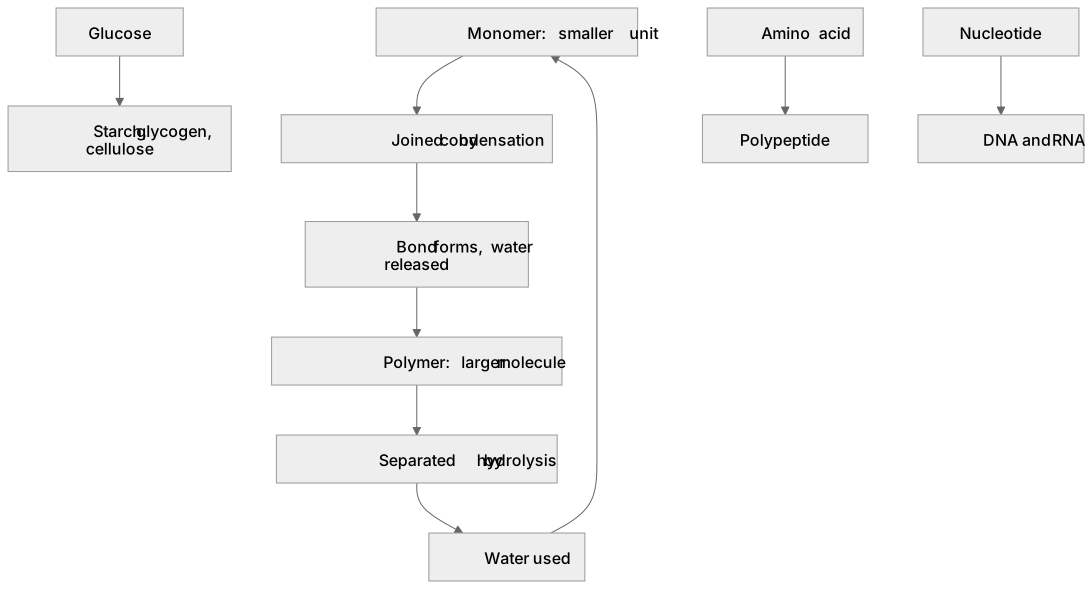
Key words
Say what each word means before you turn the card.
monomer
Try answering aloud or in your head before turning the card.
condensation
Try answering aloud or in your head before turning the card.
hydrolysis
Try answering aloud or in your head before turning the card.
See every definition
- monomer
- A smaller unit from which larger molecules are made, named together with the larger molecule it builds.
- condensation
- The joining of monomers in which each join forms one named chemical bond and releases one molecule of water.
- hydrolysis
- The process by which a polymer is taken apart again, using water.
Label the diagram
Some boxes have lost their names. Pick the right name for each number.
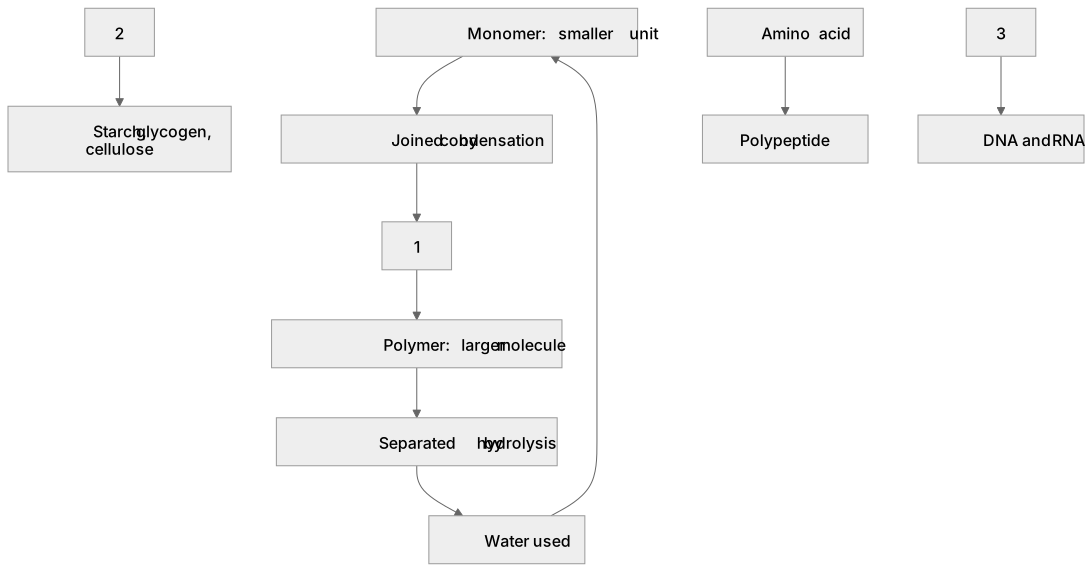
1Box 1
2Box 2
3Box 3
There is more to this lesson
The full lesson goes on to check your understanding and help you earn the marks. Create a free account to carry on, with your progress saved.
A week of Premium from your first lesson · Then the free plan continues · No card, no charge
Test your understanding of Monomers and polymers: Monomers are the smaller units from which larger molecules are made.
Active recall beats re-reading. Take an instant quiz now to test what you’ve learned and lock it into long-term memory.
A week of Premium from your first lesson · Then the free plan continues · No card, no charge