AQA · A-Level · Biology
Course version: 7402 · Version from Sept 2016
The variety of life, both past and present, is extensive, but the…
Full specification wording
Monomers and polymers: The variety of life, both past and present, is extensive, but the biochemical basis of life is similar for all living things.
Life on Earth is incredibly diverse, yet the underlying biochemical basis is fundamentally similar across all organisms.
Checked against the AQA 7402 specification (opens in a new tab) on .
- Point 1 of 6
- 4 key terms
Study notes
From the checked teaching notes for this specification point.
The idea
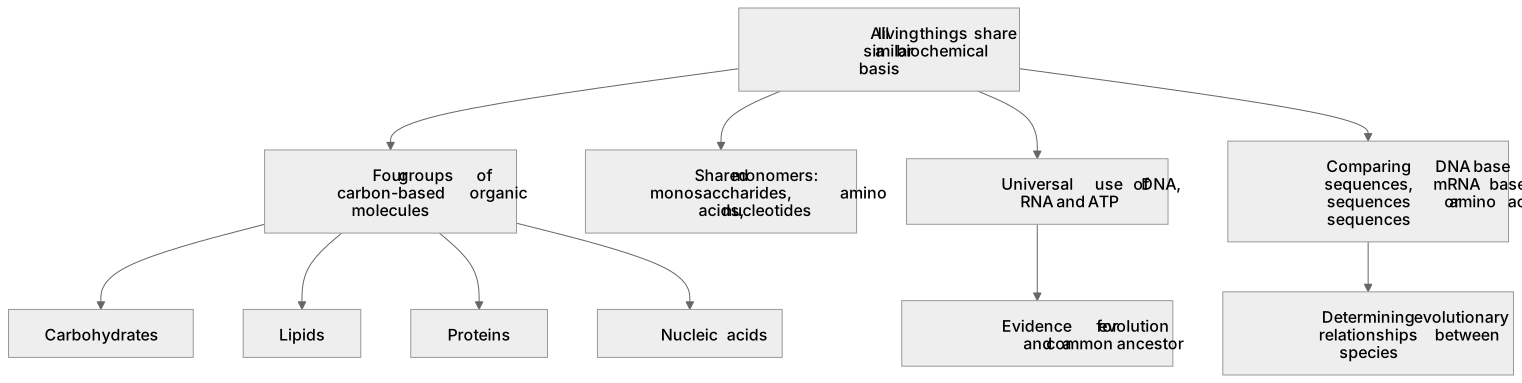
Life on Earth is incredibly diverse, yet the underlying biochemical basis is fundamentally similar across all organisms. Every living thing is constructed from four main groups of carbon-based organic molecules: carbohydrates, lipids, proteins, and nucleic acids. Organic molecules contain carbon bonded to hydrogen. Carbon's ability to form four strong covalent bonds allows it to build complex chains and rings. The same monomers—monosaccharides, amino acids, and nucleotides—are used universally. Furthermore, the same fundamental reactions, condensation and hydrolysis, assemble and dismantle these polymers. This shared biochemistry, including the universal use of DNA, RNA, and ATP, provides strong evidence for evolution and a common ancestor.
What earns the marks
- State that all living organisms share the same fundamental groups of carbon-based organic molecules: carbohydrates, lipids, proteins, and nucleic acids.
- Identify that shared monomers, such as monosaccharides, amino acids, and nucleotides, are common to all life forms.
- Explain that the universal use of DNA, essentially the same genetic code, and ATP provides biochemical evidence for a common ancestor.
- Describe how comparing DNA base sequences, mRNA base sequences, or amino acid sequences can be used to determine evolutionary relationships between diverse species.
- Recognise that organic molecules are carbon-based compounds containing carbon-hydrogen bonds, distinguishing them from inorganic carbon compounds like carbon dioxide.
Common mistakes and how to put them right
Assuming all carbon-containing compounds are organic.
Put it right by remembering that simple carbon compounds like carbon dioxide (CO2) and carbonates are inorganic because they lack carbon-hydrogen bonds.
Misinterpreting a 'similar biochemical basis' to mean organisms have identical molecules.
Put it right by understanding that while the classes of molecules (e.g., proteins) and monomers (e.g., amino acids) are shared, the specific sequences (e.g., amino acid sequences) differ between species.
Stating species are related solely because of similar physical appearances when asked for biochemical evidence.
Put it right: Specifically referencing shared molecules like DNA, RNA, or proteins.
Exam tips
- When evaluating evolutionary relationships, always specify the exact biochemical evidence being compared, such as the 'DNA base sequence' or 'amino acid sequence', rather than just writing 'DNA'.
- The concept of a shared biochemical basis is an excellent linking theme for synoptic essays, connecting biological molecules to classification, evolution, and the genetic code.
Try the lesson
The start of the Monomers and polymers: The variety of life, both past and present, is extensive, but the biochemical basis of life is similar for all living things. lesson, made from checked teaching notes for this specification point.
Have a go first
Which statement best describes the biochemical basis of life across all living organisms?
Listen
Life on Earth is incredibly diverse, yet the underlying biochemical basis is fundamentally similar across all organisms. Every living thing is constructed from four main groups of carbon-based organic molecules: carbohydrates, lipids, proteins, and nucleic acids. Organic molecules contain carbon bonded to hydrogen. Carbon's ability to form four strong covalent bonds allows it to build complex chains and rings. The same monomers—monosaccharides, amino acids, and nucleotides—are used universally. Furthermore, the same fundamental reactions, condensation and hydrolysis, assemble and dismantle these polymers. This shared biochemistry, including the universal use of DNA, RNA, and ATP, provides strong evidence for evolution and a common ancestor. A strong answer earns marks for these points. State that all living organisms share the same fundamental groups of carbon-based organic molecules: carbohydrates, lipids, proteins, and nucleic acids. Identify that shared monomers, such as monosaccharides, amino acids, and nucleotides, are common to all life forms. Explain that the universal use of DNA, essentially the same genetic code, and ATP provides biochemical evidence for a common ancestor. Describe how comparing DNA base sequences, mRNA base sequences, or amino acid sequences can be used to determine evolutionary relationships between diverse species. A common slip: Assuming all carbon-containing compounds are organic. Instead, remembering that simple carbon compounds like carbon dioxide (CO2) and carbonates are inorganic because they lack carbon-hydrogen bonds. Exam tip: When evaluating evolutionary relationships, always specify the exact biochemical evidence being compared, such as the 'DNA base sequence' or 'amino acid sequence', rather than just writing 'DNA'.
See it
Key words
Say what each word means before you turn the card.
organic molecules
Try answering aloud or in your head before turning the card.
shared monomers
Try answering aloud or in your head before turning the card.
common ancestry
Try answering aloud or in your head before turning the card.
molecular evidence for classification
Try answering aloud or in your head before turning the card.
See every definition
- organic molecules
- Carbon-based compounds containing carbon bonded to hydrogen, built from four main groups: carbohydrates, lipids, proteins and nucleic acids.
- shared monomers
- Monosaccharides, amino acids and nucleotides, which are used universally by all life forms.
- common ancestry
- The idea supported by shared biochemistry, including the universal use of DNA, RNA and ATP, that living things descend from a common ancestor.
- molecular evidence for classification
- Comparing DNA base sequences, mRNA base sequences or amino acid sequences to determine evolutionary relationships between diverse species.
Label the diagram
Some boxes have lost their names. Pick the right name for each number.
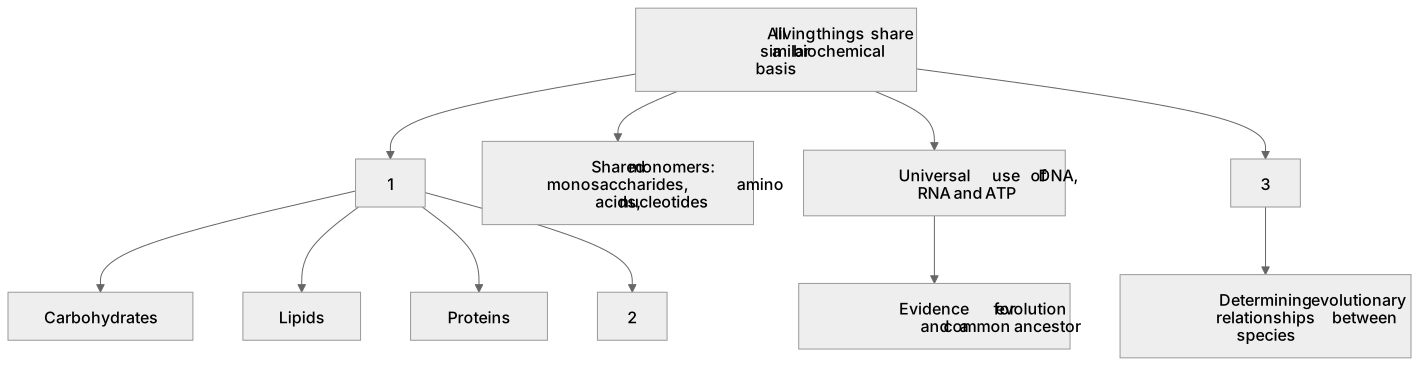
1Box 1
2Box 2
3Box 3
There is more to this lesson
The full lesson goes on to check your understanding and help you earn the marks. Create a free account to carry on, with your progress saved.
A week of Premium from your first lesson · Then the free plan continues · No card, no charge
Test your understanding of Monomers and polymers: The variety of life, both past and present, is extensive, but the biochemical basis of life is similar for all living things.
Active recall beats re-reading. Take an instant quiz now to test what you’ve learned and lock it into long-term memory.
A week of Premium from your first lesson · Then the free plan continues · No card, no charge