AQA · A-Level · Biology
Course version: 7402 · Version from Sept 2016
Students should be able to evaluate the use of stem cells in treating…
Full specification wording
Most of a cell’s DNA is not translated (A-level only): Students should be able to evaluate the use of stem cells in treating human disorders.
Evaluate means weigh both sides and reach a judgement.
Checked against the AQA 7402 specification (opens in a new tab) on .
- Point 8 of 8
- 4 key terms
Study notes
From the checked teaching notes for this specification point.
The idea
Evaluate means weigh both sides and reach a judgement. In favour: stem cells replace cell types the body cannot regenerate, offering treatment for conditions lacking a cure, like macular degeneration or spinal cord injury, and can also treat leukaemia. Adult stem cells can be taken from the patient, and induced pluripotent stem (iPS) cells are produced by reprogramming the patient's somatic cells. These carry the patient's own antigens, avoiding rejection. Also, IVF embryos used would otherwise be discarded. Against: using embryonic stem cells destroys an embryo, which some regard as a potential life; donated cells carry foreign antigens and may be rejected; iPS and embryonic cells divide indefinitely, risking tumour formation; and much evidence comes from mice, so long-term human effects are unknown.
What earns the marks
- At least one point supporting the use of stem cells, with a named disorder such as macular degeneration.
- At least one point against, such as destruction of an embryo or the risk of tumour formation.
- A point about immune rejection, either as an advantage of the patient's own cells (adult or iPS) or a disadvantage of donated cells.
- A valid limitation of the evidence, such as work done on mice rather than humans, a small sample, or unknown long-term effects.
- A justified conclusion that refers back to the data or arguments given.
Common mistakes and how to put them right
Writing only the benefits and omitting the opposing side, which weakens an evaluation.
Put it right: Include points for and against.
Writing it is unethical without stating what the ethical objection actually is. Correction: specify that using embryonic stem cells destroys an embryo.
Claiming all stem cell treatments destroy embryos, when adult and iPS sources do not.
Put it right: Distinguish between embryonic, adult, and iPS cells.
Stating that results obtained in mice apply directly to humans.
Put it right: Acknowledge that animal models may not perfectly predict human responses.
Ending without a judgement when the command word is evaluate.
Put it right: Provide a concluding sentence weighing the evidence.
Exam tips
- Split the answer into supporting and against, and check you have at least one point under each before you run out of time.
- Use the source material: quote a named finding or a figure from the stem rather than relying on general knowledge alone.
- Finish with one sentence saying which way the evidence points and why.
Try the lesson
The start of the Most of a cell’s DNA is not translated (A-level only): Students should be able to evaluate the use of stem cells in treating human disorders. lesson, made from checked teaching notes for this specification point.
Have a go first
A patient with a degenerative disorder is offered treatment using stem cells from a donated embryo. Which statement is the strongest evaluation of this use of stem cells?
Listen
Evaluate means weigh both sides and reach a judgement. In favour: stem cells replace cell types the body cannot regenerate, offering treatment for conditions lacking a cure, like macular degeneration or spinal cord injury, and can also treat leukaemia. Adult stem cells can be taken from the patient, and induced pluripotent stem (iPS) cells are produced by reprogramming the patient's somatic cells. These carry the patient's own antigens, avoiding rejection. Also, IVF embryos used would otherwise be discarded. Against: using embryonic stem cells destroys an embryo, which some regard as a potential life; donated cells carry foreign antigens and may be rejected; iPS and embryonic cells divide indefinitely, risking tumour formation; and much evidence comes from mice, so long-term human effects are unknown. A strong answer earns marks for these points. At least one point supporting the use of stem cells, with a named disorder such as macular degeneration. At least one point against, such as destruction of an embryo or the risk of tumour formation. A point about immune rejection, either as an advantage of the patient's own cells (adult or iPS) or a disadvantage of donated cells. A valid limitation of the evidence, such as work done on mice rather than humans, a small sample, or unknown long-term effects. A common slip: Writing only the benefits and omitting the opposing side, which weakens an evaluation. Instead, include points for and against. Exam tip: Split the answer into supporting and against, and check you have at least one point under each before you run out of time.
See it

Key words
Say what each word means before you turn the card.
evaluating both sides
Try answering aloud or in your head before turning the card.
ethical objections
Try answering aloud or in your head before turning the card.
immune rejection and antigens
Try answering aloud or in your head before turning the card.
risk of tumours
Try answering aloud or in your head before turning the card.
See every definition
- evaluating both sides
- Weighing points in favour and points against, then reaching a judgement.
- ethical objections
- Concerns such as using embryonic stem cells destroying an embryo, which some regard as a potential life.
- immune rejection and antigens
- Donated cells carry foreign antigens and may be rejected, whereas the patient's own adult or iPS cells carry the patient's own antigens, avoiding rejection.
- risk of tumours
- iPS and embryonic cells divide indefinitely, risking tumour formation.
Label the diagram
Some boxes have lost their names. Pick the right name for each number.
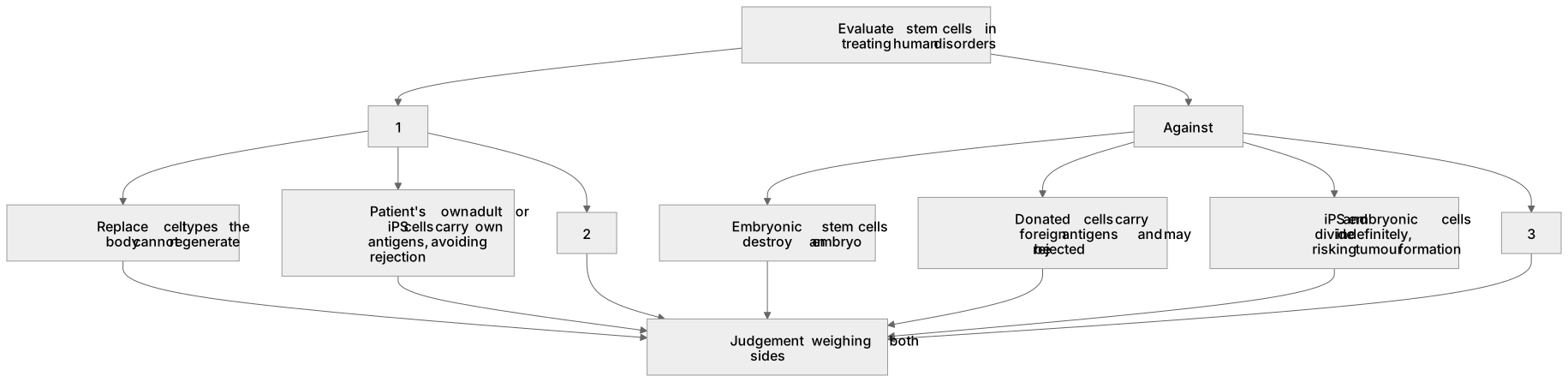
1Box 1
2Box 2
3Box 3
There is more to this lesson
The full lesson goes on to check your understanding and help you earn the marks. Create a free account to carry on, with your progress saved.
A week of Premium from your first lesson · Then the free plan continues · No card, no charge
Test your understanding of Most of a cell’s DNA is not translated (A-level only): Students should be able to evaluate the use of stem cells in treating human disorders.
Active recall beats re-reading. Take an instant quiz now to test what you’ve learned and lock it into long-term memory.
A week of Premium from your first lesson · Then the free plan continues · No card, no charge