AQA · A-Level · Biology
Course version: 7402 · Version from Sept 2016
Induced pluripotent stem cells (iPS cells) can be produced from adult…
Full specification wording
Most of a cell’s DNA is not translated (A-level only): Induced pluripotent stem cells (iPS cells) can be produced from adult somatic cells using appropriate protein transcription factors.
Induced pluripotent stem cells (iPS cells) are not ordinary body cells: they are pluripotent cells produced by reprogramming adult somatic cells, typically skin fibroblasts.
Checked against the AQA 7402 specification (opens in a new tab) on .
- Point 7 of 8
- 4 key terms
Study notes
From the checked teaching notes for this specification point.
The idea
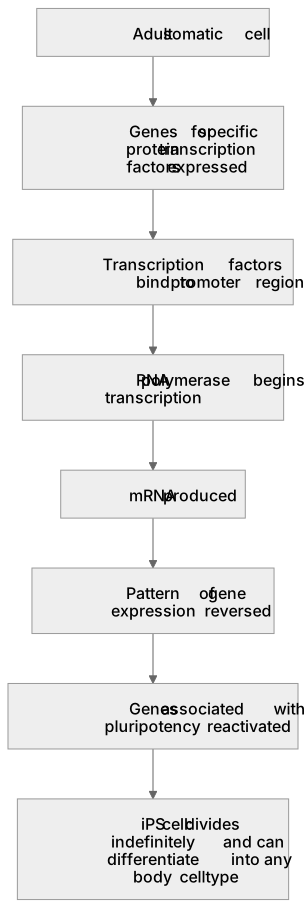
Induced pluripotent stem cells (iPS cells) are not ordinary body cells: they are pluripotent cells produced by reprogramming adult somatic cells, typically skin fibroblasts. The somatic cell is made to express a small set of genes coding for specific protein transcription factors, often delivered by a modified virus acting as a vector. A transcription factor is a protein that binds to the promoter region of a gene, allowing RNA polymerase to begin transcription; without the necessary transcription factors the gene is not transcribed and no mRNA is produced, so that protein cannot be made. Switching on this set of genes reverses the pattern of gene expression that made the cell specialised, reactivating genes associated with pluripotency, so the cell can divide indefinitely and differentiate into any type of body cell.
What earns the marks
- iPS cells are produced from adult somatic or body cells.
- Specific protein transcription factors are introduced or expressed, often using a viral vector.
- Transcription factors bind to the promoter region so that RNA polymerase can transcribe the gene into mRNA.
- The reprogrammed cell then behaves like an embryonic pluripotent cell, dividing indefinitely and able to form any body cell type.
- An advantage, such as the cells carrying the patient's own antigens so there is no immune rejection, or no embryo being destroyed.
Common mistakes and how to put them right
Stating that iPS cells are taken from embryos.
Describing transcription factors as enzymes that build mRNA, when RNA polymerase does that and the factor allows it to bind.
Calling iPS cells totipotent.
Claiming iPS treatment is risk free, when incomplete reprogramming and tumour formation are genuine concerns.
Confusing transcription factors with growth factors or with hormones.
Exam tips
- Say what a transcription factor does mechanically before saying what it achieves; the mechanism carries the mark.
- When comparing iPS cells with embryonic stem cells, make one point about immune rejection and one about ethics.
- Use somatic cell or body cell rather than normal cell.
Try the lesson
The start of the Most of a cell’s DNA is not translated (A-level only): Induced pluripotent stem cells (iPS cells) can be produced from adult somatic cells using appropriate protein transcription factors. lesson, made from checked teaching notes for this specification point.
Have a go first
Which type of cell is used as the starting material to produce induced pluripotent stem cells (iPS cells)?
Listen
Induced pluripotent stem cells (iPS cells) are not ordinary body cells: they are pluripotent cells produced by reprogramming adult somatic cells, typically skin fibroblasts. The somatic cell is made to express a small set of genes coding for specific protein transcription factors, often delivered by a modified virus acting as a vector. A transcription factor is a protein that binds to the promoter region of a gene, allowing RNA polymerase to begin transcription; without the necessary transcription factors the gene is not transcribed and no mRNA is produced, so that protein cannot be made. Switching on this set of genes reverses the pattern of gene expression that made the cell specialised, reactivating genes associated with pluripotency, so the cell can divide indefinitely and differentiate into any type of body cell. A strong answer earns marks for these points. iPS cells are produced from adult somatic or body cells. Specific protein transcription factors are introduced or expressed, often using a viral vector. Transcription factors bind to the promoter region so that RNA polymerase can transcribe the gene into mRNA. The reprogrammed cell then behaves like an embryonic pluripotent cell, dividing indefinitely and able to form any body cell type. Exam tip: Say what a transcription factor does mechanically before saying what it achieves; the mechanism carries the mark.
See it
Put it in order
Put these steps in the order they happen.
- 1. mRNA produced
- 2. iPS cell: divides indefinitely and can differentiate into any body cell type
- 3. Pattern of gene expression reversed
- 4. Adult somatic cell
- 5. Genes for specific protein transcription factors expressed
- 6. Genes associated with pluripotency reactivated
- 7. Transcription factors bind to promoter region
- 8. RNA polymerase begins transcription
Key words
Say what each word means before you turn the card.
induced pluripotency
Try answering aloud or in your head before turning the card.
somatic cells
Try answering aloud or in your head before turning the card.
transcription factors
Try answering aloud or in your head before turning the card.
promoter region
Try answering aloud or in your head before turning the card.
See every definition
- induced pluripotency
- The reversal of the pattern of gene expression that made a cell specialised, reactivating genes associated with pluripotency so the cell can divide indefinitely and differentiate into any type of body cell.
- somatic cells
- Adult body cells, typically skin fibroblasts, from which iPS cells can be produced using appropriate protein transcription factors.
- transcription factors
- Proteins that bind to the promoter region of a gene, allowing RNA polymerase to begin transcription.
- promoter region
- The part of a gene that a transcription factor binds to, allowing RNA polymerase to begin transcription.
Label the diagram
Some boxes have lost their names. Pick the right name for each number.
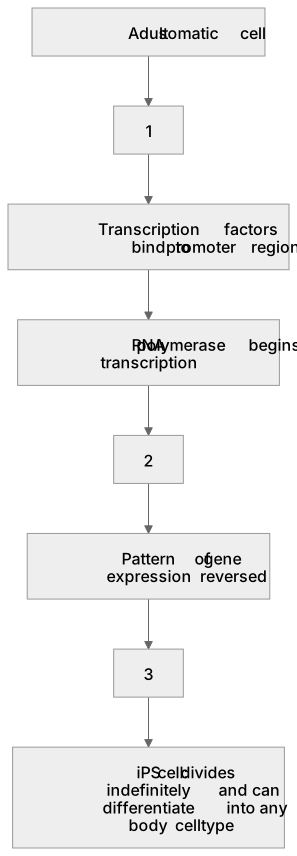
1Box 1
2Box 2
3Box 3
There is more to this lesson
The full lesson goes on to check your understanding and help you earn the marks. Create a free account to carry on, with your progress saved.
A week of Premium from your first lesson · Then the free plan continues · No card, no charge
Test your understanding of Most of a cell’s DNA is not translated (A-level only): Induced pluripotent stem cells (iPS cells) can be produced from adult somatic cells using appropriate protein transcription factors.
Active recall beats re-reading. Take an instant quiz now to test what you’ve learned and lock it into long-term memory.
A week of Premium from your first lesson · Then the free plan continues · No card, no charge