AQA · A-Level · Biology
Course version: 7402 · Version from Sept 2016
Microorganisms play a vital role in recycling chemical elements such as…
Full specification wording
Nutrient cycles (A-level only): Microorganisms play a vital role in recycling chemical elements such as phosphorus and nitrogen.
Soil microorganisms recycle nitrogen and phosphorus.
Checked against the AQA 7402 specification (opens in a new tab) on .
- Point 2 of 7
- 4 key terms
Study notes
From the checked teaching notes for this specification point.
The idea
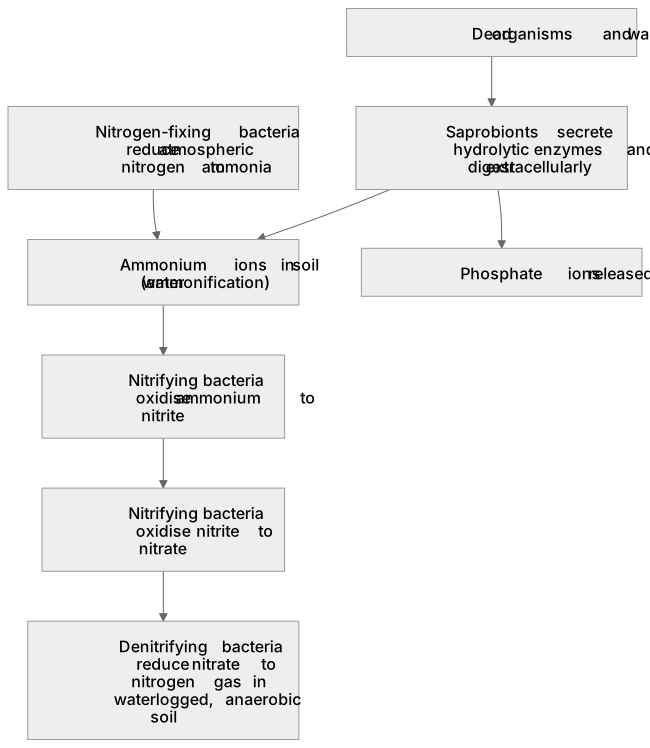
Soil microorganisms recycle nitrogen and phosphorus. Saprobionts (saprobiotic bacteria and fungi) secrete hydrolytic enzymes onto dead organisms and waste, digest the material extracellularly and absorb the products, releasing ammonia that forms ammonium ions in soil water (ammonification). Nitrifying bacteria oxidise ammonium to nitrite and nitrite to nitrate, using the released energy; these oxidations need well-aerated soil. Nitrogen-fixing bacteria, free-living or mutualistic in legume root nodules, reduce atmospheric nitrogen to ammonia using nitrogenase and ATP. Denitrifying bacteria reduce nitrate to nitrogen gas in waterlogged, anaerobic soil. Saprobionts also release phosphate ions from dead matter. In a valid experiment, sterilising soil removes other microorganisms so the test organism is the only variable changed.
What earns the marks
- Naming a functional group of soil microorganism, such as saprobionts, nitrogen-fixing, nitrifying or denitrifying bacteria, and stating the conversion it carries out.
- Describing saprobionts digesting dead material extracellularly using secreted hydrolytic enzymes and absorbing the products, releasing ammonium and phosphate ions.
- Identifying the release of a named inorganic ion, such as ammonium, nitrite, nitrate or phosphate, and linking it to the correct process.
- Explaining that sterilising soil kills or removes other microorganisms, so the test organism is the only variable changed and any ions released can be attributed to it.
- Explaining that sterilising soil removes the microorganisms that release mineral ions, so plants in sterile, un-inoculated soil show reduced growth.
- Distinguishing the four nitrogen-cycle processes by their substrate and product: ammonification, nitrification, nitrogen fixation and denitrification.
Common mistakes and how to put them right
Writing that decomposers 'break things down' with no mention of extracellular enzymes or absorption.
Put it right: State that saprobionts secrete hydrolytic enzymes, digest material outside the cell and absorb the soluble products.
Treating nitrifying and nitrogen-fixing bacteria as the same organisms doing the same job.
Put it right: Nitrifying bacteria oxidise ammonium to nitrite then nitrate; nitrogen-fixing bacteria reduce atmospheric nitrogen to ammonia.
Saying sterilising soil removes 'harmful bacteria', which is not enough without a named group or role.
Put it right: State that sterilisation removes other microorganisms so the test organism is the only variable changed.
Assuming microorganisms affect only nitrogen, when they release phosphate from dead material too.
Put it right: Saprobionts also release phosphate ions from dead matter.
Describing the microorganisms as making food for the plant rather than releasing mineral ions.
Put it right: They release inorganic ions such as ammonium, nitrate and phosphate, which plants absorb.
Exam tips
- In experiments using sterilised soil, the control mark is for removing other fungi and bacteria so the test organism is the only variable changed; the test organism itself is the independent variable.
- Learn the four nitrogen-cycle processes with the ion at each end: ammonification, nitrification, nitrogen fixation, denitrification.
- Species names are never required, but the role and the ion always are.
Try the lesson
The start of the Nutrient cycles (A-level only): Microorganisms play a vital role in recycling chemical elements such as phosphorus and nitrogen. lesson, made from checked teaching notes for this specification point.
Have a go first
Which group of microorganisms converts ammonium compounds in the soil into nitrite ions?
Listen
Soil microorganisms recycle nitrogen and phosphorus. Saprobionts (saprobiotic bacteria and fungi) secrete hydrolytic enzymes onto dead organisms and waste, digest the material extracellularly and absorb the products, releasing ammonia that forms ammonium ions in soil water (ammonification). Nitrifying bacteria oxidise ammonium to nitrite and nitrite to nitrate, using the released energy; these oxidations need well-aerated soil. Nitrogen-fixing bacteria, free-living or mutualistic in legume root nodules, reduce atmospheric nitrogen to ammonia using nitrogenase and ATP. Denitrifying bacteria reduce nitrate to nitrogen gas in waterlogged, anaerobic soil. Saprobionts also release phosphate ions from dead matter. In a valid experiment, sterilising soil removes other microorganisms so the test organism is the only variable changed. A strong answer earns marks for these points. Naming a functional group of soil microorganism, such as saprobionts, nitrogen-fixing, nitrifying or denitrifying bacteria, and stating the conversion it carries out. Describing saprobionts digesting dead material extracellularly using secreted hydrolytic enzymes and absorbing the products, releasing ammonium and phosphate ions. Identifying the release of a named inorganic ion, such as ammonium, nitrite, nitrate or phosphate, and linking it to the correct process. Explaining that sterilising soil kills or removes other microorganisms, so the test organism is the only variable changed and any ions released can be attributed to it. A common slip: Writing that decomposers 'break things down' with no mention of extracellular enzymes or absorption. Instead, state that saprobionts secrete hydrolytic enzymes, digest material outside the cell and absorb the soluble products. Exam tip: In experiments using sterilised soil, the control mark is for removing other fungi and bacteria so the test organism is the only variable changed; the test organism itself is the independent variable.
See it
Key words
Say what each word means before you turn the card.
saprobionts
Try answering aloud or in your head before turning the card.
nitrifying bacteria
Try answering aloud or in your head before turning the card.
nitrogen-fixing bacteria
Try answering aloud or in your head before turning the card.
extracellular digestion
Try answering aloud or in your head before turning the card.
See every definition
- saprobionts
- Saprobiotic bacteria and fungi that secrete hydrolytic enzymes onto dead organisms and waste, digest the material extracellularly and absorb the products.
- nitrifying bacteria
- Organisms that oxidise ammonium to nitrite and nitrite to nitrate, using the released energy, in a process needing well-aerated soil.
- nitrogen-fixing bacteria
- Free-living or mutualistic bacteria in legume root nodules that reduce atmospheric nitrogen to ammonia using nitrogenase and ATP.
- extracellular digestion
- Digestion of dead organisms and waste outside the cell, carried out by hydrolytic enzymes secreted by saprobionts, whose products are then absorbed.
Label the diagram
Some boxes have lost their names. Pick the right name for each number.
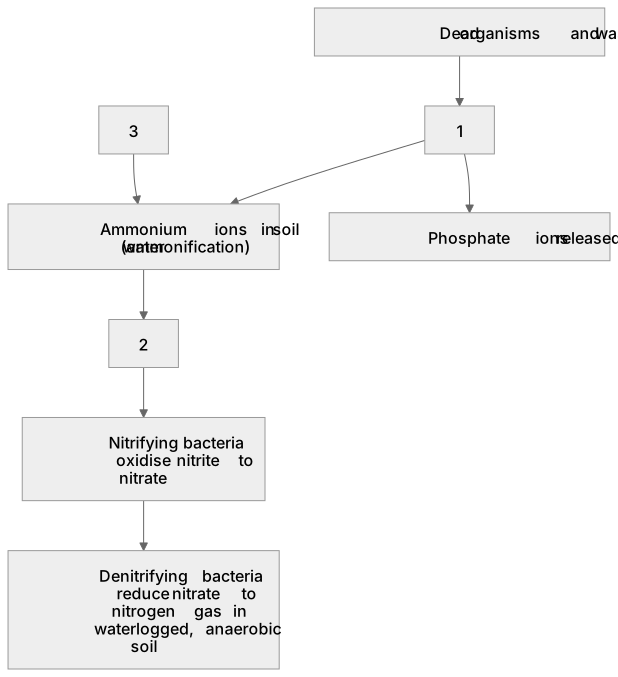
1Box 1
2Box 2
3Box 3
There is more to this lesson
The full lesson goes on to check your understanding and help you earn the marks. Create a free account to carry on, with your progress saved.
A week of Premium from your first lesson · Then the free plan continues · No card, no charge
Test your understanding of Nutrient cycles (A-level only): Microorganisms play a vital role in recycling chemical elements such as phosphorus and nitrogen.
Active recall beats re-reading. Take an instant quiz now to test what you’ve learned and lock it into long-term memory.
A week of Premium from your first lesson · Then the free plan continues · No card, no charge