AQA · A-Level · Biology
Course version: 7402 · Version from Sept 2016
Nutrients are recycled within natural ecosystems, exemplified by the…
Full specification wording
Nutrient cycles (A-level only): Nutrients are recycled within natural ecosystems, exemplified by the nitrogen cycle and the phosphorus cycle.
Nutrients are recycled within ecosystems, whereas energy flows through and is lost.
Checked against the AQA 7402 specification (opens in a new tab) on .
- Point 1 of 7
- 4 key terms
Study notes
From the checked teaching notes for this specification point.
The idea
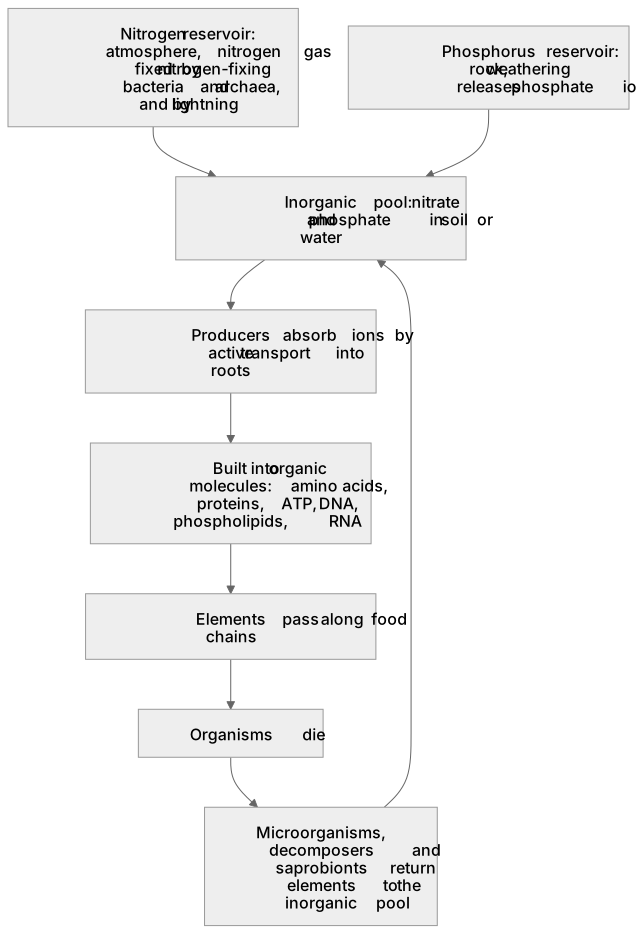
Nutrients are recycled within ecosystems, whereas energy flows through and is lost. Nitrogen and phosphorus follow this pattern: producers absorb inorganic ions from soil or water, building them into organic molecules. Elements pass along food chains, and microorganisms return them to the inorganic pool when organisms die. Nitrogen enters mainly as nitrate, absorbed by active transport into roots, and is used to make amino acids, proteins, ATP and DNA. It has a vast atmospheric reservoir of nitrogen gas, fixed mainly by nitrogen-fixing bacteria and archaea, though lightning also contributes. Phosphorus has no significant gaseous stage; its reservoir is rock, which weathers to release phosphate ions into soil water. Phosphate is needed for phospholipids, ATP, DNA and RNA.
What earns the marks
- Explaining that nutrients are recycled whereas energy flows through and is lost.
- Identifying that producers absorb the nutrient as a named inorganic ion, such as nitrate or phosphate.
- Naming an organic molecule the element is built into, such as protein, DNA or ATP.
- Describing how decomposers or saprobionts return the element to the inorganic pool.
- Identifying the reservoir, such as the atmosphere for nitrogen and rock for phosphorus.
Common mistakes and how to put them right
Saying energy is recycled, when only matter is recycled and energy flows through the ecosystem.
Claiming plants absorb nitrogen gas from the air, which is actually fixed by nitrogen-fixing microorganisms or lightning.
Giving phosphorus an atmospheric stage, when its reservoir is rock and sediment.
Naming only proteins as the use of nitrogen, forgetting nucleotides, ATP and chlorophyll.
Describing uptake as diffusion when nitrate and phosphate enter root cells by active transport.
Exam tips
- Nutrient cycles appear on the published list of topics for the 'importance of cycles in biology' essay, so keep a labelled diagram of each in your notes.
- Name the ion, not the element: nitrate and phosphate, absorbed by active transport.
- When asked why a mineral is needed, answer with molecules and then a consequence, for example nitrate to amino acids to enzymes to growth.
Try the lesson
The start of the Nutrient cycles (A-level only): Nutrients are recycled within natural ecosystems, exemplified by the nitrogen cycle and the phosphorus cycle. lesson, made from checked teaching notes for this specification point.
Have a go first
In a natural ecosystem, why are nutrients such as nitrogen and phosphorus described as being recycled?
Listen
Nutrients are recycled within ecosystems, whereas energy flows through and is lost. Nitrogen and phosphorus follow this pattern: producers absorb inorganic ions from soil or water, building them into organic molecules. Elements pass along food chains, and microorganisms return them to the inorganic pool when organisms die. Nitrogen enters mainly as nitrate, absorbed by active transport into roots, and is used to make amino acids, proteins, ATP and DNA. It has a vast atmospheric reservoir of nitrogen gas, fixed mainly by nitrogen-fixing bacteria and archaea, though lightning also contributes. Phosphorus has no significant gaseous stage; its reservoir is rock, which weathers to release phosphate ions into soil water. Phosphate is needed for phospholipids, ATP, DNA and RNA. A strong answer earns marks for these points. Explaining that nutrients are recycled whereas energy flows through and is lost. Identifying that producers absorb the nutrient as a named inorganic ion, such as nitrate or phosphate. Naming an organic molecule the element is built into, such as protein, DNA or ATP. Describing how decomposers or saprobionts return the element to the inorganic pool. Exam tip: Nutrient cycles appear on the published list of topics for the 'importance of cycles in biology' essay, so keep a labelled diagram of each in your notes.
See it
Key words
Say what each word means before you turn the card.
nutrient recycling
Try answering aloud or in your head before turning the card.
energy flows and matter cycles
Try answering aloud or in your head before turning the card.
nitrate and phosphate uptake
Try answering aloud or in your head before turning the card.
decomposers
Try answering aloud or in your head before turning the card.
See every definition
- nutrient recycling
- Nutrients are recycled within natural ecosystems, as shown by the nitrogen cycle and the phosphorus cycle.
- energy flows and matter cycles
- Nutrients are recycled within ecosystems, whereas energy flows through and is lost.
- nitrate and phosphate uptake
- Nitrate and phosphate enter root cells by active transport, and producers absorb these inorganic ions from soil or water.
- decomposers
- Microorganisms return elements to the inorganic pool when organisms die.
Label the diagram
Some boxes have lost their names. Pick the right name for each number.
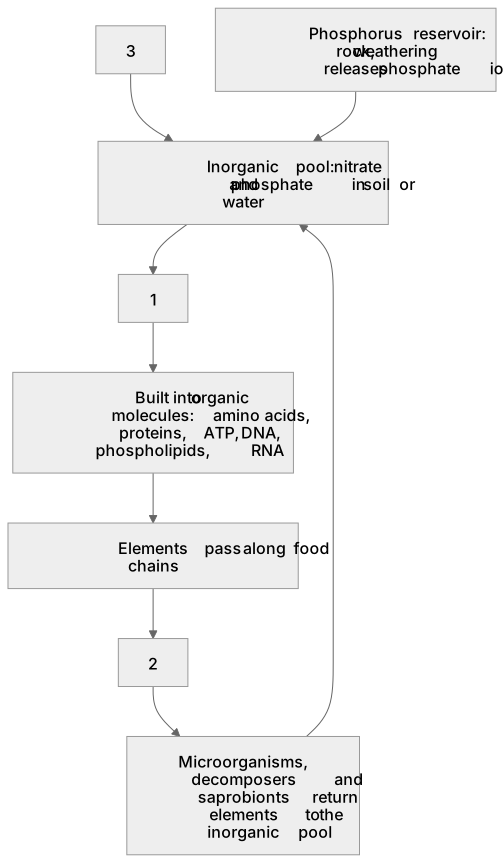
1Box 1
2Box 2
3Box 3
There is more to this lesson
The full lesson goes on to check your understanding and help you earn the marks. Create a free account to carry on, with your progress saved.
A week of Premium from your first lesson · Then the free plan continues · No card, no charge
Test your understanding of Nutrient cycles (A-level only): Nutrients are recycled within natural ecosystems, exemplified by the nitrogen cycle and the phosphorus cycle.
Active recall beats re-reading. Take an instant quiz now to test what you’ve learned and lock it into long-term memory.
A week of Premium from your first lesson · Then the free plan continues · No card, no charge