AQA · A-Level · Biology
Course version: 7402 · Version from Sept 2016
The environmental issues arising from the use of fertilisers including…
Full specification wording
Nutrient cycles (A-level only): The environmental issues arising from the use of fertilisers including leaching and eutrophication.
Leaching is the washing of soluble ions down through the soil by rain or irrigation water, and it matters most for nitrate: every nitrate salt is soluble and nothing in the soil binds it, so it…
Checked against the AQA 7402 specification (opens in a new tab) on .
- Point 7 of 7
- 3 key terms
Study notes
From the checked teaching notes for this specification point.
The idea
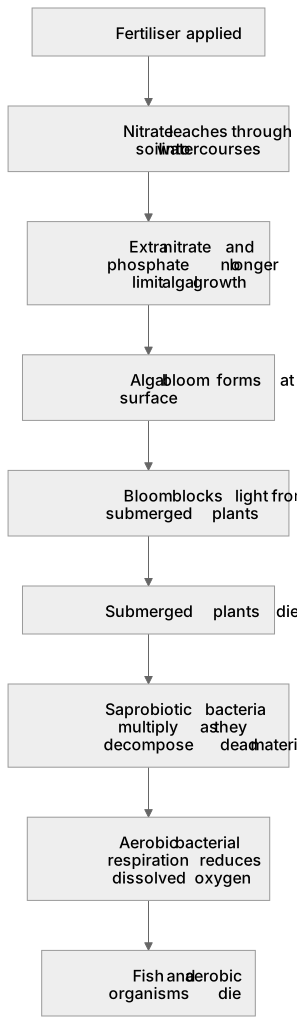
Leaching is the washing of soluble ions down through the soil by rain or irrigation water, and it matters most for nitrate: every nitrate salt is soluble and nothing in the soil binds it, so it moves with the drainage water. Phosphate is an anion too, so repulsion by the negatively charged clay cannot be the difference; phosphate is fixed in place by adsorption onto, and precipitation with, iron, aluminium and calcium compounds, so it reaches water mainly on eroded soil in run-off. Leached nitrate reaches groundwater and then rivers and lakes, where it fertilises the water. Eutrophication then follows a fixed sequence. The extra nitrate and phosphate remove the limiting factor on algal growth, so algae multiply rapidly and form a surface bloom. The bloom blocks light from reaching submerged plants, which die.
What earns the marks
- Leaching as the washing of soluble nitrate through the soil into watercourses.
- The extra nitrate or phosphate no longer limiting algal growth, so an algal bloom forms.
- The bloom blocking light so that submerged plants die.
- Saprobiotic bacteria multiplying as they decompose the dead material.
- Aerobic bacterial respiration reducing dissolved oxygen, so fish and aerobic organisms die.
Common mistakes and how to put them right
Writing about leaching and eutrophication in questions about controlling a variable, where examiners explicitly ignore them.
Saying the algae use up all the oxygen, when the oxygen is consumed by the decomposing bacteria.
Leaving out the light-blocking step, so there is no reason given for the plants dying.
Confusing leaching with surface run-off.
Put it right: Leaching is downward movement through the soil.
Claiming eutrophication is caused only by nitrate, ignoring phosphate from fertiliser and sewage.
Exam tips
- Write eutrophication as a chain of cause and effect with at least five links; a list of terms scores poorly.
- Name the organisms doing the respiring as aerobic saprobiotic bacteria, not the algae.
- If a question is about experimental design rather than pollution, resist writing about eutrophication because it earns nothing there.
Try the lesson
The start of the Nutrient cycles (A-level only): The environmental issues arising from the use of fertilisers including leaching and eutrophication. lesson, made from checked teaching notes for this specification point.
Have a go first
What is meant by leaching of nitrate ions from soil?
Listen
Leaching is the washing of soluble ions down through the soil by rain or irrigation water, and it matters most for nitrate: every nitrate salt is soluble and nothing in the soil binds it, so it moves with the drainage water. Phosphate is an anion too, so repulsion by the negatively charged clay cannot be the difference; phosphate is fixed in place by adsorption onto, and precipitation with, iron, aluminium and calcium compounds, so it reaches water mainly on eroded soil in run-off. Leached nitrate reaches groundwater and then rivers and lakes, where it fertilises the water. Eutrophication then follows a fixed sequence. The extra nitrate and phosphate remove the limiting factor on algal growth, so algae multiply rapidly and form a surface bloom. The bloom blocks light from reaching submerged plants, which die. A strong answer earns marks for these points. leaching as the washing of soluble nitrate through the soil into watercourses. the extra nitrate or phosphate no longer limiting algal growth, so an algal bloom forms. the bloom blocking light so that submerged plants die. saprobiotic bacteria multiplying as they decompose the dead material. Exam tip: Write eutrophication as a chain of cause and effect with at least five links; a list of terms scores poorly.
See it
Key words
Say what each word means before you turn the card.
leaching
Try answering aloud or in your head before turning the card.
eutrophication
Try answering aloud or in your head before turning the card.
algal bloom
Try answering aloud or in your head before turning the card.
See every definition
- leaching
- The washing of soluble ions down through the soil by rain or irrigation water, mattering most for nitrate because every nitrate salt is soluble and nothing in the soil binds it.
- eutrophication
- A fixed sequence following the arrival of leached nitrate in rivers and lakes, where the extra nitrate and phosphate fertilise the water.
- algal bloom
- A surface bloom formed when the extra nitrate and phosphate remove the limiting factor on algal growth, so algae multiply rapidly.
Label the diagram
Some boxes have lost their names. Pick the right name for each number.
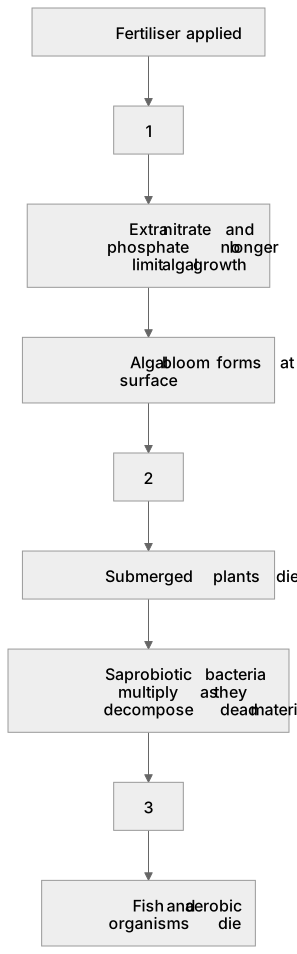
1Box 1
2Box 2
3Box 3
There is more to this lesson
The full lesson goes on to check your understanding and help you earn the marks. Create a free account to carry on, with your progress saved.
A week of Premium from your first lesson · Then the free plan continues · No card, no charge
Test your understanding of Nutrient cycles (A-level only): The environmental issues arising from the use of fertilisers including leaching and eutrophication.
Active recall beats re-reading. Take an instant quiz now to test what you’ve learned and lock it into long-term memory.
A week of Premium from your first lesson · Then the free plan continues · No card, no charge