AQA · A-Level · Biology
Course version: 7402 · Version from Sept 2016
The use of natural and artificial fertilisers to replace the nitrates and…
Full specification wording
Nutrient cycles (A-level only): The use of natural and artificial fertilisers to replace the nitrates and phosphates lost by harvesting plants and removing livestock.
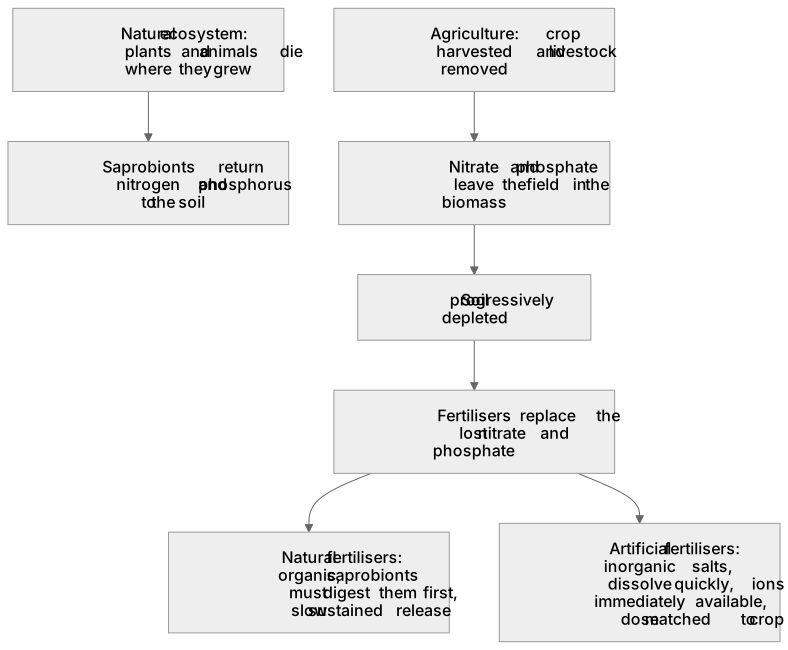
In a natural ecosystem, plants and animals die where they grew, so saprobionts return their nitrogen and phosphorus to the soil.
Checked against the AQA 7402 specification (opens in a new tab) on .
- Point 6 of 7
- 4 key terms
Study notes
From the checked teaching notes for this specification point.
The idea
In a natural ecosystem, plants and animals die where they grew, so saprobionts return their nitrogen and phosphorus to the soil. Agriculture breaks that loop: the crop is harvested and the livestock are walked off the field, so the nitrate and phosphate locked in that biomass leave with them and the soil is progressively depleted. Fertilisers replace it. Natural fertilisers are organic, including manure, slurry, compost and bone meal, and the ions they contain are not immediately available because saprobionts must first digest the organic matter and release them; release is therefore slow and sustained, and the organic matter also improves soil structure and water retention. Artificial fertilisers are inorganic salts of known composition that dissolve quickly, so the ions are immediately available and the dose can be matched precisely to the crop.
What earns the marks
- The idea that harvesting a crop or removing livestock takes ions out of the field inside the biomass.
- Fertilisers replacing the nitrate and phosphate lost.
- A named use of the ion, such as nitrate for amino acids and proteins, or phosphate for ATP, DNA and phospholipids.
- A valid difference between natural and artificial fertilisers, such as rate of release or precision of composition.
- Stating that fertiliser must be kept constant as a controlled variable in a growth experiment.
Common mistakes and how to put them right
Saying fertiliser feeds the plant, as though it were a food rather than a source of mineral ions.
Claiming natural fertiliser acts immediately, when saprobionts must decompose it first.
Explaining only nitrate and ignoring phosphate, which the specification names alongside it.
Answering that fertiliser increases photosynthesis without saying which molecule the ion is needed for.
Assuming more fertiliser always means more yield, when uptake saturates and surplus is leached.
Exam tips
- Answer 'why does a crop need nitrate' with molecules first, amino acids, proteins, nucleotides, ATP and chlorophyll, then growth.
- Comparison questions need a stated difference on both sides, for example organic releases ions slowly whereas inorganic dissolves at once.
- In experiments, say the fertiliser is kept the same so that it is not a second variable affecting growth.
Try the lesson
The start of the Nutrient cycles (A-level only): The use of natural and artificial fertilisers to replace the nitrates and phosphates lost by harvesting plants and removing livestock. lesson, made from checked teaching notes for this specification point.
Have a go first
Why are fertilisers applied to farmland after crops have been harvested?
Listen
In a natural ecosystem, plants and animals die where they grew, so saprobionts return their nitrogen and phosphorus to the soil. Agriculture breaks that loop: the crop is harvested and the livestock are walked off the field, so the nitrate and phosphate locked in that biomass leave with them and the soil is progressively depleted. Fertilisers replace it. Natural fertilisers are organic, including manure, slurry, compost and bone meal, and the ions they contain are not immediately available because saprobionts must first digest the organic matter and release them; release is therefore slow and sustained, and the organic matter also improves soil structure and water retention. Artificial fertilisers are inorganic salts of known composition that dissolve quickly, so the ions are immediately available and the dose can be matched precisely to the crop. A strong answer earns marks for these points. the idea that harvesting a crop or removing livestock takes ions out of the field inside the biomass. fertilisers replacing the nitrate and phosphate lost. a named use of the ion, such as nitrate for amino acids and proteins, or phosphate for ATP, DNA and phospholipids. a valid difference between natural and artificial fertilisers, such as rate of release or precision of composition. Exam tip: Answer 'why does a crop need nitrate' with molecules first, amino acids, proteins, nucleotides, ATP and chlorophyll, then growth.
See it
Key words
Say what each word means before you turn the card.
natural fertilisers
Try answering aloud or in your head before turning the card.
artificial fertilisers
Try answering aloud or in your head before turning the card.
ion availability
Try answering aloud or in your head before turning the card.
soil structure
Try answering aloud or in your head before turning the card.
See every definition
- natural fertilisers
- Organic materials such as manure, slurry, compost and bone meal whose ions are not immediately available because saprobionts must first digest the organic matter and release them.
- artificial fertilisers
- Inorganic salts of known composition that dissolve quickly, so the ions are immediately available and the dose can be matched precisely to the crop.
- ion availability
- Whether the ions a fertiliser contains can be taken up at once, which is slow and sustained for organic matter but immediate for inorganic salts.
- soil structure
- A property improved by the organic matter in natural fertilisers, along with water retention.
Label the diagram
Some boxes have lost their names. Pick the right name for each number.
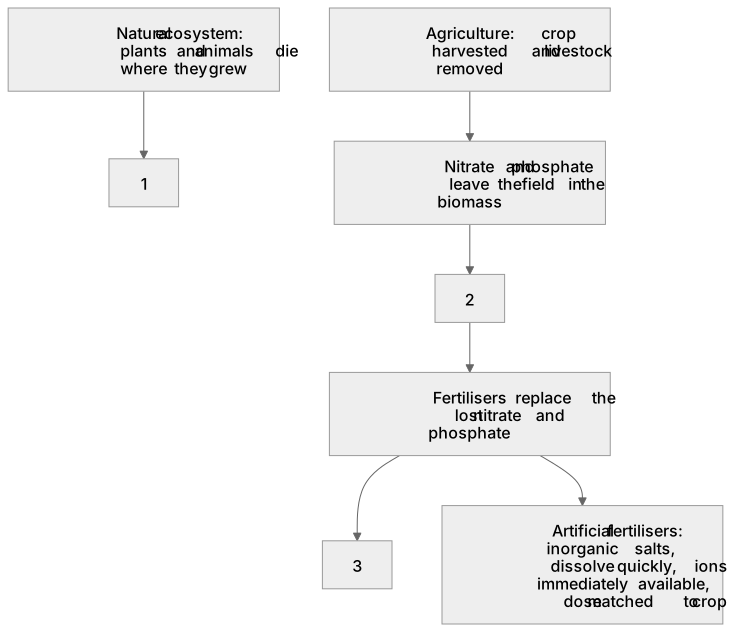
1Box 1
2Box 2
3Box 3
There is more to this lesson
The full lesson goes on to check your understanding and help you earn the marks. Create a free account to carry on, with your progress saved.
A week of Premium from your first lesson · Then the free plan continues · No card, no charge
Test your understanding of Nutrient cycles (A-level only): The use of natural and artificial fertilisers to replace the nitrates and phosphates lost by harvesting plants and removing livestock.
Active recall beats re-reading. Take an instant quiz now to test what you’ve learned and lock it into long-term memory.
A week of Premium from your first lesson · Then the free plan continues · No card, no charge