AQA · A-Level · Biology
Course version: 7402 · Version from Sept 2016
The role of bacteria in the nitrogen cycle in sufficient detail to…
Full specification wording
Nutrient cycles (A-level only): The role of bacteria in the nitrogen cycle in sufficient detail to illustrate the processes of saprobiotic nutrition, ammonification, nitrification, nitrogen fixation and denitrification.
The nitrogen cycle involves five key processes.
Checked against the AQA 7402 specification (opens in a new tab) on .
- Point 5 of 7
- 4 key terms
Study notes
From the checked teaching notes for this specification point.
The idea
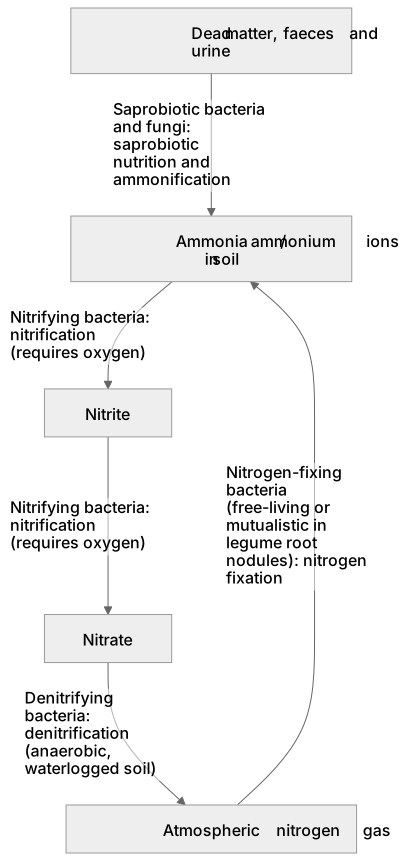
The nitrogen cycle involves five key processes. Saprobiotic nutrition and ammonification are performed by saprobiotic bacteria and fungi, which secrete enzymes onto dead matter and waste, releasing nitrogen as ammonia that forms ammonium ions in soil. Nitrification involves nitrifying bacteria oxidising ammonium to nitrite, then to nitrate. This requires oxygen, so it stops in waterlogged soil. Nitrogen fixation uses nitrogen-fixing bacteria (free-living or mutualistic in legume root nodules) to reduce atmospheric nitrogen gas to ammonia. Finally, denitrification occurs in anaerobic, waterlogged soils where denitrifying bacteria reduce soil nitrates into nitrogen gas, returning it to the atmosphere and reducing soil fertility.
What earns the marks
- Ammonification as the release of ammonia or ammonium ions from dead material, faeces and urine.
- Nitrification as ammonium to nitrite and nitrite to nitrate by nitrifying bacteria.
- Nitrogen fixation as the reduction of atmospheric nitrogen to ammonia.
- Denitrification as the reduction of nitrate to nitrogen gas under anaerobic conditions.
- Linking aeration of the soil to more nitrification and less denitrification.
Common mistakes and how to put them right
Swapping nitrification and nitrogen fixation, which are different processes carried out by different bacteria.
Writing that nitrifying bacteria convert ammonium straight to nitrate, missing the nitrite intermediate.
Placing denitrification in aerobic conditions, when it occurs in waterlogged, anaerobic soil.
Exam tips
- Draw the cycle as a loop of ions, nitrogen gas to ammonium to nitrite to nitrate and back to nitrogen gas, and label the bacteria on each arrow.
- Anything that waterlogs soil favours denitrification and blocks nitrification; say so explicitly when explaining a poor yield.
Try the lesson
The start of the Nutrient cycles (A-level only): The role of bacteria in the nitrogen cycle in sufficient detail to illustrate the processes of saprobiotic nutrition, ammonification, nitrification, nitrogen fixation and denitrification. lesson, made from checked teaching notes for this specification point.
Have a go first
Which process carried out by bacteria converts nitrogen gas in the atmosphere into a form that plants can absorb?
Listen
The nitrogen cycle involves five key processes. Saprobiotic nutrition and ammonification are performed by saprobiotic bacteria and fungi, which secrete enzymes onto dead matter and waste, releasing nitrogen as ammonia that forms ammonium ions in soil. Nitrification involves nitrifying bacteria oxidising ammonium to nitrite, then to nitrate. This requires oxygen, so it stops in waterlogged soil. Nitrogen fixation uses nitrogen-fixing bacteria (free-living or mutualistic in legume root nodules) to reduce atmospheric nitrogen gas to ammonia. Finally, denitrification occurs in anaerobic, waterlogged soils where denitrifying bacteria reduce soil nitrates into nitrogen gas, returning it to the atmosphere and reducing soil fertility. A strong answer earns marks for these points. ammonification as the release of ammonia or ammonium ions from dead material, faeces and urine. nitrification as ammonium to nitrite and nitrite to nitrate by nitrifying bacteria. nitrogen fixation as the reduction of atmospheric nitrogen to ammonia. denitrification as the reduction of nitrate to nitrogen gas under anaerobic conditions. Exam tip: Draw the cycle as a loop of ions, nitrogen gas to ammonium to nitrite to nitrate and back to nitrogen gas, and label the bacteria on each arrow.
See it
Key words
Say what each word means before you turn the card.
ammonification
Try answering aloud or in your head before turning the card.
nitrification
Try answering aloud or in your head before turning the card.
nitrogen fixation
Try answering aloud or in your head before turning the card.
denitrification
Try answering aloud or in your head before turning the card.
See every definition
- ammonification
- Saprobiotic bacteria and fungi secrete enzymes onto dead matter and waste, releasing nitrogen as ammonia that forms ammonium ions in soil.
- nitrification
- Nitrifying bacteria oxidise ammonium to nitrite, then to nitrate, a process requiring oxygen that stops in waterlogged soil.
- nitrogen fixation
- Nitrogen-fixing bacteria, free-living or mutualistic in legume root nodules, reduce atmospheric nitrogen gas to ammonia.
- denitrification
- In anaerobic, waterlogged soils, denitrifying bacteria reduce soil nitrates into nitrogen gas, returning it to the atmosphere and reducing soil fertility.
Label the diagram
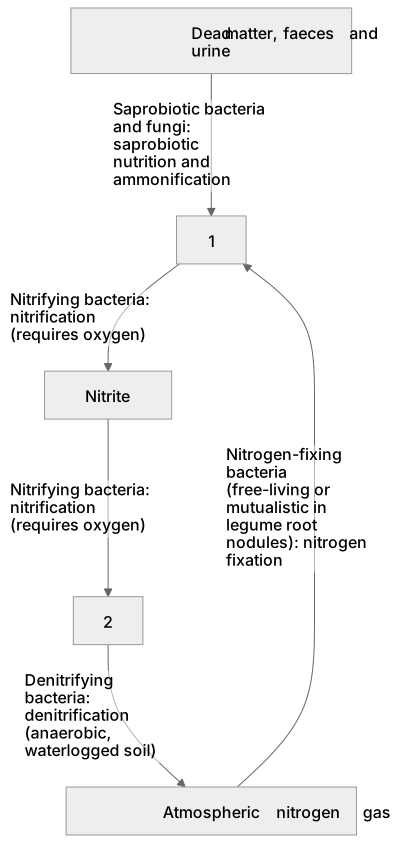
Some boxes have lost their names. Pick the right name for each number.
1Box 1
2Box 2
There is more to this lesson
The full lesson goes on to check your understanding and help you earn the marks. Create a free account to carry on, with your progress saved.
A week of Premium from your first lesson · Then the free plan continues · No card, no charge
Test your understanding of Nutrient cycles (A-level only): The role of bacteria in the nitrogen cycle in sufficient detail to illustrate the processes of saprobiotic nutrition, ammonification, nitrification, nitrogen fixation and denitrification.
Active recall beats re-reading. Take an instant quiz now to test what you’ve learned and lock it into long-term memory.
A week of Premium from your first lesson · Then the free plan continues · No card, no charge