AQA · A-Level · Biology
Course version: 7402 · Version from Sept 2016
Required practical 7: Use of chromatography to investigate the pigments…
Full specification wording
Photosynthesis (A-level only): Required practical 7: Use of chromatography to investigate the pigments isolated from leaves of different plants, eg, leaves from shade-tolerant and shade-intolerant plants or leaves of different colours.
Pigments are extracted by grinding leaf tissue (e.g., from shade-tolerant and shade-intolerant plants) with sand and a solvent.
Checked against the AQA 7402 specification (opens in a new tab) on .
- Point 6 of 7
Study notes
From the checked teaching notes for this specification point.
The idea
Pigments are extracted by grinding leaf tissue (e.g., from shade-tolerant and shade-intolerant plants) with sand and a solvent. A pencil origin line is drawn on chromatography paper. The extract is spotted repeatedly onto the origin. The paper is suspended in a closed vessel with the solvent below the origin line, preventing the spot from washing off. Pigments separate based on their solubility in the solvent and attraction to the paper; more soluble pigments travel further. The run stops before the solvent reaches the top. Rf values (distance moved by pigment divided by distance moved by solvent front) are calculated to identify and compare pigments between different plant types, revealing adaptations to varying light intensities.
What earns the marks
- Draw the origin line in pencil and apply the extract to that line, ensuring the solvent level is below the origin so the spot does not dissolve into the solvent.
- Stop the run and mark the solvent front before the solvent reaches the top of the paper.
- Explain separation: pigments have different solubilities in the mobile phase (solvent) and different affinities for the stationary phase (paper).
- Calculate the Rf value by dividing the distance moved by the centre of the pigment spot by the distance moved by the solvent front.
- Compare chromatograms from different plants (e.g., shade-tolerant vs shade-intolerant) to identify differences in pigment composition related to light adaptation.
Common mistakes and how to put them right
Drawing the origin line in ink.
Put it right: Use a pencil, as ink contains pigments that will dissolve in the solvent and contaminate the chromatogram.
Letting the solvent run off the top of the paper.
Put it right: Stop the run before the top and immediately mark the solvent front, otherwise Rf values cannot be calculated.
Failing to compare different plant types.
Put it right: Ensure the investigation explicitly compares pigments from different leaves (e.g., shade-tolerant vs shade-intolerant) to meet the practical's objective.
Explaining separation purely by 'pigment size'.
Put it right: Explain separation in terms of differing solubilities in the solvent and affinities for the paper.
Exam tips
- When comparing shade-tolerant and shade-intolerant plants, note that shade-tolerant plants often have a wider variety or higher concentration of accessory pigments to maximise light absorption.
- Measure the Rf value from the origin line to the centre of each pigment spot, ensuring you use the same units (e.g., mm) for both the pigment and solvent front distances.
Try the lesson
The start of the Photosynthesis (A-level only): Required practical 7: Use of chromatography to investigate the pigments isolated from leaves of different plants, eg, leaves from shade-tolerant and shade-intolerant plants or leaves of different colours. lesson, made from checked teaching notes for this specification point.
Have a go first
In chromatography of leaf pigments, which pigment normally travels the furthest up the chromatography paper?
Listen
Pigments are extracted by grinding leaf tissue (e.g., from shade-tolerant and shade-intolerant plants) with sand and a solvent. A pencil origin line is drawn on chromatography paper. The extract is spotted repeatedly onto the origin. The paper is suspended in a closed vessel with the solvent below the origin line, preventing the spot from washing off. Pigments separate based on their solubility in the solvent and attraction to the paper; more soluble pigments travel further. The run stops before the solvent reaches the top. Rf values (distance moved by pigment divided by distance moved by solvent front) are calculated to identify and compare pigments between different plant types, revealing adaptations to varying light intensities. A strong answer earns marks for these points. Draw the origin line in pencil and apply the extract to that line, ensuring the solvent level is below the origin so the spot does not dissolve into the solvent. Stop the run and mark the solvent front before the solvent reaches the top of the paper. Explain separation: pigments have different solubilities in the mobile phase (solvent) and different affinities for the stationary phase (paper). Calculate the Rf value by dividing the distance moved by the centre of the pigment spot by the distance moved by the solvent front. A common slip: Drawing the origin line in ink. Instead, use a pencil, as ink contains pigments that will dissolve in the solvent and contaminate the chromatogram. Exam tip: When comparing shade-tolerant and shade-intolerant plants, note that shade-tolerant plants often have a wider variety or higher concentration of accessory pigments to maximise light absorption.
See it
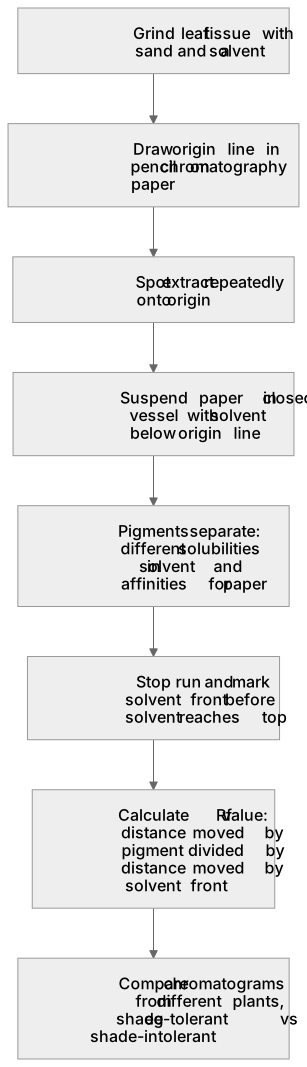
Put it in order
Put these steps in the order they happen.
- 1. Pigments separate: different solubilities in solvent and affinities for paper
- 2. Compare chromatograms from different plants, eg shade-tolerant vs shade-intolerant
- 3. Stop run and mark solvent front before solvent reaches top
- 4. Grind leaf tissue with sand and a solvent
- 5. Draw origin line in pencil on chromatography paper
- 6. Calculate Rf value: distance moved by pigment divided by distance moved by solvent front
- 7. Spot extract repeatedly onto origin
- 8. Suspend paper in closed vessel with solvent below origin line
Label the diagram
Some boxes have lost their names. Pick the right name for each number.
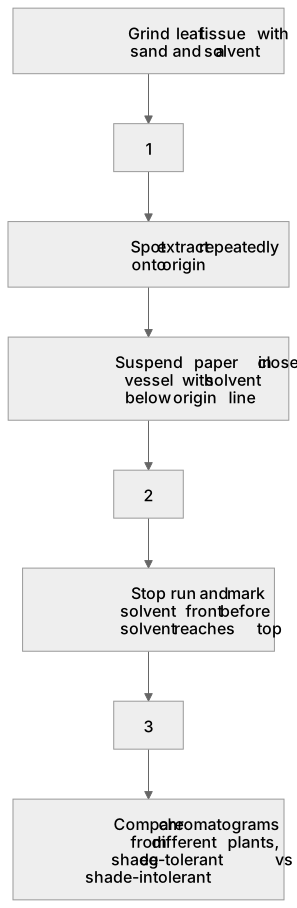
1Box 1
2Box 2
3Box 3
There is more to this lesson
The full lesson goes on to check your understanding and help you earn the marks. Create a free account to carry on, with your progress saved.
A week of Premium from your first lesson · Then the free plan continues · No card, no charge
Test your understanding of Photosynthesis (A-level only): Required practical 7: Use of chromatography to investigate the pigments isolated from leaves of different plants, eg, leaves from shade-tolerant and shade-intolerant plants or leaves of different colours.
Active recall beats re-reading. Take an instant quiz now to test what you’ve learned and lock it into long-term memory.
A week of Premium from your first lesson · Then the free plan continues · No card, no charge