AQA · A-Level · Biology
Course version: 7402 · Version from Sept 2016
Required practical 8: Investigation into the effect of a named factor on…
Full specification wording
Photosynthesis (A-level only): Required practical 8: Investigation into the effect of a named factor on the rate of dehydrogenase activity in extracts of chloroplasts.
Chloroplasts are extracted by grinding leaf tissue in ice-cold, buffered, isotonic solution, then filtering and centrifuging.
Checked against the AQA 7402 specification (opens in a new tab) on .
- Point 7 of 7
- 4 key terms
Study notes
From the checked teaching notes for this specification point.
The idea
Chloroplasts are extracted by grinding leaf tissue in ice-cold, buffered, isotonic solution, then filtering and centrifuging. Cold reduces enzyme activity and tissue damage, the buffer holds pH constant so enzymes are not denatured, and the isotonic solution prevents osmotic damage. The suspension is mixed with DCPIP, a blue dye acting as an artificial electron acceptor in place of NADP. In the light, electrons from photoionisation and photolysis reduce DCPIP, which turns from blue to colourless; the faster the colour loss, the greater the dehydrogenase activity and the faster the light-dependent reaction. Rate is the reciprocal of time to decolourise, or is calculated from colorimeter readings at set intervals. A named factor, such as light intensity or temperature, is varied while others are controlled.
What earns the marks
- Explaining why the extraction medium is ice-cold, buffered and isotonic, giving a distinct reason for each condition.
- Explaining that DCPIP acts as an artificial electron acceptor in place of NADP, and that its reduction causes the colour change from blue to colourless.
- Describing how rate is measured, either as the reciprocal of the time to decolourise or from colorimeter readings taken at set intervals.
- Naming the factor varied and describing how it is changed, for example light intensity by changing lamp distance.
- Describing a valid control, such as a tube kept in the dark, together with named controlled variables.
Common mistakes and how to put them right
Saying DCPIP is oxidised when it is being reduced, or that it changes from colourless to blue.
Put it right by stating that DCPIP is reduced and turns from blue to colourless.
Using distilled water as the extraction medium, so chloroplasts take in water and burst.
Put it right by using an isotonic solution to prevent osmotic damage.
Leaving the extract at room temperature for long periods, so enzymes and organelles are damaged before the experiment begins.
Put it right by keeping the extract ice-cold throughout.
Using a colorimeter without stating the filter or the quantity recorded, so the rate is never defined.
Put it right by naming the filter and the reading taken at each time interval.
Treating decolourisation as evidence of photosynthesis as a whole, rather than of the light-dependent reaction.
Put it right by stating that DCPIP reduction measures the light-dependent reaction only.
Failing to name the factor being varied, so the investigation does not match the required practical.
Put it right by naming the factor and describing how it is varied.
Exam tips
- Justify each part of the extraction medium separately, because ice-cold, buffered and isotonic are three distinct reasons.
- Define your measure of rate before describing the method; the reciprocal of the time to decolourise is the usual one.
- Name the factor you vary and say how you vary it, since the practical requires a named factor.
Try the lesson
The start of the Photosynthesis (A-level only): Required practical 8: Investigation into the effect of a named factor on the rate of dehydrogenase activity in extracts of chloroplasts. lesson, made from checked teaching notes for this specification point.
Have a go first
In Required practical 8, which dye is used as an artificial electron acceptor to measure dehydrogenase activity in chloroplast extracts?
Listen
Chloroplasts are extracted by grinding leaf tissue in ice-cold, buffered, isotonic solution, then filtering and centrifuging. Cold reduces enzyme activity and tissue damage, the buffer holds pH constant so enzymes are not denatured, and the isotonic solution prevents osmotic damage. The suspension is mixed with DCPIP, a blue dye acting as an artificial electron acceptor in place of NADP. In the light, electrons from photoionisation and photolysis reduce DCPIP, which turns from blue to colourless; the faster the colour loss, the greater the dehydrogenase activity and the faster the light-dependent reaction. Rate is the reciprocal of time to decolourise, or is calculated from colorimeter readings at set intervals. A named factor, such as light intensity or temperature, is varied while others are controlled. A strong answer earns marks for these points. Explaining why the extraction medium is ice-cold, buffered and isotonic, giving a distinct reason for each condition. Explaining that DCPIP acts as an artificial electron acceptor in place of NADP, and that its reduction causes the colour change from blue to colourless. Describing how rate is measured, either as the reciprocal of the time to decolourise or from colorimeter readings taken at set intervals. Naming the factor varied and describing how it is changed, for example light intensity by changing lamp distance. A common slip: Saying DCPIP is oxidised when it is being reduced, or that it changes from colourless to blue. Instead, stating that DCPIP is reduced and turns from blue to colourless. Exam tip: Justify each part of the extraction medium separately, because ice-cold, buffered and isotonic are three distinct reasons.
See it
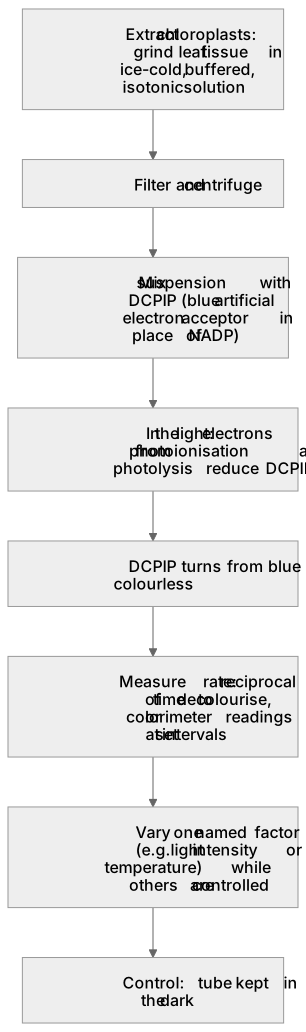
Put it in order
Put these steps in the order they happen.
- 1. DCPIP turns from blue to colourless
- 2. Control: tube kept in the dark
- 3. Measure rate: reciprocal of time to decolourise, or colorimeter readings at set intervals
- 4. Extract chloroplasts: grind leaf tissue in ice-cold, buffered, isotonic solution
- 5. Filter and centrifuge
- 6. Vary one named factor (e.g. light intensity or temperature) while others are controlled
- 7. Mix suspension with DCPIP (blue artificial electron acceptor in place of NADP)
- 8. In the light: electrons from photoionisation and photolysis reduce DCPIP
Key words
Say what each word means before you turn the card.
DCPIP
Try answering aloud or in your head before turning the card.
dehydrogenase activity
Try answering aloud or in your head before turning the card.
colorimetry
Try answering aloud or in your head before turning the card.
chloroplast extraction
Try answering aloud or in your head before turning the card.
See every definition
- DCPIP
- A blue dye acting as an artificial electron acceptor in place of NADP, which turns from blue to colourless when reduced.
- dehydrogenase activity
- Measured by the rate of colour loss, where the faster the colour loss the greater the activity and the faster the light-dependent reaction.
- colorimetry
- Used to calculate rate from colorimeter readings at set intervals, naming the filter and the reading taken at each time interval.
- chloroplast extraction
- Carried out by grinding leaf tissue in ice-cold, buffered, isotonic solution, then filtering and centrifuging.
Label the diagram
Some boxes have lost their names. Pick the right name for each number.
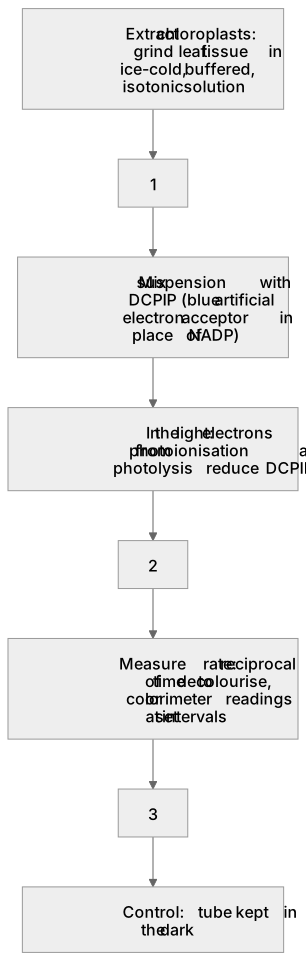
1Box 1
2Box 2
3Box 3
There is more to this lesson
The full lesson goes on to check your understanding and help you earn the marks. Create a free account to carry on, with your progress saved.
A week of Premium from your first lesson · Then the free plan continues · No card, no charge
Test your understanding of Photosynthesis (A-level only): Required practical 8: Investigation into the effect of a named factor on the rate of dehydrogenase activity in extracts of chloroplasts.
Active recall beats re-reading. Take an instant quiz now to test what you’ve learned and lock it into long-term memory.
A week of Premium from your first lesson · Then the free plan continues · No card, no charge