AQA · A-Level · Biology
Course version: 7402 · Version from Sept 2016
The light-independent reaction uses reduced NADP from the light- dependent…
Full specification wording
Photosynthesis (A-level only): The light-independent reaction uses reduced NADP from the light- dependent reaction to form a simple sugar.
The light-independent reaction occurs in the stroma of the chloroplast.
Checked against the AQA 7402 specification (opens in a new tab) on .
- Point 2 of 7
- 4 key terms
Study notes
From the checked teaching notes for this specification point.
The idea
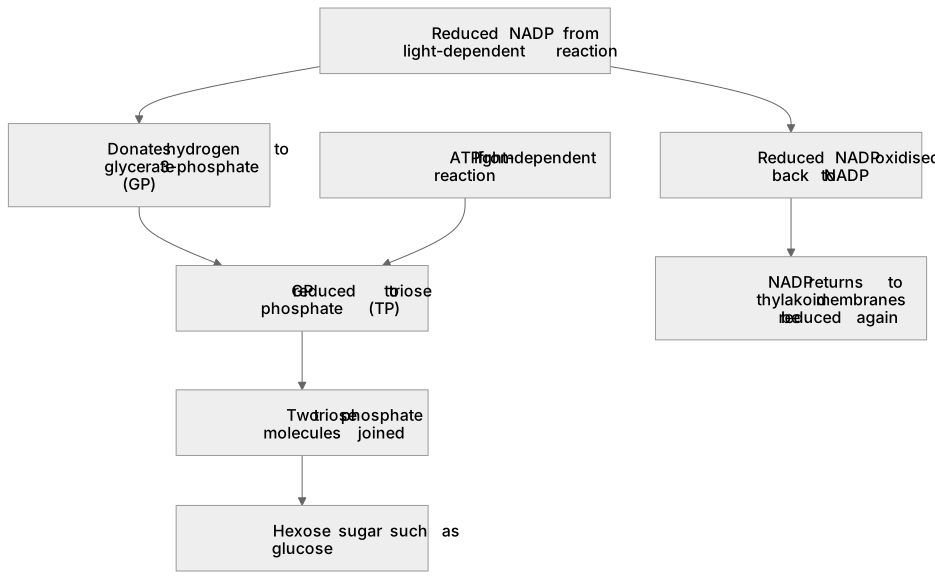
The light-independent reaction occurs in the stroma of the chloroplast. It depends on the products of the light-dependent reaction, so it stops soon after light is removed even though light is not used directly in it. Reduced NADP is the reducing agent: it donates hydrogen to glycerate 3-phosphate (GP), converting it to triose phosphate (TP), and is oxidised back to NADP, which returns to the thylakoid membranes to be reduced again. ATP from the light-dependent reaction supplies energy for this reduction. Triose phosphate is the simple sugar produced; two triose phosphate molecules can be joined to give a hexose sugar such as glucose. In limiting-factor questions, less reduced NADP means less GP is reduced, so less triose phosphate and less sugar are formed.
What earns the marks
- States that reduced NADP reduces glycerate 3-phosphate to triose phosphate.
- Names triose phosphate, or the hexose formed from two triose phosphates, as the simple sugar produced.
- Explains that oxidised NADP returns to the light-dependent reaction to be reduced again.
- In a limiting-factor context, links less reduced NADP to less reduction of GP and therefore less triose phosphate and less sugar formed.
- Locates the light-independent reaction in the stroma of the chloroplast.
- Distinguishes the role of reduced NADP (hydrogen/reducing power) from that of ATP (energy) in the reduction of GP.
Common mistakes and how to put them right
Calling it the dark reaction and claiming it happens only at night.
Put it right: It is the light-independent reaction and can occur whenever its products are available, but it stops soon after light is removed because reduced NADP and ATP run out.
Writing NADP where reduced NADP is required, so the reducing agent is never identified.
Put it right: Reduced NADP is the reducing agent; NADP is the oxidised form that returns to the thylakoids.
Using reduced NAD in place of reduced NADP.
Put it right: Photosynthesis uses reduced NADP, not reduced NAD.
Saying glucose is made directly from carbon dioxide, without passing through GP and triose phosphate.
Put it right: Carbon dioxide combines with RuBP to form two molecules of GP, which is reduced to triose phosphate, and two triose phosphates can form a hexose sugar.
Claiming that all triose phosphate becomes glucose.
Put it right: Most triose phosphate is used to regenerate RuBP, and only some leaves the cycle to form organic substances.
Exam tips
- In any question about light falling, follow the chain: less reduced NADP, less GP reduced, less triose phosphate, less sugar.
- State where the oxidised NADP goes, because that recycling step is a marking point many students omit.
- When asked about the simple sugar, name triose phosphate and explain how two triose phosphate molecules form a hexose sugar such as glucose.
Try the lesson
The start of the Photosynthesis (A-level only): The light-independent reaction uses reduced NADP from the light- dependent reaction to form a simple sugar. lesson, made from checked teaching notes for this specification point.
Have a go first
Which simple sugar is formed in the light-independent reaction of photosynthesis?
Listen
The light-independent reaction occurs in the stroma of the chloroplast. It depends on the products of the light-dependent reaction, so it stops soon after light is removed even though light is not used directly in it. Reduced NADP is the reducing agent: it donates hydrogen to glycerate 3-phosphate (GP), converting it to triose phosphate (TP), and is oxidised back to NADP, which returns to the thylakoid membranes to be reduced again. ATP from the light-dependent reaction supplies energy for this reduction. Triose phosphate is the simple sugar produced; two triose phosphate molecules can be joined to give a hexose sugar such as glucose. In limiting-factor questions, less reduced NADP means less GP is reduced, so less triose phosphate and less sugar are formed. A strong answer earns marks for these points. States that reduced NADP reduces glycerate 3-phosphate to triose phosphate. Names triose phosphate, or the hexose formed from two triose phosphates, as the simple sugar produced. Explains that oxidised NADP returns to the light-dependent reaction to be reduced again. In a limiting-factor context, links less reduced NADP to less reduction of GP and therefore less triose phosphate and less sugar formed. A common slip: Calling it the dark reaction and claiming it happens only at night. Instead, it is the light-independent reaction and can occur whenever its products are available, but it stops soon after light is removed because reduced NADP and ATP run out. Exam tip: In any question about light falling, follow the chain: less reduced NADP, less GP reduced, less triose phosphate, less sugar.
See it
Key words
Say what each word means before you turn the card.
stroma
Try answering aloud or in your head before turning the card.
reduced NADP
Try answering aloud or in your head before turning the card.
reduction of GP
Try answering aloud or in your head before turning the card.
triose phosphate
Try answering aloud or in your head before turning the card.
See every definition
- stroma
- The light-independent reaction occurs in this part of the chloroplast.
- reduced NADP
- The reducing agent that donates hydrogen to glycerate 3-phosphate, converting it to triose phosphate, and is oxidised back to NADP.
- reduction of GP
- The conversion of glycerate 3-phosphate to triose phosphate, for which ATP from the light-dependent reaction supplies energy.
- triose phosphate
- The simple sugar produced; two molecules can be joined to give a hexose sugar such as glucose.
Label the diagram
Some boxes have lost their names. Pick the right name for each number.
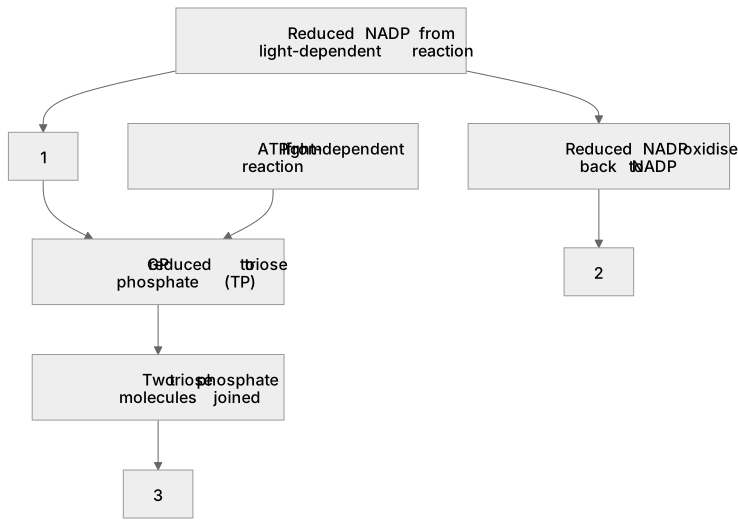
1Box 1
2Box 2
3Box 3
There is more to this lesson
The full lesson goes on to check your understanding and help you earn the marks. Create a free account to carry on, with your progress saved.
A week of Premium from your first lesson · Then the free plan continues · No card, no charge
Test your understanding of Photosynthesis (A-level only): The light-independent reaction uses reduced NADP from the light- dependent reaction to form a simple sugar.
Active recall beats re-reading. Take an instant quiz now to test what you’ve learned and lock it into long-term memory.
A week of Premium from your first lesson · Then the free plan continues · No card, no charge