AQA · A-Level · Biology
Course version: 7402 · Version from Sept 2016
A population as a group of organisms of the same species occupying a…
Full specification wording
Populations (A-level only): A population as a group of organisms of the same species occupying a particular space at a particular time that can potentially interbreed.
The definition has four parts and each can earn credit: a group of organisms, of the same species, occupying a particular space at a particular time, which can potentially interbreed.
Checked against the AQA 7402 specification (opens in a new tab) on .
- Point 2 of 5
Study notes
From the checked teaching notes for this specification point.
The idea
The definition has four parts and each can earn credit: a group of organisms, of the same species, occupying a particular space at a particular time, which can potentially interbreed. The word potentially matters, because members that never actually mate still belong to the population as long as they could. The time element matters because populations change, so the number of monkeyflowers on a hillside in July is not the number in January, and any measurement of population size is a snapshot of one moment. The space element is why ecologists define an area before sampling it, and why mark-release-recapture estimates assume no migration into or out of that area. Because members can interbreed, they share a gene pool, making the population the unit to which allele frequency measurements and Hardy-Weinberg calculations apply.
What earns the marks
- Organisms of the same species.
- Occupying the same place at the same time.
- The individuals being able to interbreed, or potentially interbreeding.
- Linking a population to a shared gene pool when the question moves on to allele frequencies.
Common mistakes and how to put them right
Leaving out the same species, so that the definition describes any group of organisms rather than one species.
Put it right: A community is all the populations of different species in an area, which is a different concept.
Leaving out the time, which is what makes population size a value for a stated moment.
Writing that the individuals do interbreed rather than can interbreed, which wrongly excludes individuals that have not yet bred.
Defining a population as all the members of a species, which ignores that a species can have many populations.
Describing a habitat rather than the organisms living in it.
Exam tips
- Even a one-mark definition needs every element, so write the whole sentence rather than a phrase.
- In an ecology question, state the area and the time your figure refers to, because those are part of what a population is.
- If the question uses the word potentially, use it in your answer too.
Try the lesson
The start of the Populations (A-level only): A population as a group of organisms of the same species occupying a particular space at a particular time that can potentially interbreed. lesson, made from checked teaching notes for this specification point.
Have a go first
Which statement best defines a population?
Listen
The definition has four parts and each can earn credit: a group of organisms, of the same species, occupying a particular space at a particular time, which can potentially interbreed. The word potentially matters, because members that never actually mate still belong to the population as long as they could. The time element matters because populations change, so the number of monkeyflowers on a hillside in July is not the number in January, and any measurement of population size is a snapshot of one moment. The space element is why ecologists define an area before sampling it, and why mark-release-recapture estimates assume no migration into or out of that area. Because members can interbreed, they share a gene pool, making the population the unit to which allele frequency measurements and Hardy-Weinberg calculations apply. A strong answer earns marks for these points. organisms of the same species. occupying the same place at the same time. the individuals being able to interbreed, or potentially interbreeding. linking a population to a shared gene pool when the question moves on to allele frequencies. Exam tip: Even a one-mark definition needs every element, so write the whole sentence rather than a phrase.
See it
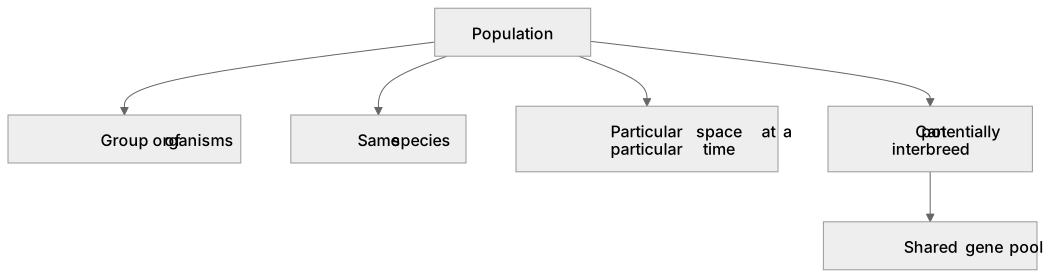
Label the diagram
Some boxes have lost their names. Pick the right name for each number.
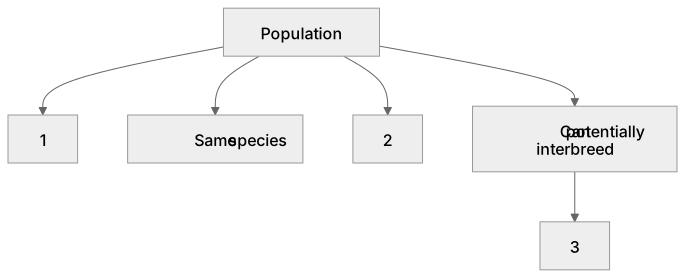
1Box 1
2Box 2
3Box 3
There is more to this lesson
The full lesson goes on to check your understanding and help you earn the marks. Create a free account to carry on, with your progress saved.
A week of Premium from your first lesson · Then the free plan continues · No card, no charge
Test your understanding of Populations (A-level only): A population as a group of organisms of the same species occupying a particular space at a particular time that can potentially interbreed.
Active recall beats re-reading. Take an instant quiz now to test what you’ve learned and lock it into long-term memory.
A week of Premium from your first lesson · Then the free plan continues · No card, no charge