AQA · A-Level · Biology
Course version: 7402 · Version from Sept 2016
Populations (A-level only): Species exist as one or more populations.
A species is a group of organisms able to interbreed and produce fertile offspring, but its members are rarely spread evenly across the landscape.
Checked against the AQA 7402 specification (opens in a new tab) on .
- Point 1 of 5
- 3 key terms
Study notes
From the checked teaching notes for this specification point.
The idea
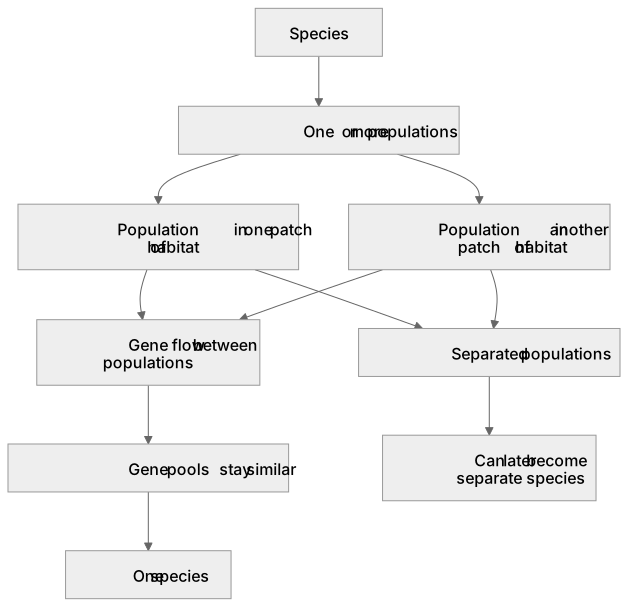
A species is a group of organisms able to interbreed and produce fertile offspring, but its members are rarely spread evenly across the landscape. They usually occupy separate patches of suitable habitat, and each patch holds a population. Lemurs of one species living on opposite sides of a river, or monkeyflowers growing at different altitudes on the same mountain, are one species divided into several populations. What keeps them a single species is gene flow: if individuals move between the populations, or gametes do, as when a bee carries pollen from one hillside to another, alleles are shared and the two gene pools stay similar.
What earns the marks
- Defining a species by the ability to interbreed and produce fertile offspring.
- A population as the members of one species living in the same place at the same time.
- Gene flow between populations keeping the gene pools of one species similar.
- Recognising that separated populations of one species can later become separate species.
Common mistakes and how to put them right
Using species and population as if they meant the same thing in a genetics or ecology answer.
Saying two populations are different species simply because they live apart or look different.
Writing that a population contains several species, which describes a community.
Assuming geographical separation instantly creates a new species, with no reference to accumulating genetic differences.
Exam tips
- Check which word the question uses; allele frequency and gene pool questions always concern a population, not a whole species.
- If a map shows two groups divided by a barrier, call them separate populations of one species until the data show they cannot interbreed.
- Name gene flow explicitly, because it is the idea that links separate populations back into one species.
Try the lesson
The start of the Populations (A-level only): Species exist as one or more populations. lesson, made from checked teaching notes for this specification point.
Have a go first
What is meant by the term population in biology?
Listen
A species is a group of organisms able to interbreed and produce fertile offspring, but its members are rarely spread evenly across the landscape. They usually occupy separate patches of suitable habitat, and each patch holds a population. Lemurs of one species living on opposite sides of a river, or monkeyflowers growing at different altitudes on the same mountain, are one species divided into several populations. What keeps them a single species is gene flow: if individuals move between the populations, or gametes do, as when a bee carries pollen from one hillside to another, alleles are shared and the two gene pools stay similar. A strong answer earns marks for these points. defining a species by the ability to interbreed and produce fertile offspring. a population as the members of one species living in the same place at the same time. gene flow between populations keeping the gene pools of one species similar. recognising that separated populations of one species can later become separate species. Exam tip: Check which word the question uses; allele frequency and gene pool questions always concern a population, not a whole species.
See it
Key words
Say what each word means before you turn the card.
species
Try answering aloud or in your head before turning the card.
population
Try answering aloud or in your head before turning the card.
gene flow
Try answering aloud or in your head before turning the card.
See every definition
- species
- A group of organisms able to interbreed and produce fertile offspring.
- population
- The members of one species living in the same place at the same time.
- gene flow
- Individuals or gametes moving between populations, so that alleles are shared and the two gene pools stay similar.
Label the diagram
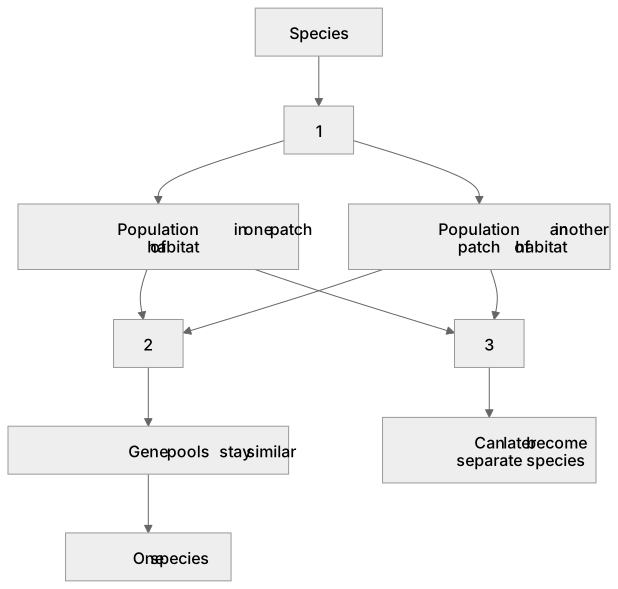
Some boxes have lost their names. Pick the right name for each number.
1Box 1
2Box 2
3Box 3
There is more to this lesson
The full lesson goes on to check your understanding and help you earn the marks. Create a free account to carry on, with your progress saved.
A week of Premium from your first lesson · Then the free plan continues · No card, no charge
Test your understanding of Populations (A-level only): Species exist as one or more populations.
Active recall beats re-reading. Take an instant quiz now to test what you’ve learned and lock it into long-term memory.
A week of Premium from your first lesson · Then the free plan continues · No card, no charge