AQA · A-Level · Biology
Course version: 7402 · Version from Sept 2016
A community and the non-living components of its environment together form…
Full specification wording
Populations in ecosystems (A-level only): A community and the non-living components of its environment together form an ecosystem.
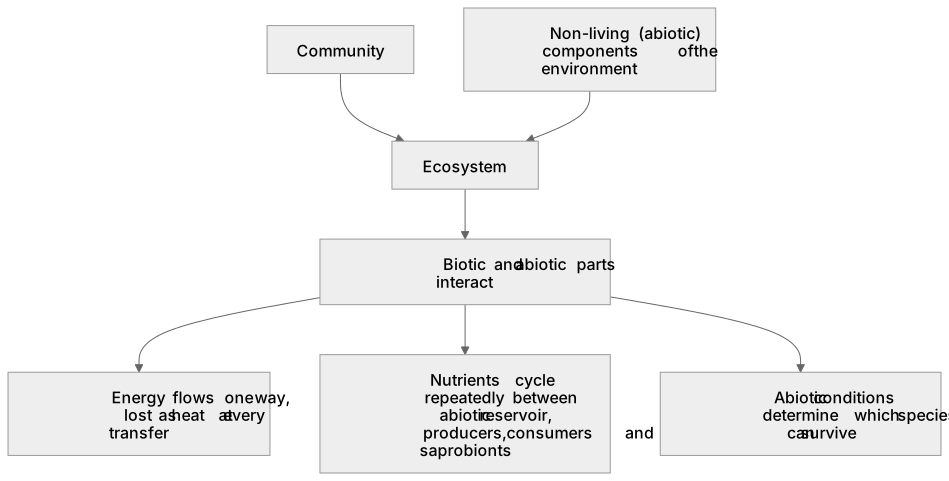
An ecosystem is the community plus the abiotic components of its environment, working as one interacting unit.
Checked against the AQA 7402 specification (opens in a new tab) on .
- Point 2 of 14
- 4 key terms
Study notes
From the checked teaching notes for this specification point.
The idea
An ecosystem is the community plus the abiotic components of its environment, working as one interacting unit. Abiotic components are non-living, physical and chemical conditions: light intensity, temperature, water availability, pH, oxygen and carbon dioxide concentration, soil type and wind exposure. Two things link the living and non-living parts. Energy flows one way: light is captured by producers, passes along food chains and is lost as heat at every transfer, so the system needs a constant input. Nutrients such as carbon and nitrogen cycle repeatedly between the abiotic reservoir, producers, consumers and saprobionts.
What earns the marks
- An ecosystem being a community, or all the populations, together with the non-living or abiotic components of the environment.
- Naming a correct abiotic factor such as light intensity, temperature, pH, water availability or mineral ion concentration.
- Stating that the biotic and abiotic parts interact.
- Energy flowing through the ecosystem while nutrients are cycled between organisms and the abiotic environment.
- Stating that abiotic conditions determine which species can survive in that ecosystem.
Common mistakes and how to put them right
Naming predators, competitors or pathogens as abiotic factors.
Writing the vague phrase the environment instead of the non-living components of the environment.
Stating that nutrients flow through and energy is recycled, which reverses both.
Listing soil or water as members of the community.
Using habitat and ecosystem as if they were the same term.
Exam tips
- Learn the exact terminology for fill-the-gap questions, as precise wording is required.
- Name a specific abiotic factor such as light intensity rather than a vague one such as weather.
- If a question asks how a factor affects an ecosystem, follow it through to a named population.
Try the lesson
The start of the Populations in ecosystems (A-level only): A community and the non-living components of its environment together form an ecosystem. lesson, made from checked teaching notes for this specification point.
Have a go first
Which of the following best describes an ecosystem?
Listen
An ecosystem is the community plus the abiotic components of its environment, working as one interacting unit. Abiotic components are non-living, physical and chemical conditions: light intensity, temperature, water availability, pH, oxygen and carbon dioxide concentration, soil type and wind exposure. Two things link the living and non-living parts. Energy flows one way: light is captured by producers, passes along food chains and is lost as heat at every transfer, so the system needs a constant input. Nutrients such as carbon and nitrogen cycle repeatedly between the abiotic reservoir, producers, consumers and saprobionts. A strong answer earns marks for these points. an ecosystem being a community, or all the populations, together with the non-living or abiotic components of the environment. naming a correct abiotic factor such as light intensity, temperature, pH, water availability or mineral ion concentration. stating that the biotic and abiotic parts interact. energy flowing through the ecosystem while nutrients are cycled between organisms and the abiotic environment. Exam tip: Learn the exact terminology for fill-the-gap questions, as precise wording is required.
See it
Key words
Say what each word means before you turn the card.
ecosystem
Try answering aloud or in your head before turning the card.
abiotic components
Try answering aloud or in your head before turning the card.
energy flow
Try answering aloud or in your head before turning the card.
nutrient cycling
Try answering aloud or in your head before turning the card.
See every definition
- ecosystem
- A community and the non-living components of its environment together form this.
- abiotic components
- Non-living, physical and chemical conditions such as light intensity, temperature, water availability, pH, oxygen and carbon dioxide concentration, soil type and wind exposure.
- energy flow
- Light is captured by producers, passes along food chains and is lost as heat at every transfer, so the system needs a constant input.
- nutrient cycling
- Nutrients such as carbon and nitrogen cycle repeatedly between the abiotic reservoir, producers, consumers and saprobionts.
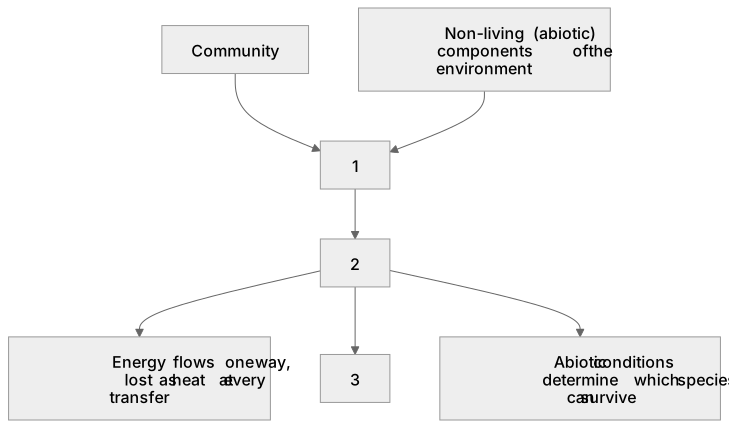
Label the diagram
Some boxes have lost their names. Pick the right name for each number.
1Box 1
2Box 2
3Box 3
There is more to this lesson
The full lesson goes on to check your understanding and help you earn the marks. Create a free account to carry on, with your progress saved.
A week of Premium from your first lesson · Then the free plan continues · No card, no charge
Test your understanding of Populations in ecosystems (A-level only): A community and the non-living components of its environment together form an ecosystem.
Active recall beats re-reading. Take an instant quiz now to test what you’ve learned and lock it into long-term memory.
A week of Premium from your first lesson · Then the free plan continues · No card, no charge