AQA · A-Level · Biology
Course version: 7402 · Version from Sept 2016
Ecosystems can range in size from the very small to the very large.
Full specification wording
Populations in ecosystems (A-level only): Ecosystems can range in size from the very small to the very large.
An ecosystem is defined by what it contains, not by how big it is.
Checked against the AQA 7402 specification (opens in a new tab) on .
- Point 3 of 14
- 4 key terms
Study notes
From the checked teaching notes for this specification point.
The idea
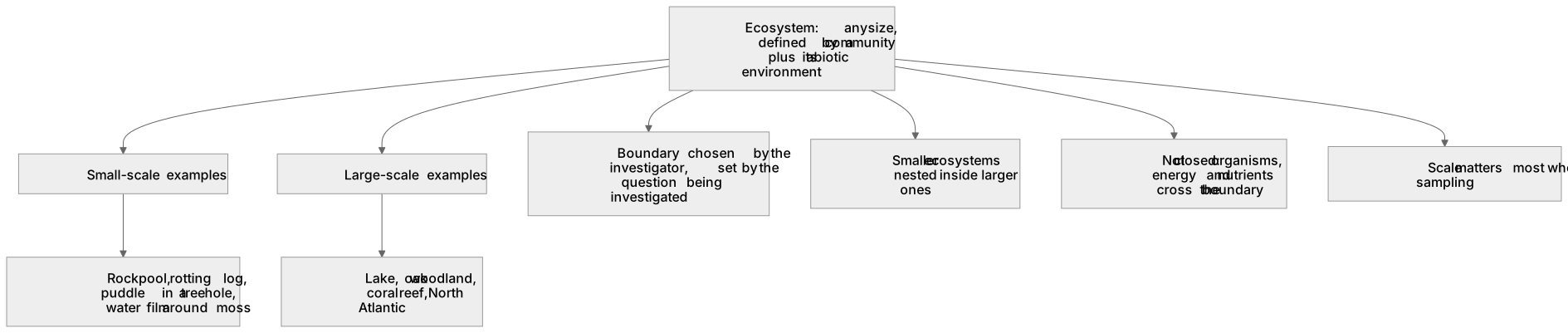
An ecosystem is defined by what it contains, not by how big it is. A rotting log, a rock pool, a puddle in a tree hole or the film of water around a cushion of moss each contains a community of interacting species together with its own abiotic conditions, so each is an ecosystem. So is a lake, an oak woodland, a coral reef or the North Atlantic. What sets the boundary is the question being investigated, so the investigator chooses it. Small ecosystems sit nested inside larger ones: a rock pool within a rocky shore within a coastal ecosystem. No ecosystem is closed. Organisms migrate across the boundary, energy enters as light and leaves as heat, and nutrients are carried in and out by water, wind and animals, so what happens outside affects what happens inside. Scale matters most when you sample.
What earns the marks
- Stating that an ecosystem may be any size provided it contains a community and the abiotic environment it interacts with.
- A correct small-scale example such as a rock pool, rotting log, leaf litter or puddle.
- A correct large-scale example such as a lake, woodland or ocean.
- Stating that smaller ecosystems are found within larger ones.
- Stating that ecosystems are not closed, because organisms, energy and nutrients cross the boundary.
Common mistakes and how to put them right
Assuming an ecosystem has to be large, and so refusing to accept a rock pool as one.
Calling a small ecosystem a habitat when the question specifically asked for an ecosystem.
Treating the boundary of an ecosystem as fixed in nature rather than chosen by the investigator.
Naming a small ecosystem without identifying both its community and its abiotic components.
Forgetting that a larger area needs more samples before an estimate is valid.
Exam tips
- State the scale you are working at, then name the community and one abiotic factor at that scale.
- In sampling questions, link the size of the area to the number of samples needed.
- When asked to suggest why an estimate is unreliable, area sampled and number of quadrats are usually available marks.
Try the lesson
The start of the Populations in ecosystems (A-level only): Ecosystems can range in size from the very small to the very large. lesson, made from checked teaching notes for this specification point.
Have a go first
Which statement best describes the size of an ecosystem?
Listen
An ecosystem is defined by what it contains, not by how big it is. A rotting log, a rock pool, a puddle in a tree hole or the film of water around a cushion of moss each contains a community of interacting species together with its own abiotic conditions, so each is an ecosystem. So is a lake, an oak woodland, a coral reef or the North Atlantic. What sets the boundary is the question being investigated, so the investigator chooses it. Small ecosystems sit nested inside larger ones: a rock pool within a rocky shore within a coastal ecosystem. No ecosystem is closed. Organisms migrate across the boundary, energy enters as light and leaves as heat, and nutrients are carried in and out by water, wind and animals, so what happens outside affects what happens inside. Scale matters most when you sample. A strong answer earns marks for these points. stating that an ecosystem may be any size provided it contains a community and the abiotic environment it interacts with. a correct small-scale example such as a rock pool, rotting log, leaf litter or puddle. a correct large-scale example such as a lake, woodland or ocean. stating that smaller ecosystems are found within larger ones. Exam tip: State the scale you are working at, then name the community and one abiotic factor at that scale.
See it
Key words
Say what each word means before you turn the card.
scale of ecosystems
Try answering aloud or in your head before turning the card.
nested ecosystems
Try answering aloud or in your head before turning the card.
ecosystem boundaries
Try answering aloud or in your head before turning the card.
open systems
Try answering aloud or in your head before turning the card.
See every definition
- scale of ecosystems
- Ecosystems can range in size from the very small to the very large, and scale matters most when you sample.
- nested ecosystems
- Small ecosystems sit nested inside larger ones, such as a rock pool within a rocky shore within a coastal ecosystem.
- ecosystem boundaries
- What sets the boundary is the question being investigated, so the investigator chooses it rather than it being fixed in nature.
- open systems
- No ecosystem is closed, because organisms migrate across the boundary, energy enters as light and leaves as heat, and nutrients are carried in and out.
Label the diagram
Some boxes have lost their names. Pick the right name for each number.
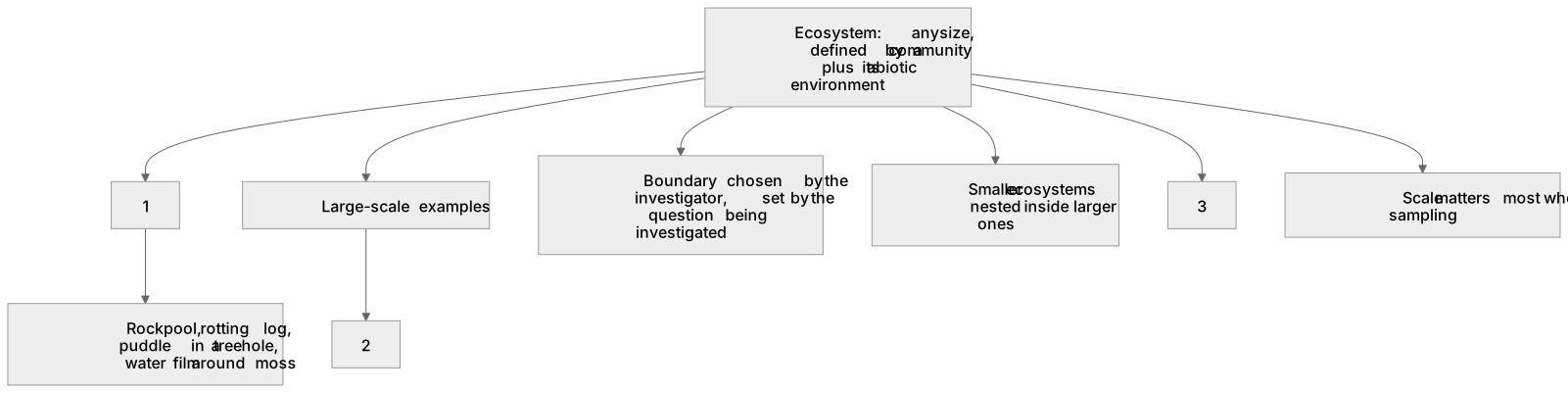
1Box 1
2Box 2
3Box 3
There is more to this lesson
The full lesson goes on to check your understanding and help you earn the marks. Create a free account to carry on, with your progress saved.
A week of Premium from your first lesson · Then the free plan continues · No card, no charge
Test your understanding of Populations in ecosystems (A-level only): Ecosystems can range in size from the very small to the very large.
Active recall beats re-reading. Take an instant quiz now to test what you’ve learned and lock it into long-term memory.
A week of Premium from your first lesson · Then the free plan continues · No card, no charge