AQA · A-Level · Biology
Course version: 7402 · Version from Sept 2016
Changes that organisms produce in their abiotic environment can result in…
Full specification wording
Populations in ecosystems (A-level only): Changes that organisms produce in their abiotic environment can result in a less hostile environment and change biodiversity.
Abiotic conditions on newly exposed ground are hostile: there is no soil, so no store of water or mineral ions, temperatures swing widely, and exposure to wind and light is high.
Checked against the AQA 7402 specification (opens in a new tab) on .
- Point 11 of 14
- 3 key terms
Study notes
From the checked teaching notes for this specification point.
The idea
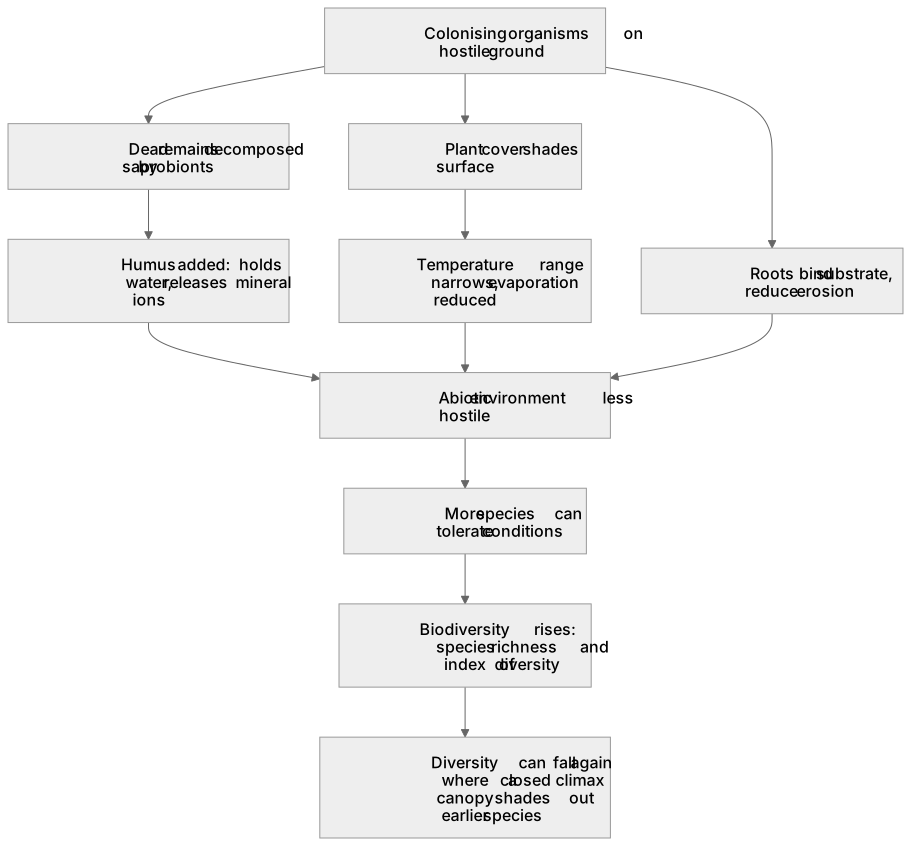
Abiotic conditions on newly exposed ground are hostile: there is no soil, so no store of water or mineral ions, temperatures swing widely, and exposure to wind and light is high. Colonising organisms change this. Dead remains decomposed by saprobionts add humus, which holds water and releases mineral ions. Plant cover shades the surface, narrowing the temperature range and reducing evaporation. Roots bind the substrate and reduce erosion; on a dune, marram grass traps sand and adds humus. Each change makes the abiotic environment less hostile. More species can tolerate the conditions, so biodiversity rises, measured as species richness and an index of diversity.
What earns the marks
- Naming an abiotic factor that becomes less hostile, such as soil water content, mineral ion concentration, temperature range, wind exposure or pH.
- The mechanism, such as dead organisms being decomposed by saprobionts to form humus that retains water and releases mineral ions.
- Stating that more species are adapted to, or can tolerate, the new conditions.
- Increased biodiversity expressed as species richness and/or an index of diversity; note that species richness alone counts species present but omits evenness, so an index of diversity gives a fuller comparison.
- Recognising that diversity can fall again where a closed climax canopy shades out earlier species.
Common mistakes and how to put them right
Writing that the environment improves without naming a single abiotic factor.
Treating biodiversity as species richness only, ignoring the number of individuals of each species.
Put it right: Species richness omits evenness, so use an index of diversity for fuller comparisons.
Claiming diversity always reaches its maximum at the climax community.
Describing decomposition without naming saprobionts or humus.
Confusing a less hostile abiotic environment with reduced competition, when competition usually intensifies.
Exam tips
- Quote the index of diversity when data are supplied, and say what a higher value means about the community.
- Give the abiotic factor and the direction of change, for example soil water content increases.
- Link every abiotic change to the species that can now survive.
Try the lesson
The start of the Populations in ecosystems (A-level only): Changes that organisms produce in their abiotic environment can result in a less hostile environment and change biodiversity. lesson, made from checked teaching notes for this specification point.
Have a go first
Pioneer mosses colonise bare rock. As they grow and decay, a thin layer of organic matter builds up on the surface. Which statement best explains the ecological effect of this change to the abiotic environment?
Listen
Abiotic conditions on newly exposed ground are hostile: there is no soil, so no store of water or mineral ions, temperatures swing widely, and exposure to wind and light is high. Colonising organisms change this. Dead remains decomposed by saprobionts add humus, which holds water and releases mineral ions. Plant cover shades the surface, narrowing the temperature range and reducing evaporation. Roots bind the substrate and reduce erosion; on a dune, marram grass traps sand and adds humus. Each change makes the abiotic environment less hostile. More species can tolerate the conditions, so biodiversity rises, measured as species richness and an index of diversity. A strong answer earns marks for these points. naming an abiotic factor that becomes less hostile, such as soil water content, mineral ion concentration, temperature range, wind exposure or pH. the mechanism, such as dead organisms being decomposed by saprobionts to form humus that retains water and releases mineral ions. stating that more species are adapted to, or can tolerate, the new conditions. increased biodiversity expressed as species richness and/or an index of diversity; note that species richness alone counts species present but omits evenness, so an index of diversity gives a fuller comparison. A common slip: treating biodiversity as species richness only, ignoring the number of individuals of each species. Instead, species richness omits evenness, so use an index of diversity for fuller comparisons. Exam tip: Quote the index of diversity when data are supplied, and say what a higher value means about the community.
See it
Key words
Say what each word means before you turn the card.
humus
Try answering aloud or in your head before turning the card.
species richness
Try answering aloud or in your head before turning the card.
index of diversity
Try answering aloud or in your head before turning the card.
See every definition
- humus
- Material formed when dead remains are decomposed by saprobionts, which holds water and releases mineral ions.
- species richness
- A measure of biodiversity that counts species present but omits evenness.
- index of diversity
- A measure of biodiversity that gives a fuller comparison than species richness alone.
Label the diagram
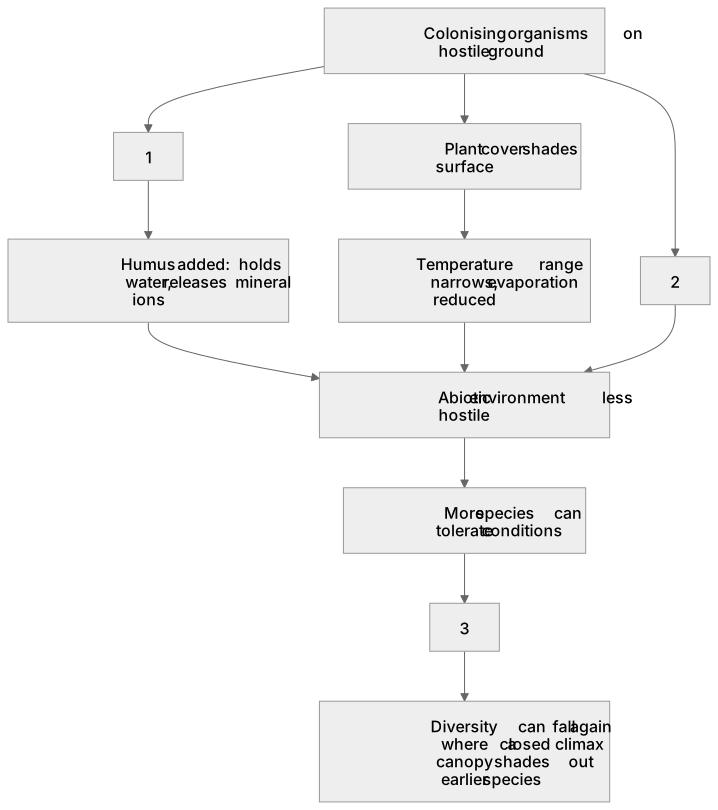
Some boxes have lost their names. Pick the right name for each number.
1Box 1
2Box 2
3Box 3
There is more to this lesson
The full lesson goes on to check your understanding and help you earn the marks. Create a free account to carry on, with your progress saved.
A week of Premium from your first lesson · Then the free plan continues · No card, no charge
Test your understanding of Populations in ecosystems (A-level only): Changes that organisms produce in their abiotic environment can result in a less hostile environment and change biodiversity.
Active recall beats re-reading. Take an instant quiz now to test what you’ve learned and lock it into long-term memory.
A week of Premium from your first lesson · Then the free plan continues · No card, no charge