AQA · A-Level · Biology
Course version: 7402 · Version from Sept 2016
Conservation of habitats frequently involves management of succession.
Full specification wording
Populations in ecosystems (A-level only): Conservation of habitats frequently involves management of succession.
Many valued habitats are early or mid-successional: heather moorland, chalk grassland, coppiced woodland, reedbed and open dune.
Checked against the AQA 7402 specification (opens in a new tab) on .
- Point 12 of 14
- 3 key terms
Study notes
From the checked teaching notes for this specification point.
The idea
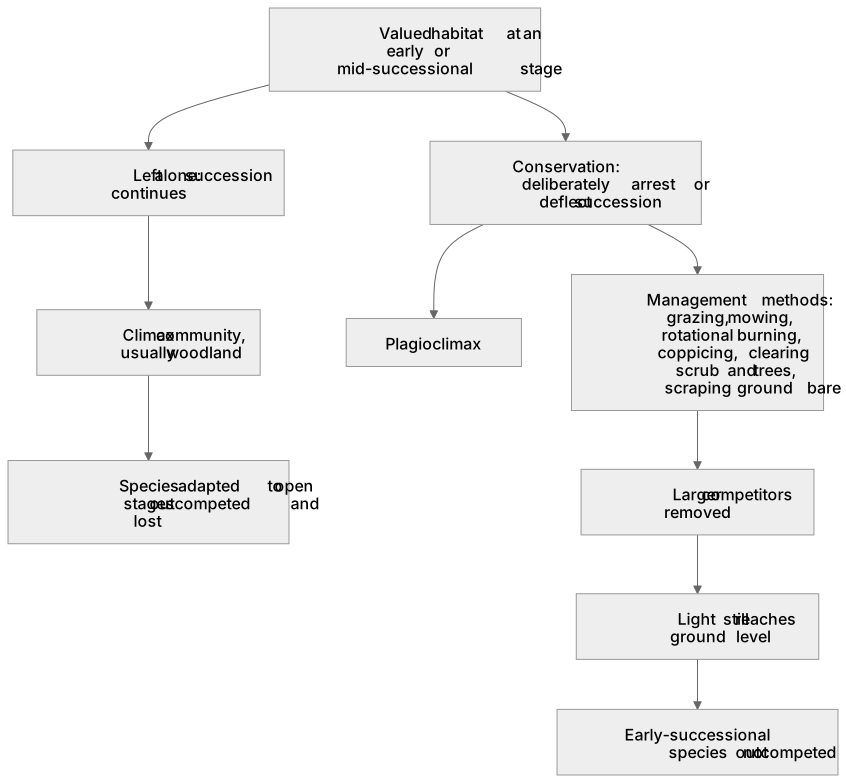
Many valued habitats are early or mid-successional: heather moorland, chalk grassland, coppiced woodland, reedbed and open dune. Left alone, each would continue through succession to the climax community, usually woodland, and the species adapted to the open stages would be outcompeted and lost. Conservation therefore deliberately arrests or deflects succession, producing what is called a plagioclimax. The practical methods all remove the larger competitors and keep light reaching ground level: grazing by sheep, cattle or rabbits, mowing, rotational burning of heather, coppicing, clearing invading scrub and trees, and scraping ground bare to restart colonisation.
What earns the marks
- Stating that without management succession would continue towards the climax community.
- Naming a management method such as grazing, mowing, burning, coppicing or scrub clearance.
- Explaining that the method removes larger competing plants so that light still reaches ground level and early-successional species are not outcompeted.
- Conserving species and biodiversity, or conserving habitats and niches, as a reason for the management.
- A second distinct reason, such as a source of medicines or timber, reduced erosion, reduced climate change, or tourism.
Common mistakes and how to put them right
Stating that conservation means leaving a habitat completely undisturbed, which would destroy an early-successional habitat.
Naming a management method without saying which stage of succession it prevents.
Writing to save the animals instead of naming conserved species, habitats or niches.
Confusing conservation, which is active management to maintain a habitat, with preservation, which is leaving it untouched.
Giving the same reason twice in different words when the question asks for two reasons.
Exam tips
- A suggest two reasons question needs two genuinely different reasons; check the wording of the question and the number of marks available before deciding how many distinct points to give.
- Always link the management method back to halting or deflecting succession.
- Where local people are mentioned in the stem, land use and livelihoods are usually creditable points.
Try the lesson
The start of the Populations in ecosystems (A-level only): Conservation of habitats frequently involves management of succession. lesson, made from checked teaching notes for this specification point.
Have a go first
Which of the following best describes why conservationists might manage succession in a habitat?
Listen
Many valued habitats are early or mid-successional: heather moorland, chalk grassland, coppiced woodland, reedbed and open dune. Left alone, each would continue through succession to the climax community, usually woodland, and the species adapted to the open stages would be outcompeted and lost. Conservation therefore deliberately arrests or deflects succession, producing what is called a plagioclimax. The practical methods all remove the larger competitors and keep light reaching ground level: grazing by sheep, cattle or rabbits, mowing, rotational burning of heather, coppicing, clearing invading scrub and trees, and scraping ground bare to restart colonisation. A strong answer earns marks for these points. stating that without management succession would continue towards the climax community. naming a management method such as grazing, mowing, burning, coppicing or scrub clearance. explaining that the method removes larger competing plants so that light still reaches ground level and early-successional species are not outcompeted. conserving species and biodiversity, or conserving habitats and niches, as a reason for the management. Exam tip: A suggest two reasons question needs two genuinely different reasons; check the wording of the question and the number of marks available before deciding how many distinct points to give.
See it
Key words
Say what each word means before you turn the card.
conservation
Try answering aloud or in your head before turning the card.
managed succession
Try answering aloud or in your head before turning the card.
plagioclimax
Try answering aloud or in your head before turning the card.
See every definition
- conservation
- Active management to maintain a habitat, frequently involving management of succession.
- managed succession
- Deliberately arresting or deflecting succession so that the species adapted to the open stages are not outcompeted and lost.
- plagioclimax
- What is produced when conservation deliberately arrests or deflects succession, rather than letting it continue to the climax community.
Label the diagram
Some boxes have lost their names. Pick the right name for each number.
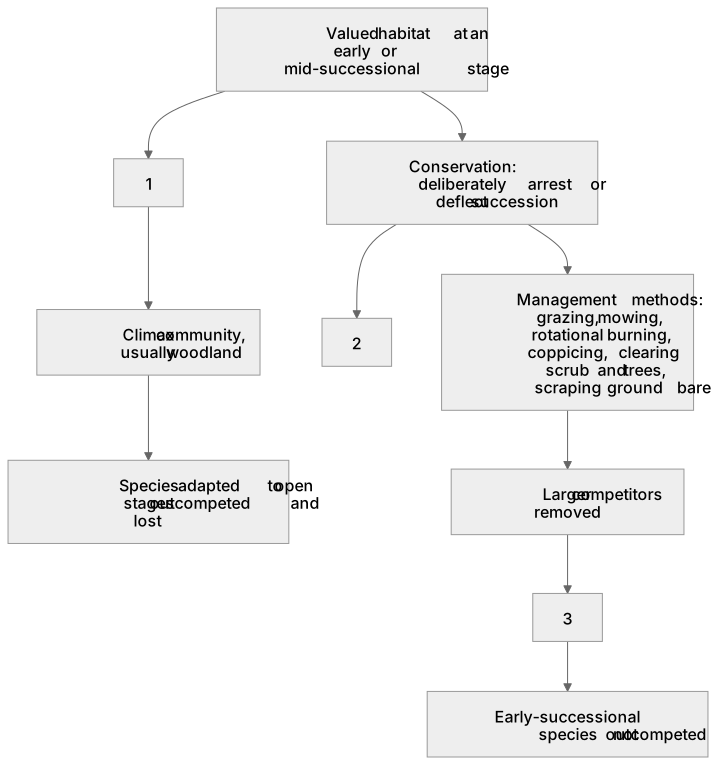
1Box 1
2Box 2
3Box 3
There is more to this lesson
The full lesson goes on to check your understanding and help you earn the marks. Create a free account to carry on, with your progress saved.
A week of Premium from your first lesson · Then the free plan continues · No card, no charge
Test your understanding of Populations in ecosystems (A-level only): Conservation of habitats frequently involves management of succession.
Active recall beats re-reading. Take an instant quiz now to test what you’ve learned and lock it into long-term memory.
A week of Premium from your first lesson · Then the free plan continues · No card, no charge