AQA · A-Level · Biology
Course version: 7402 · Version from Sept 2016
Primary succession, from colonisation by pioneer species to climax…
Full specification wording
Populations in ecosystems (A-level only): Primary succession, from colonisation by pioneer species to climax community.
Primary succession begins on newly exposed land with no soil, like bare rock or blown sand.
Checked against the AQA 7402 specification (opens in a new tab) on .
- Point 8 of 14
- 4 key terms
Study notes
From the checked teaching notes for this specification point.
The idea
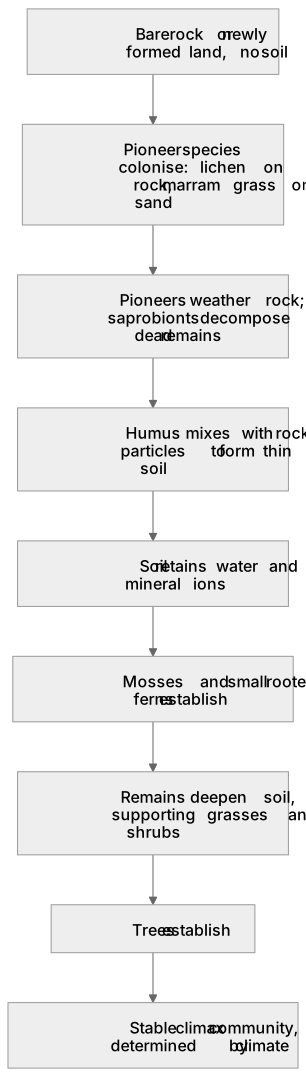
Primary succession begins on newly exposed land with no soil, like bare rock or blown sand. The first colonisers are pioneer species adapted to harsh abiotic conditions. For example, lichens colonise bare rock, while marram grass colonises sand. Pioneers weather rock and, upon death, saprobionts decompose their remains. This dead organic matter (humus) mixes with rock particles to form a thin soil. Soil retains water and mineral ions, allowing mosses (using rhizoids) and small rooted ferns to establish. Their remains deepen the soil, supporting grasses, shrubs, and eventually trees. Each stage is a seral stage, making the environment less hostile for new species, culminating in a stable climax community determined by the climate.
What earns the marks
- Primary succession beginning on bare rock or newly formed land where there is no soil.
- Naming a pioneer species, such as lichen on rock or marram grass on sand, adapted to harsh abiotic conditions.
- Pioneers eroding the rock and their dead remains being decomposed to form humus and therefore soil.
- The soil retaining water and mineral ions so that larger plants can establish.
- The climax community as the final stable community, determined largely by the climate.
Common mistakes and how to put them right
Calling colonisation of a cleared field or a burnt wood primary succession, when soil remains and it is secondary succession.
Saying pioneers make soil without mentioning erosion of the rock and decomposition of dead organisms.
Assuming every climax community is woodland, when climate can give grassland, tundra or dune heath.
Listing seral stages in order with no abiotic change to explain why the sequence happens.
Describing pioneers as the first plants to evolve rather than the first to colonise.
Exam tips
- Answer succession questions as a repeating chain: species present, change to the abiotic environment, new species now able to survive.
- Use the terms pioneer species, seral stage and climax community by name.
- Check whether soil is already present before deciding between primary and secondary succession.
Try the lesson
The start of the Populations in ecosystems (A-level only): Primary succession, from colonisation by pioneer species to climax community. lesson, made from checked teaching notes for this specification point.
Have a go first
What name is given to the first species to colonise an area during primary succession?
Listen
Primary succession begins on newly exposed land with no soil, like bare rock or blown sand. The first colonisers are pioneer species adapted to harsh abiotic conditions. For example, lichens colonise bare rock, while marram grass colonises sand. Pioneers weather rock and, upon death, saprobionts decompose their remains. This dead organic matter (humus) mixes with rock particles to form a thin soil. Soil retains water and mineral ions, allowing mosses (using rhizoids) and small rooted ferns to establish. Their remains deepen the soil, supporting grasses, shrubs, and eventually trees. Each stage is a seral stage, making the environment less hostile for new species, culminating in a stable climax community determined by the climate. A strong answer earns marks for these points. primary succession beginning on bare rock or newly formed land where there is no soil. naming a pioneer species, such as lichen on rock or marram grass on sand, adapted to harsh abiotic conditions. pioneers eroding the rock and their dead remains being decomposed to form humus and therefore soil. the soil retaining water and mineral ions so that larger plants can establish. Exam tip: Answer succession questions as a repeating chain: species present, change to the abiotic environment, new species now able to survive.
See it
Key words
Say what each word means before you turn the card.
primary succession
Try answering aloud or in your head before turning the card.
pioneer species
Try answering aloud or in your head before turning the card.
soil formation
Try answering aloud or in your head before turning the card.
climax community
Try answering aloud or in your head before turning the card.
See every definition
- primary succession
- Begins on newly exposed land with no soil, like bare rock or blown sand, from colonisation by pioneer species to climax community.
- pioneer species
- The first colonisers, adapted to harsh abiotic conditions, such as lichens on bare rock and marram grass on sand.
- soil formation
- Pioneers weather rock and, upon death, saprobionts decompose their remains, so dead organic matter mixes with rock particles to form a thin soil.
- climax community
- The final stable community, determined by the climate.
Label the diagram
Some boxes have lost their names. Pick the right name for each number.
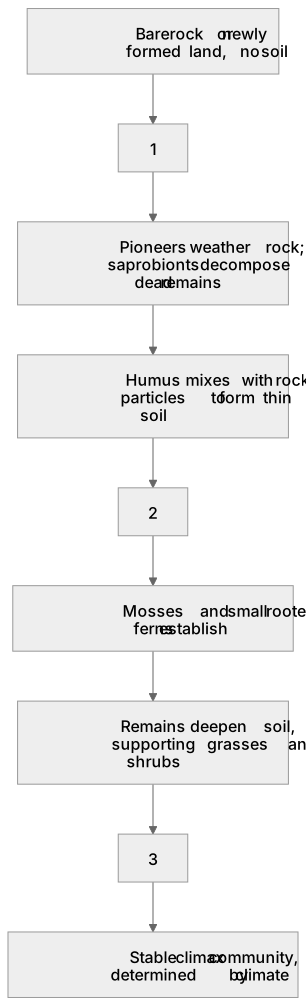
1Box 1
2Box 2
3Box 3
There is more to this lesson
The full lesson goes on to check your understanding and help you earn the marks. Create a free account to carry on, with your progress saved.
A week of Premium from your first lesson · Then the free plan continues · No card, no charge
Test your understanding of Populations in ecosystems (A-level only): Primary succession, from colonisation by pioneer species to climax community.
Active recall beats re-reading. Take an instant quiz now to test what you’ve learned and lock it into long-term memory.
A week of Premium from your first lesson · Then the free plan continues · No card, no charge