AQA · A-Level · Biology
Course version: 7402 · Version from Sept 2016
The importance of maintaining a stable blood glucose concentration in…
Full specification wording
Principles of homeostasis and negative feedback (A-level only): The importance of maintaining a stable blood glucose concentration in terms of availability of respiratory substrate and of the water potential of blood.
Glucose matters twice over.
Checked against the AQA 7402 specification (opens in a new tab) on .
- Point 3 of 6
- 4 key terms
Study notes
From the checked teaching notes for this specification point.
The idea
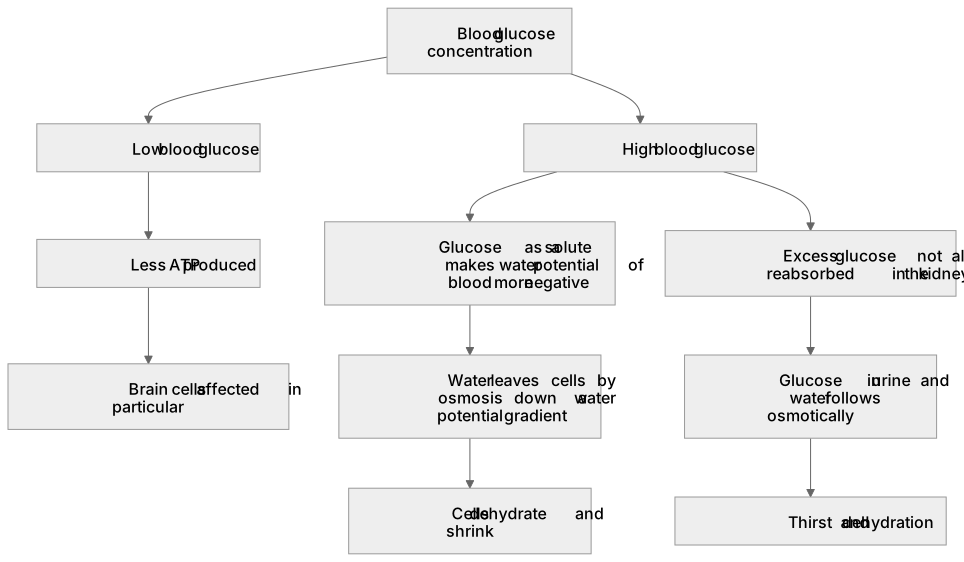
Glucose matters twice over. First, it is the main respiratory substrate: it is oxidised in respiration to release energy for ATP synthesis, and some cells, notably brain cells, which cannot respire fatty acids, depend on it almost entirely. If blood glucose falls too low, those cells cannot produce enough ATP, so active transport and nerve function fail, causing confusion, unconsciousness and eventually death. Second, glucose is a solute, so it contributes to the water potential of blood. If blood glucose rises too high, the water potential of the plasma becomes more negative than that of the cells, so water leaves cells by osmosis down a water potential gradient and they dehydrate and shrink. In the kidney the excess glucose is not all reabsorbed, so glucose appears in the urine and water follows it osmotically, producing thirst and dehydration.
What earns the marks
- Glucose being the main respiratory substrate, respired to release energy for the synthesis of ATP.
- A low blood glucose concentration meaning less ATP is produced, affecting brain cells in particular.
- Glucose being a solute that lowers the water potential of the blood.
- A high blood glucose concentration making the water potential of blood more negative, so water leaves cells by osmosis.
- Relating cell dehydration, or water loss in the urine, to the need for control in both directions.
Common mistakes and how to put them right
Writing that respiration produces energy rather than releasing energy to make ATP.
Saying a high glucose concentration gives a higher water potential, when adding solute makes water potential more negative.
Answering only about respiration and leaving out the water potential half of the statement.
Claiming water moves into cells when blood glucose rises.
Stating that brain cells store glycogen and so are unaffected by a low blood glucose concentration.
Exam tips
- The statement names two reasons, so a question on it almost always needs both; write a sentence on each.
- Use more negative water potential rather than lower, which is ambiguous.
- Link osmosis to a water potential gradient every time; a bare by osmosis usually loses the explanation mark.
Try the lesson
The start of the Principles of homeostasis and negative feedback (A-level only): The importance of maintaining a stable blood glucose concentration in terms of availability of respiratory substrate and of the water potential of blood. lesson, made from checked teaching notes for this specification point.
Have a go first
Why is a stable blood glucose concentration important for the availability of respiratory substrate?
Listen
Glucose matters twice over. First, it is the main respiratory substrate: it is oxidised in respiration to release energy for ATP synthesis, and some cells, notably brain cells, which cannot respire fatty acids, depend on it almost entirely. If blood glucose falls too low, those cells cannot produce enough ATP, so active transport and nerve function fail, causing confusion, unconsciousness and eventually death. Second, glucose is a solute, so it contributes to the water potential of blood. If blood glucose rises too high, the water potential of the plasma becomes more negative than that of the cells, so water leaves cells by osmosis down a water potential gradient and they dehydrate and shrink. In the kidney the excess glucose is not all reabsorbed, so glucose appears in the urine and water follows it osmotically, producing thirst and dehydration. A strong answer earns marks for these points. glucose being the main respiratory substrate, respired to release energy for the synthesis of ATP. a low blood glucose concentration meaning less ATP is produced, affecting brain cells in particular. glucose being a solute that lowers the water potential of the blood. a high blood glucose concentration making the water potential of blood more negative, so water leaves cells by osmosis. Exam tip: The statement names two reasons, so a question on it almost always needs both; write a sentence on each.
See it
Key words
Say what each word means before you turn the card.
respiratory substrate
Try answering aloud or in your head before turning the card.
ATP production
Try answering aloud or in your head before turning the card.
brain dependence on glucose
Try answering aloud or in your head before turning the card.
water potential of blood
Try answering aloud or in your head before turning the card.
See every definition
- respiratory substrate
- Glucose is the main one, oxidised in respiration to release energy for ATP synthesis.
- ATP production
- If blood glucose falls too low, cells cannot produce enough, so active transport and nerve function fail.
- brain dependence on glucose
- Brain cells cannot respire fatty acids and depend on glucose almost entirely.
- water potential of blood
- Glucose is a solute, so it contributes to this, and a high concentration makes it more negative than that of the cells.
Label the diagram
Some boxes have lost their names. Pick the right name for each number.
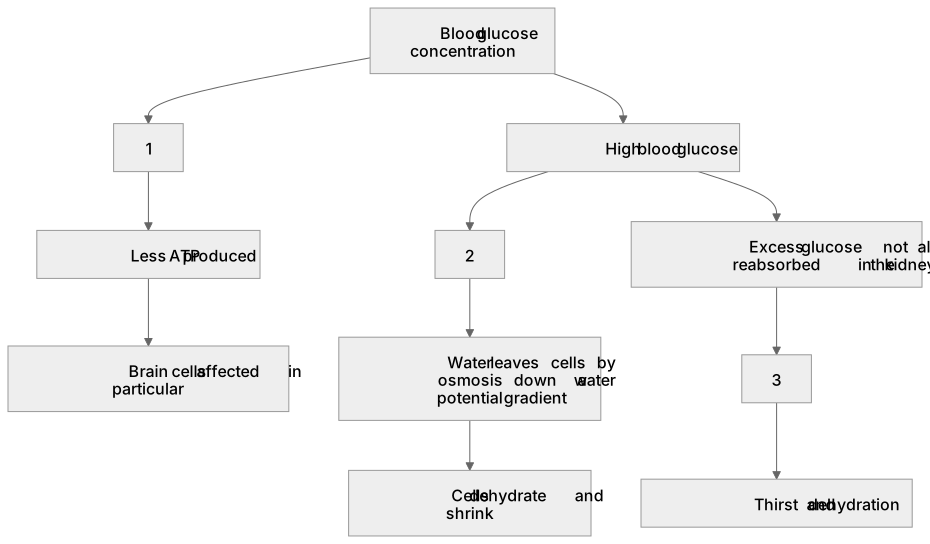
1Box 1
2Box 2
3Box 3
There is more to this lesson
The full lesson goes on to check your understanding and help you earn the marks. Create a free account to carry on, with your progress saved.
A week of Premium from your first lesson · Then the free plan continues · No card, no charge
Test your understanding of Principles of homeostasis and negative feedback (A-level only): The importance of maintaining a stable blood glucose concentration in terms of availability of respiratory substrate and of the water potential of blood.
Active recall beats re-reading. Take an instant quiz now to test what you’ve learned and lock it into long-term memory.
A week of Premium from your first lesson · Then the free plan continues · No card, no charge