AQA · A-Level · Biology
Course version: 7402 · Version from Sept 2016
Negative feedback restores systems to their original level.
Full specification wording
Principles of homeostasis and negative feedback (A-level only): Negative feedback restores systems to their original level.
In negative feedback a change in a variable sets in motion a response that reverses that change.
Checked against the AQA 7402 specification (opens in a new tab) on .
- Point 4 of 6
- 4 key terms
Study notes
From the checked teaching notes for this specification point.
The idea
In negative feedback a change in a variable sets in motion a response that reverses that change. Receptors detect a deviation from the set point, the information passes to a coordinator, effectors produce a response in the opposite direction to the original change, the variable returns towards the set point, and when it is back within limits the receptors detect this and the corrective response is switched off. That last step matters, because a system that could not stop correcting would overshoot. Blood glucose is the standard example: a rise is detected by the beta cells of the islets of Langerhans, insulin is secreted, glucose is taken up and stored as glycogen, and the falling concentration then reduces insulin secretion. Positive feedback is the opposite.
What earns the marks
- The change being detected by receptors as a deviation from a set point or norm.
- The effector response acting in the opposite direction to the original change.
- The variable being returned to, or towards, its original level.
- The corrective mechanism then being switched off, so the system does not overshoot.
- Contrasting this with positive feedback, in which the response increases the original change.
Common mistakes and how to put them right
Describing negative feedback as something that stops a change, rather than reversing it back to the set point.
Omitting the switch-off step, so the system described would overshoot indefinitely.
Taking negative to mean that the value falls, rather than that the response opposes the change.
Labelling a homeostatic mechanism as positive feedback simply because the level rises.
Writing about hormones or nerves without ever naming receptor, coordinator and effector.
Exam tips
- Draw the loop as a circle with four labels, stimulus, receptor, effector, return, and write from it.
- The word restores is doing work in the specification; say the level returns to normal, not just that it changes.
- For an unfamiliar system, decide first whether the response opposes or amplifies the change, because that judgement usually carries the mark.
Try the lesson
The start of the Principles of homeostasis and negative feedback (A-level only): Negative feedback restores systems to their original level. lesson, made from checked teaching notes for this specification point.
Have a go first
What does negative feedback do to a system that has moved away from its original level?
Listen
In negative feedback a change in a variable sets in motion a response that reverses that change. Receptors detect a deviation from the set point, the information passes to a coordinator, effectors produce a response in the opposite direction to the original change, the variable returns towards the set point, and when it is back within limits the receptors detect this and the corrective response is switched off. That last step matters, because a system that could not stop correcting would overshoot. Blood glucose is the standard example: a rise is detected by the beta cells of the islets of Langerhans, insulin is secreted, glucose is taken up and stored as glycogen, and the falling concentration then reduces insulin secretion. Positive feedback is the opposite. A strong answer earns marks for these points. the change being detected by receptors as a deviation from a set point or norm. the effector response acting in the opposite direction to the original change. the variable being returned to, or towards, its original level. the corrective mechanism then being switched off, so the system does not overshoot. Exam tip: Draw the loop as a circle with four labels, stimulus, receptor, effector, return, and write from it.
See it
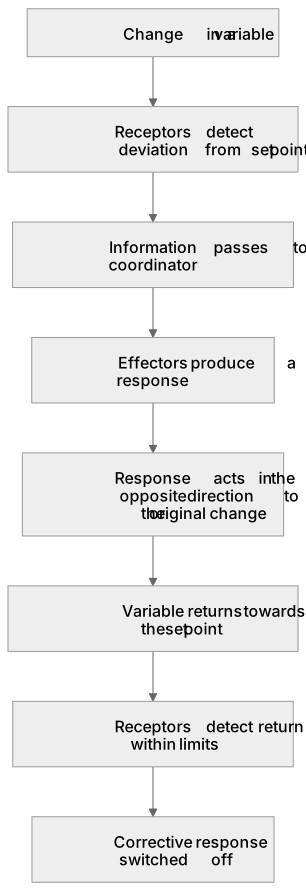
Put it in order
Put these steps in the order they happen.
- 1. Response acts in the opposite direction to the original change
- 2. Corrective response switched off
- 3. Variable returns towards the set point
- 4. Change in a variable
- 5. Receptors detect deviation from set point
- 6. Receptors detect return within limits
- 7. Information passes to a coordinator
- 8. Effectors produce a response
Key words
Say what each word means before you turn the card.
deviation from set point
Try answering aloud or in your head before turning the card.
corrective response
Try answering aloud or in your head before turning the card.
return to the original level
Try answering aloud or in your head before turning the card.
switching off the response
Try answering aloud or in your head before turning the card.
See every definition
- deviation from set point
- A change in a variable that receptors detect, setting in motion a response that reverses that change.
- corrective response
- A response produced by effectors in the opposite direction to the original change, returning the variable towards the set point.
- return to the original level
- The variable coming back to, or towards, its original level once the corrective response has acted.
- switching off the response
- When the variable is back within limits the receptors detect this and the corrective response is stopped, so the system does not overshoot.
Label the diagram
Some boxes have lost their names. Pick the right name for each number.
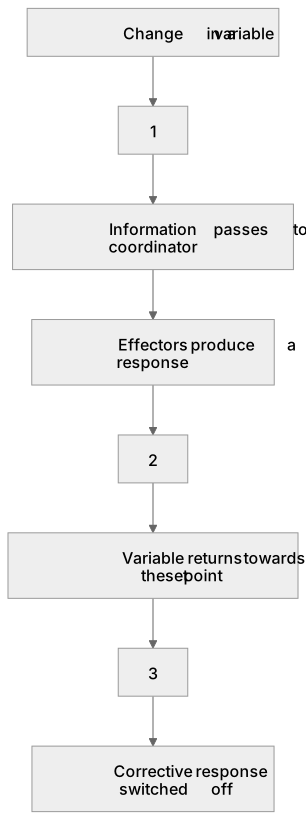
1Box 1
2Box 2
3Box 3
There is more to this lesson
The full lesson goes on to check your understanding and help you earn the marks. Create a free account to carry on, with your progress saved.
A week of Premium from your first lesson · Then the free plan continues · No card, no charge
Test your understanding of Principles of homeostasis and negative feedback (A-level only): Negative feedback restores systems to their original level.
Active recall beats re-reading. Take an instant quiz now to test what you’ve learned and lock it into long-term memory.
A week of Premium from your first lesson · Then the free plan continues · No card, no charge