AQA · A-Level · Biology
Course version: 7402 · Version from Sept 2016
The possession of separate mechanisms involving negative feedback controls…
Full specification wording
Principles of homeostasis and negative feedback (A-level only): The possession of separate mechanisms involving negative feedback controls departures in different directions from the original state, giving a greater degree of control.
A system with only one corrective mechanism can push a variable one way and then wait passively for it to drift back.
Checked against the AQA 7402 specification (opens in a new tab) on .
- Point 5 of 6
- 4 key terms
Study notes
From the checked teaching notes for this specification point.
The idea
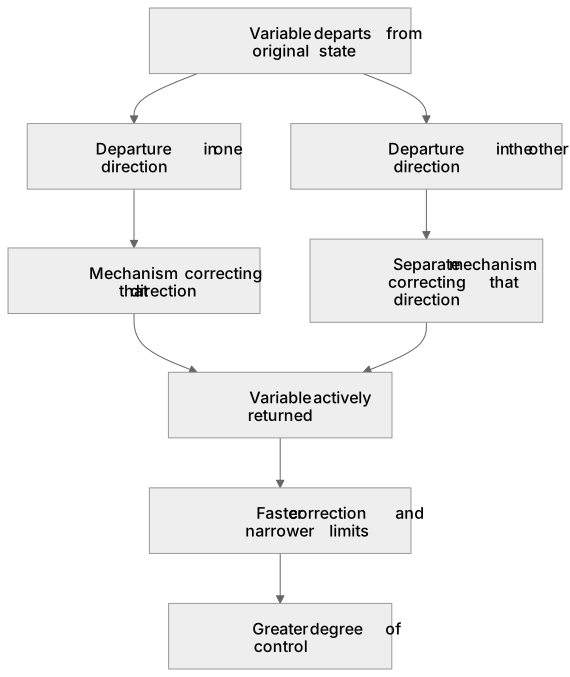
A system with only one corrective mechanism can push a variable one way and then wait passively for it to drift back. A system with two mechanisms, each controlling a departure in a different direction, can actively pull the value back from either side, so corrections are faster and the variable stays within a narrower range, which is what a greater degree of control means. Blood glucose is regulated by insulin, which lowers it, and by glucagon, which raises it; the two are secreted by different cells of the islets of Langerhans and have opposite effects. Heart rate is raised by sympathetic and lowered by parasympathetic neurones. Body temperature is corrected by vasodilation and sweating when too hot and by vasoconstriction, shivering and a raised metabolic rate when too cold.
What earns the marks
- Stating that one mechanism corrects a rise while a separate mechanism corrects a fall.
- Naming a valid pair, such as insulin and glucagon, or sympathetic and parasympathetic stimulation.
- Explaining that the variable is actively returned from either direction rather than drifting back.
- Stating that this gives faster correction and keeps the variable within narrower limits.
- Relating this to a greater degree of control overall.
Common mistakes and how to put them right
Naming a pair that acts in the same direction, such as glucagon and adrenaline, when opposing mechanisms are wanted.
Saying the two mechanisms cancel each other out.
Stating that two mechanisms give better control without explaining why one alone is worse.
Describing insulin as switching glucagon off, rather than both being controlled separately by blood glucose concentration.
Treating vasodilation and vasoconstriction as one mechanism in reverse rather than as two separate responses.
Exam tips
- Always give a paired example, one mechanism for each direction, and say what each does to the variable.
- Unpack the phrase greater degree of control as faster return and narrower fluctuation.
- Prepare one worked example, glucose or temperature, that you can deploy in either context.
Try the lesson
The start of the Principles of homeostasis and negative feedback (A-level only): The possession of separate mechanisms involving negative feedback controls departures in different directions from the original state, giving a greater degree of control. lesson, made from checked teaching notes for this specification point.
Have a go first
What is the main advantage of having separate negative feedback mechanisms to control departures in different directions from an original state?
Listen
A system with only one corrective mechanism can push a variable one way and then wait passively for it to drift back. A system with two mechanisms, each controlling a departure in a different direction, can actively pull the value back from either side, so corrections are faster and the variable stays within a narrower range, which is what a greater degree of control means. Blood glucose is regulated by insulin, which lowers it, and by glucagon, which raises it; the two are secreted by different cells of the islets of Langerhans and have opposite effects. Heart rate is raised by sympathetic and lowered by parasympathetic neurones. Body temperature is corrected by vasodilation and sweating when too hot and by vasoconstriction, shivering and a raised metabolic rate when too cold. A strong answer earns marks for these points. stating that one mechanism corrects a rise while a separate mechanism corrects a fall. naming a valid pair, such as insulin and glucagon, or sympathetic and parasympathetic stimulation. explaining that the variable is actively returned from either direction rather than drifting back. stating that this gives faster correction and keeps the variable within narrower limits. Exam tip: Always give a paired example, one mechanism for each direction, and say what each does to the variable.
See it
Key words
Say what each word means before you turn the card.
opposing mechanisms
Try answering aloud or in your head before turning the card.
insulin and glucagon
Try answering aloud or in your head before turning the card.
sympathetic and parasympathetic control
Try answering aloud or in your head before turning the card.
degree of control
Try answering aloud or in your head before turning the card.
See every definition
- opposing mechanisms
- Separate mechanisms involving negative feedback that control departures in different directions from the original state.
- insulin and glucagon
- Secreted by different cells of the islets of Langerhans, they have opposite effects, with one lowering blood glucose and the other raising it.
- sympathetic and parasympathetic control
- Neurones that raise heart rate and neurones that lower it.
- degree of control
- Greater when separate mechanisms actively pull the value back from either side, so corrections are faster and the variable stays within a narrower range.
Label the diagram
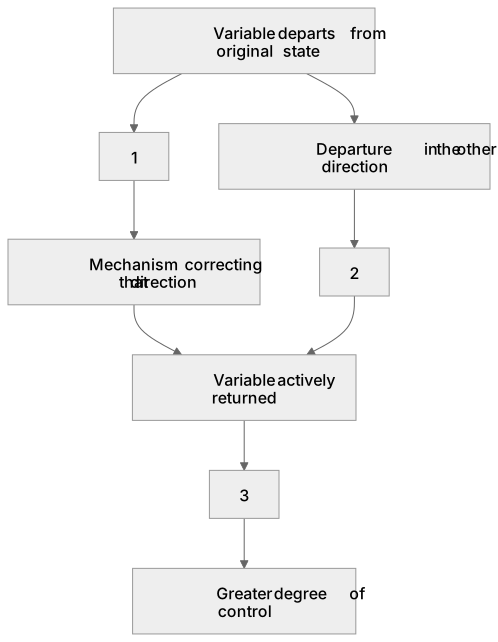
Some boxes have lost their names. Pick the right name for each number.
1Box 1
2Box 2
3Box 3
There is more to this lesson
The full lesson goes on to check your understanding and help you earn the marks. Create a free account to carry on, with your progress saved.
A week of Premium from your first lesson · Then the free plan continues · No card, no charge
Test your understanding of Principles of homeostasis and negative feedback (A-level only): The possession of separate mechanisms involving negative feedback controls departures in different directions from the original state, giving a greater degree of control.
Active recall beats re-reading. Take an instant quiz now to test what you’ve learned and lock it into long-term memory.
A week of Premium from your first lesson · Then the free plan continues · No card, no charge