AQA · A-Level · Biology
Course version: 7402 · Version from Sept 2016
Fragments of DNA can be amplified by in vitro and in vivo techniques.
Full specification wording
Recombinant DNA technology (A-level only): Fragments of DNA can be amplified by in vitro and in vivo techniques.
A single copy of a gene is no use for screening, sequencing or manufacture, so the fragment must be amplified.
Checked against the AQA 7402 specification (opens in a new tab) on .
- Point 4 of 10
- 3 key terms
Study notes
From the checked teaching notes for this specification point.
The idea
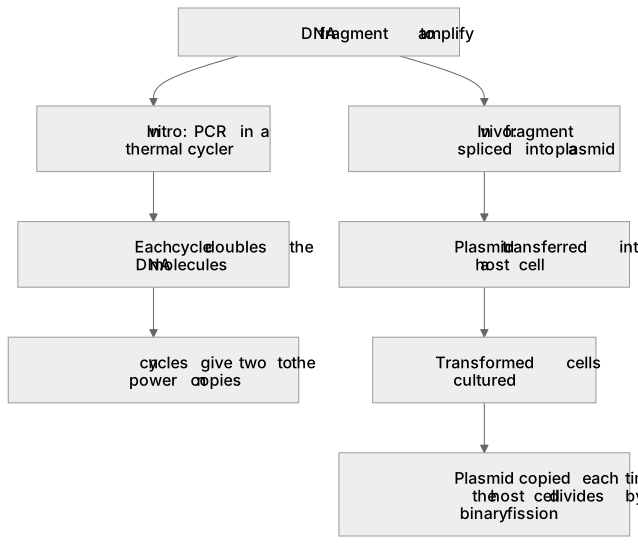
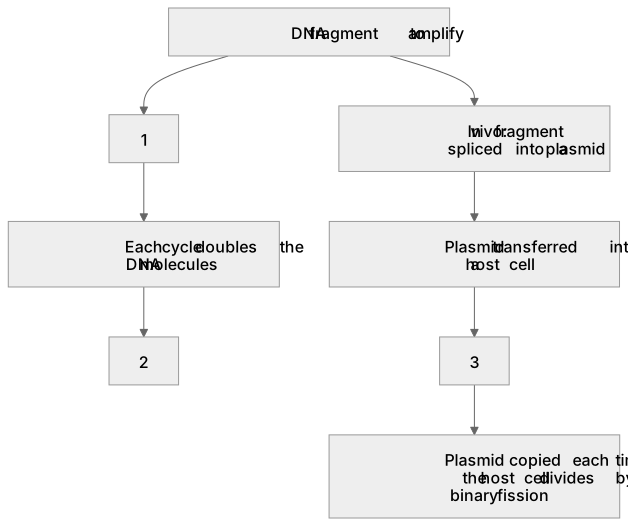
A single copy of a gene is no use for screening, sequencing or manufacture, so the fragment must be amplified. In vitro means outside a living organism, and the standard method is the polymerase chain reaction, carried out in a thermal cycler with primers, free DNA nucleotides and a heat-stable DNA polymerase. Each cycle doubles the number of DNA molecules, so n cycles give two to the power n copies. PCR is very fast, needs only a trace of starting material and produces the fragment on its own, but it copies any errors and makes only DNA. In vivo means inside a living organism. The fragment, with promoter and terminator regions added, is spliced into a plasmid, transferred into a host cell, and the transformed cells are cultured; every time a bacterium divides by binary fission the plasmid is copied too.
What earns the marks
- Using PCR to amplify the DNA or sample, or a correct description of amplification.
- Identifying PCR as in vitro, taking place outside living cells.
- The in vivo route being insertion of the fragment into a vector and culture of transformed host cells.
- The plasmid being copied each time the host cell divides, so copy number rises with the population.
- A valid comparison, such as PCR being faster and needing a smaller sample, while in vivo culture also yields the protein and larger quantities.
Common mistakes and how to put them right
Using in vitro and in vivo the wrong way round.
Describing PCR as taking place inside a bacterium.
Saying PCR produces protein, when it produces only DNA.
Claiming PCR 'makes a gene', when it copies a fragment that must already be present.
Giving a comparison with no criterion, such as 'PCR is better', with nothing measured.
Exam tips
- Fix the terms by their literal meaning: in vitro is in glass, in vivo is in the living.
- Comparison questions want a named criterion - speed, quantity, accuracy or whether protein is produced.
- If the question says 'amplify', the first mark is almost always the word PCR or a description of doubling.
Try the lesson
The start of the Recombinant DNA technology (A-level only): Fragments of DNA can be amplified by in vitro and in vivo techniques. lesson, made from checked teaching notes for this specification point.
Have a go first
Which technique amplifies DNA fragments in vitro?
Listen
A single copy of a gene is no use for screening, sequencing or manufacture, so the fragment must be amplified. In vitro means outside a living organism, and the standard method is the polymerase chain reaction, carried out in a thermal cycler with primers, free DNA nucleotides and a heat-stable DNA polymerase. Each cycle doubles the number of DNA molecules, so n cycles give two to the power n copies. PCR is very fast, needs only a trace of starting material and produces the fragment on its own, but it copies any errors and makes only DNA. In vivo means inside a living organism. The fragment, with promoter and terminator regions added, is spliced into a plasmid, transferred into a host cell, and the transformed cells are cultured; every time a bacterium divides by binary fission the plasmid is copied too. A strong answer earns marks for these points. using PCR to amplify the DNA or sample, or a correct description of amplification. identifying PCR as in vitro, taking place outside living cells. the in vivo route being insertion of the fragment into a vector and culture of transformed host cells. the plasmid being copied each time the host cell divides, so copy number rises with the population. Exam tip: Fix the terms by their literal meaning: in vitro is in glass, in vivo is in the living.
See it
Key words
Say what each word means before you turn the card.
in vitro and in vivo
Try answering aloud or in your head before turning the card.
polymerase chain reaction
Try answering aloud or in your head before turning the card.
transformed host cells
Try answering aloud or in your head before turning the card.
See every definition
- in vitro and in vivo
- In vitro means outside a living organism, while in vivo means inside a living organism.
- polymerase chain reaction
- The standard in vitro method, carried out in a thermal cycler with primers, free DNA nucleotides and a heat-stable DNA polymerase.
- transformed host cells
- Cells that have taken up a plasmid carrying the fragment, with promoter and terminator regions added, and are then cultured.
Label the diagram
Some boxes have lost their names. Pick the right name for each number.
1Box 1
2Box 2
3Box 3
There is more to this lesson
The full lesson goes on to check your understanding and help you earn the marks. Create a free account to carry on, with your progress saved.
A week of Premium from your first lesson · Then the free plan continues · No card, no charge
Test your understanding of Recombinant DNA technology (A-level only): Fragments of DNA can be amplified by in vitro and in vivo techniques.
Active recall beats re-reading. Take an instant quiz now to test what you’ve learned and lock it into long-term memory.
A week of Premium from your first lesson · Then the free plan continues · No card, no charge