AQA · A-Level · Biology
Course version: 7402 · Version from Sept 2016
Fragments of DNA can be produced by several methods, including: conversion…
Full specification wording
Recombinant DNA technology (A-level only): Fragments of DNA can be produced by several methods, including: conversion of mRNA to complementary DNA (cDNA), using reverse transcriptase using restriction enzymes to cut a fragment containing the desired gene from DNA creating the gene in a ‘gene machine’.
There are three routes to a DNA fragment.
Checked against the AQA 7402 specification (opens in a new tab) on .
- Point 3 of 10
- 4 key terms
Study notes
From the checked teaching notes for this specification point.
The idea
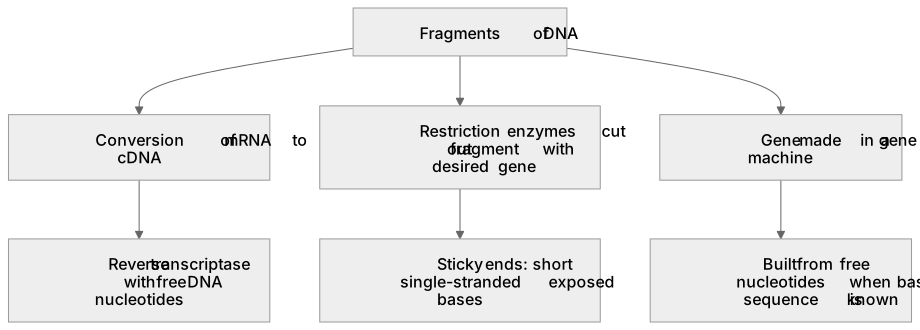
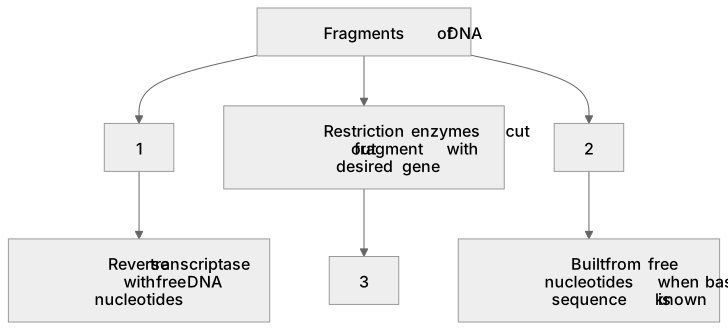
There are three routes to a DNA fragment. First, complementary DNA: choose a cell that makes the protein in quantity, so it is rich in the relevant mRNA - beta cells of the pancreas for insulin - extract the mature mRNA, and use reverse transcriptase with free DNA nucleotides to build a single-stranded DNA copy; DNA polymerase then adds the second strand. Because the mRNA has already been spliced, cDNA contains only exons, so a bacterium can express it. Second, restriction endonucleases: each enzyme recognises one specific palindromic sequence and hydrolyses phosphodiester bonds in the sugar-phosphate backbone there. A staggered cut leaves sticky ends, short single-stranded runs of exposed bases that can later pair with complementary ends. Third, the gene machine: if the base sequence is known, the gene can be synthesised from free nucleotides, with no introns and no need for mRNA.
What earns the marks
- Using reverse transcriptase with free DNA nucleotides to make cDNA from mRNA.
- Explaining that cDNA contains no introns because the mRNA has already been spliced.
- Restriction endonucleases cutting the DNA at specific base sequences, that is at recognition or restriction sites, accepting palindromic sequences.
- A staggered cut producing sticky ends, short exposed single-stranded sections of bases.
- The gene machine building the gene from a known base sequence, free of introns.
Common mistakes and how to put them right
Saying reverse transcriptase makes mRNA from DNA, which is the wrong direction.
Saying restriction enzymes cut at random, or that they simply 'cut the gene out', with no recognition sequence named.
Describing sticky ends as complementary amino acids or as complementary genes.
Choosing any cell to extract mRNA from, when the mark is for a cell that actively produces the protein.
Saying the restriction enzyme breaks the hydrogen bonds between the strands, when it hydrolyses phosphodiester bonds in the backbone.
Exam tips
- If a question gives you a choice of method, cDNA is the safe answer for a eukaryotic gene because of the introns.
- Use the phrase 'specific base sequence' or 'recognition site' whenever restriction enzymes appear - it is where the mark sits.
- Say which bond is broken or formed; the examiner is checking you know phosphodiester bonds from hydrogen bonds.
Try the lesson
The start of the Recombinant DNA technology (A-level only): Fragments of DNA can be produced by several methods, including: conversion of mRNA to complementary DNA (cDNA), using reverse transcriptase using restriction enzymes to cut a fragment containing the desired gene from DNA creating the gene in a ‘gene machine’. lesson, made from checked teaching notes for this specification point.
Have a go first
Which enzyme is used to convert mRNA into complementary DNA (cDNA)?
Listen
There are three routes to a DNA fragment. First, complementary DNA: choose a cell that makes the protein in quantity, so it is rich in the relevant mRNA - beta cells of the pancreas for insulin - extract the mature mRNA, and use reverse transcriptase with free DNA nucleotides to build a single-stranded DNA copy; DNA polymerase then adds the second strand. Because the mRNA has already been spliced, cDNA contains only exons, so a bacterium can express it. Second, restriction endonucleases: each enzyme recognises one specific palindromic sequence and hydrolyses phosphodiester bonds in the sugar-phosphate backbone there. A staggered cut leaves sticky ends, short single-stranded runs of exposed bases that can later pair with complementary ends. Third, the gene machine: if the base sequence is known, the gene can be synthesised from free nucleotides, with no introns and no need for mRNA. A strong answer earns marks for these points. using reverse transcriptase with free DNA nucleotides to make cDNA from mRNA. explaining that cDNA contains no introns because the mRNA has already been spliced. restriction endonucleases cutting the DNA at specific base sequences, that is at recognition or restriction sites, accepting palindromic sequences. a staggered cut producing sticky ends, short exposed single-stranded sections of bases. Exam tip: If a question gives you a choice of method, cDNA is the safe answer for a eukaryotic gene because of the introns.
See it
Key words
Say what each word means before you turn the card.
cDNA and reverse transcriptase
Try answering aloud or in your head before turning the card.
restriction endonucleases
Try answering aloud or in your head before turning the card.
recognition sites
Try answering aloud or in your head before turning the card.
sticky ends
Try answering aloud or in your head before turning the card.
See every definition
- cDNA and reverse transcriptase
- Reverse transcriptase with free DNA nucleotides builds a single-stranded DNA copy from mature mRNA, and DNA polymerase then adds the second strand.
- restriction endonucleases
- Each enzyme recognises one specific palindromic sequence and hydrolyses phosphodiester bonds in the sugar-phosphate backbone there.
- recognition sites
- The specific palindromic base sequence at which a restriction endonuclease cuts the DNA.
- sticky ends
- Short single-stranded runs of exposed bases left by a staggered cut, which can later pair with complementary ends.
Label the diagram
Some boxes have lost their names. Pick the right name for each number.
1Box 1
2Box 2
3Box 3
There is more to this lesson
The full lesson goes on to check your understanding and help you earn the marks. Create a free account to carry on, with your progress saved.
A week of Premium from your first lesson · Then the free plan continues · No card, no charge
Test your understanding of Recombinant DNA technology (A-level only): Fragments of DNA can be produced by several methods, including: conversion of mRNA to complementary DNA (cDNA), using reverse transcriptase using restriction enzymes to cut a fragment containing the desired gene from DNA creating the gene in a ‘gene machine’.
Active recall beats re-reading. Take an instant quiz now to test what you’ve learned and lock it into long-term memory.
A week of Premium from your first lesson · Then the free plan continues · No card, no charge