AQA · A-Level · Biology
Course version: 7402 · Version from Sept 2016
Since the genetic code is universal, as are transcription and translation…
Full specification wording
Recombinant DNA technology (A-level only): Since the genetic code is universal, as are transcription and translation mechanisms, the transferred DNA can be translated within cells of the recipient (transgenic) organism.
The genetic code is universal: the same DNA triplet and mRNA codon code for the same amino acid in almost every organism.
Checked against the AQA 7402 specification (opens in a new tab) on .
- Point 2 of 10
- 4 key terms
Study notes
From the checked teaching notes for this specification point.
The idea
The genetic code is universal: the same DNA triplet and mRNA codon code for the same amino acid in almost every organism. Transcription and translation mechanisms are also universal. RNA polymerase transcribes mRNA, and ribosomes assemble amino acids as dictated by codons. Thus, a human gene transferred into a bacterium can be transcribed and translated to produce a human amino acid sequence. However, limitations exist. Bacteria lack spliceosomes and cannot remove introns from eukaryotic pre-mRNA, so cDNA made from mature mRNA is used instead of chromosomal DNA. Furthermore, bacteria lack eukaryotic promoter recognition and organelles like the Golgi apparatus, meaning they cannot perform post-translational modifications such as glycosylation.
What earns the marks
- The genetic code is universal, meaning the same triplets or codons code for the same amino acids in almost all species.
- The mechanism of transcription is fundamentally the same in both organisms.
- The mechanism of translation is the same, as bacteria possess ribosomes to translate the mRNA.
- Bacteria cannot splice pre-mRNA because they lack spliceosomes, so introns are not removed.
- Bacteria lack a Golgi apparatus, so the protein cannot undergo post-translational modifications like glycosylation.
- Bacteria lack eukaryotic promoter recognition, which can prevent the transcription of unmodified eukaryotic genes.
Common mistakes and how to put them right
Writing 'DNA is universal' on its own, which is not accepted unless qualified as the genetic code.
Stating 'the genetic code is degenerate' as the reason a bacterium can use a human gene.
Put it right: This is incorrect and rejected.
Claiming bacteria lack transcription factors entirely, rather than lacking specific eukaryotic promoter recognition.
Forgetting introns and claiming a bacterium can express any human gene taken straight from a chromosome.
Exam tips
- Two distinct marks are often available for stating the code is universal and the mechanisms are universal; write both.
- When asked why a bacterium might fail to make a functional human protein, name a missing structure (e.g., Golgi apparatus) and its function (e.g., glycosylation).
Try the lesson
The start of the Recombinant DNA technology (A-level only): Since the genetic code is universal, as are transcription and translation mechanisms, the transferred DNA can be translated within cells of the recipient (transgenic) organism. lesson, made from checked teaching notes for this specification point.
Have a go first
Why can a human gene that has been transferred into a bacterium be translated by the bacterium?
Listen
The genetic code is universal: the same DNA triplet and mRNA codon code for the same amino acid in almost every organism. Transcription and translation mechanisms are also universal. RNA polymerase transcribes mRNA, and ribosomes assemble amino acids as dictated by codons. Thus, a human gene transferred into a bacterium can be transcribed and translated to produce a human amino acid sequence. However, limitations exist. Bacteria lack spliceosomes and cannot remove introns from eukaryotic pre-mRNA, so cDNA made from mature mRNA is used instead of chromosomal DNA. Furthermore, bacteria lack eukaryotic promoter recognition and organelles like the Golgi apparatus, meaning they cannot perform post-translational modifications such as glycosylation. A strong answer earns marks for these points. The genetic code is universal, meaning the same triplets or codons code for the same amino acids in almost all species. The mechanism of transcription is fundamentally the same in both organisms. The mechanism of translation is the same, as bacteria possess ribosomes to translate the mRNA. Bacteria cannot splice pre-mRNA because they lack spliceosomes, so introns are not removed. Exam tip: Two distinct marks are often available for stating the code is universal and the mechanisms are universal; write both.
See it

Key words
Say what each word means before you turn the card.
universal genetic code
Try answering aloud or in your head before turning the card.
transcription and translation mechanisms
Try answering aloud or in your head before turning the card.
transgenic organisms
Try answering aloud or in your head before turning the card.
post-translational modification
Try answering aloud or in your head before turning the card.
See every definition
- universal genetic code
- The same DNA triplet and mRNA codon code for the same amino acid in almost every organism.
- transcription and translation mechanisms
- RNA polymerase transcribes mRNA, and ribosomes assemble amino acids as dictated by codons, and these mechanisms are also universal.
- transgenic organisms
- Organisms whose cells contain transferred DNA that can be translated within them.
- post-translational modification
- Modifications such as glycosylation, which bacteria cannot perform because they lack organelles like the Golgi apparatus.
Label the diagram
Some boxes have lost their names. Pick the right name for each number.
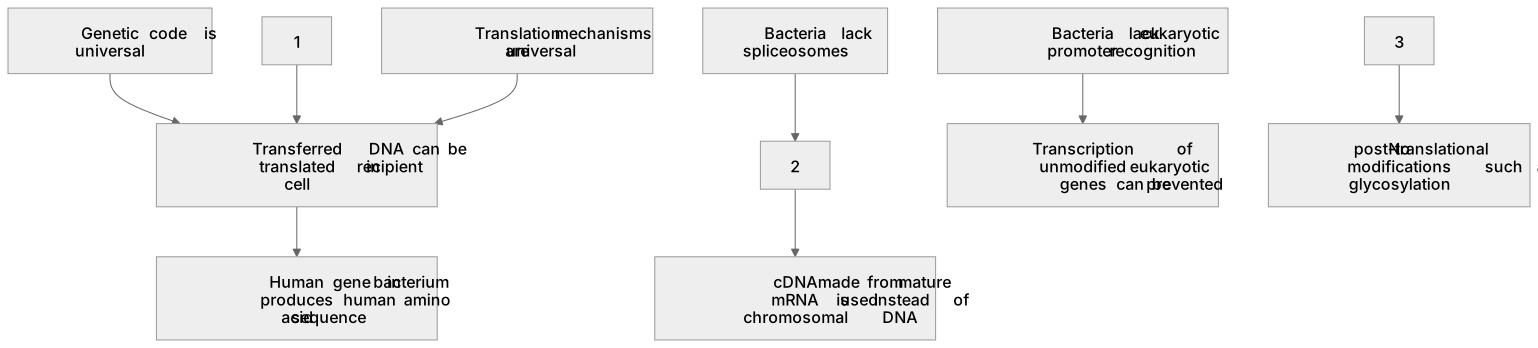
1Box 1
2Box 2
3Box 3
There is more to this lesson
The full lesson goes on to check your understanding and help you earn the marks. Create a free account to carry on, with your progress saved.
A week of Premium from your first lesson · Then the free plan continues · No card, no charge
Test your understanding of Recombinant DNA technology (A-level only): Since the genetic code is universal, as are transcription and translation mechanisms, the transferred DNA can be translated within cells of the recipient (transgenic) organism.
Active recall beats re-reading. Take an instant quiz now to test what you’ve learned and lock it into long-term memory.
A week of Premium from your first lesson · Then the free plan continues · No card, no charge