AQA · A-Level · Biology
Course version: 7402 · Version from Sept 2016
In eukaryotes and some prokaryotes, translation of the mRNA produced from…
Full specification wording
Regulation of transcription and translation (A-level only): In eukaryotes and some prokaryotes, translation of the mRNA produced from target genes can be inhibited by RNA interference (RNAi).
RNA interference silences a gene after its mRNA has already been made, so transcription is unaffected.
Checked against the AQA 7402 specification (opens in a new tab) on .
- Point 6 of 7
- 4 key terms
Study notes
From the checked teaching notes for this specification point.
The idea
RNA interference silences a gene after its mRNA has already been made, so transcription is unaffected. Double-stranded RNA in the cytoplasm is cut by an enzyme, dicer, into short lengths of about 21 nucleotides called small interfering RNA, siRNA. One strand of each siRNA is taken up by a protein complex, RISC. The siRNA acts as a guide: its bases pair with complementary bases on any mRNA carrying that sequence. Once the complex is attached, the enzyme in it cuts the mRNA into fragments, which are then hydrolysed in the cytoplasm. The mRNA never reaches a ribosome, so no polypeptide is translated and the gene is effectively switched off. microRNA works in a similar way but pairs less precisely, so it can block translation of several different mRNA molecules rather than destroying one. RNAi occurs in eukaryotes and in some prokaryotes, and is used experimentally to test what a gene does.
What earns the marks
- Double-stranded RNA being cut by an enzyme into small sections of siRNA.
- One strand of the siRNA combining with an enzyme or protein complex in the cytoplasm.
- The siRNA bases pairing with complementary bases on the target mRNA.
- The mRNA being cut or hydrolysed, so it cannot be translated at a ribosome.
- Concluding that the polypeptide is not produced, so the gene is not expressed.
Common mistakes and how to put them right
Saying RNAi stops transcription, when the mRNA has already been transcribed and the block is at translation.
Saying the siRNA binds to the DNA or to the gene rather than to the mRNA.
Describing siRNA as complementary to the template strand of the gene instead of to the mRNA.
Confusing siRNA with tRNA, so writing about anticodons and amino acids.
Saying the protein is broken down, when it is the mRNA that is destroyed and the protein is never made.
Exam tips
- Anchor the answer with the word 'complementary' next to the word 'mRNA' - that pairing is where the mark sits.
- Finish every RNAi answer with 'so the polypeptide is not produced', which is usually the last mark.
- Say explicitly that this happens after transcription, to show you know the level of control being described.
Try the lesson
The start of the Regulation of transcription and translation (A-level only): In eukaryotes and some prokaryotes, translation of the mRNA produced from target genes can be inhibited by RNA interference (RNAi). lesson, made from checked teaching notes for this specification point.
Have a go first
Which molecule binds to a target mRNA molecule during RNA interference to prevent its translation?
Listen
RNA interference silences a gene after its mRNA has already been made, so transcription is unaffected. Double-stranded RNA in the cytoplasm is cut by an enzyme, dicer, into short lengths of about 21 nucleotides called small interfering RNA, siRNA. One strand of each siRNA is taken up by a protein complex, RISC. The siRNA acts as a guide: its bases pair with complementary bases on any mRNA carrying that sequence. Once the complex is attached, the enzyme in it cuts the mRNA into fragments, which are then hydrolysed in the cytoplasm. The mRNA never reaches a ribosome, so no polypeptide is translated and the gene is effectively switched off. microRNA works in a similar way but pairs less precisely, so it can block translation of several different mRNA molecules rather than destroying one. RNAi occurs in eukaryotes and in some prokaryotes, and is used experimentally to test what a gene does. A strong answer earns marks for these points. double-stranded RNA being cut by an enzyme into small sections of siRNA. one strand of the siRNA combining with an enzyme or protein complex in the cytoplasm. the siRNA bases pairing with complementary bases on the target mRNA. the mRNA being cut or hydrolysed, so it cannot be translated at a ribosome. Exam tip: Anchor the answer with the word 'complementary' next to the word 'mRNA' - that pairing is where the mark sits.
See it
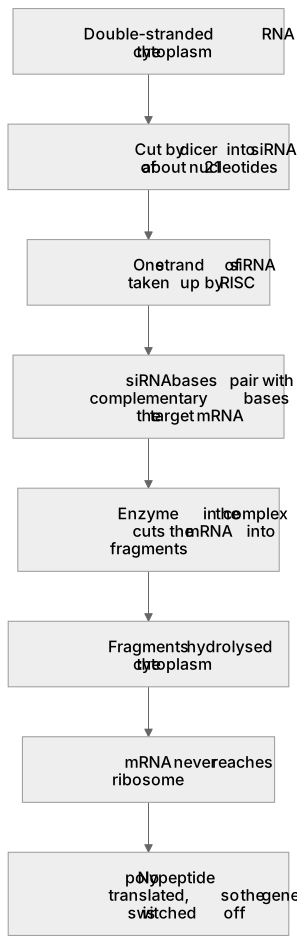
Put it in order
Put these steps in the order they happen.
- 1. Enzyme in the complex cuts the mRNA into fragments
- 2. No polypeptide translated, so the gene is switched off
- 3. Fragments hydrolysed in the cytoplasm
- 4. Double-stranded RNA in the cytoplasm
- 5. Cut by dicer into siRNA of about 21 nucleotides
- 6. mRNA never reaches a ribosome
- 7. One strand of siRNA taken up by RISC
- 8. siRNA bases pair with complementary bases on the target mRNA
Key words
Say what each word means before you turn the card.
RNA interference
Try answering aloud or in your head before turning the card.
siRNA and microRNA
Try answering aloud or in your head before turning the card.
complementary base pairing
Try answering aloud or in your head before turning the card.
mRNA hydrolysis
Try answering aloud or in your head before turning the card.
See every definition
- RNA interference
- In eukaryotes and some prokaryotes, translation of the mRNA produced from target genes can be inhibited by this process.
- siRNA and microRNA
- Double-stranded RNA in the cytoplasm is cut by an enzyme into short lengths of about 21 nucleotides called small interfering RNA; microRNA works in a similar way but pairs less precisely.
- complementary base pairing
- The bases of the siRNA pair with complementary bases on any mRNA carrying that sequence, acting as a guide.
- mRNA hydrolysis
- Once the complex is attached, the enzyme in it cuts the mRNA into fragments, which are then hydrolysed in the cytoplasm.
Label the diagram
Some boxes have lost their names. Pick the right name for each number.
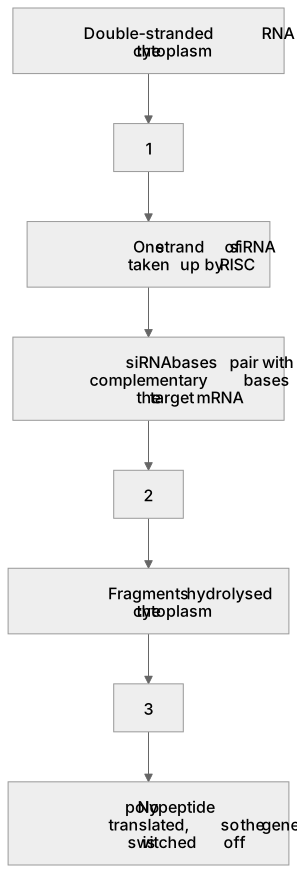
1Box 1
2Box 2
3Box 3
There is more to this lesson
The full lesson goes on to check your understanding and help you earn the marks. Create a free account to carry on, with your progress saved.
A week of Premium from your first lesson · Then the free plan continues · No card, no charge
Test your understanding of Regulation of transcription and translation (A-level only): In eukaryotes and some prokaryotes, translation of the mRNA produced from target genes can be inhibited by RNA interference (RNAi).
Active recall beats re-reading. Take an instant quiz now to test what you’ve learned and lock it into long-term memory.
A week of Premium from your first lesson · Then the free plan continues · No card, no charge