AQA · A-Level · Biology
Course version: 7402 · Version from Sept 2016
If respiration is aerobic, pyruvate from glycolysis enters the…
Full specification wording
Respiration (A-level only): If respiration is aerobic, pyruvate from glycolysis enters the mitochondrial matrix by active transport.
Glycolysis occurs in the cytoplasm and produces pyruvate.
Checked against the AQA 7402 specification (opens in a new tab) on .
- Point 6 of 8
- 4 key terms
Study notes
From the checked teaching notes for this specification point.
The idea
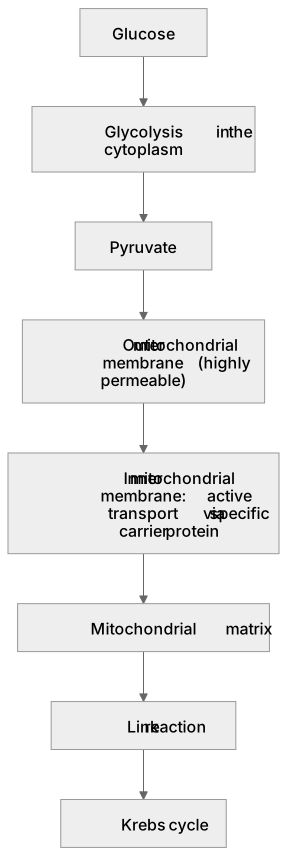
Glycolysis occurs in the cytoplasm and produces pyruvate. For aerobic respiration, pyruvate must reach the mitochondrial matrix, where the link reaction and Krebs cycle occur. Pyruvate crosses the outer mitochondrial membrane, which is highly permeable, then crosses the inner mitochondrial membrane by active transport through a specific carrier protein. This transport requires energy and ensures a continuous supply of pyruvate for the link reaction. Glucose itself does not enter the mitochondrion because it is broken down to pyruvate in the cytoplasm during glycolysis. A common error is to state that glucose enters mitochondria; instead, pyruvate is the molecule transported into the matrix. The carrier protein is specific to pyruvate, and active transport allows pyruvate to move against its concentration gradient if necessary.
What earns the marks
- Pyruvate is transported into the mitochondrial matrix by active transport.
- A specific carrier protein in the inner mitochondrial membrane is required for pyruvate transport.
- Pyruvate, not glucose, is the molecule that enters the mitochondrion after glycolysis.
- Pyruvate is used in the link reaction within the mitochondrial matrix, linking glycolysis to the Krebs cycle.
Common mistakes and how to put them right
Writing that glucose enters the mitochondrion.
Put it right: Glucose is broken down to pyruvate in the cytoplasm; pyruvate enters the mitochondrion.
Stating that pyruvate simply diffuses into the matrix.
Put it right: Pyruvate crosses the inner mitochondrial membrane by active transport via a carrier protein.
Claiming pyruvate crosses both mitochondrial membranes by active transport.
Put it right: The outer membrane is highly permeable; only the inner membrane requires active transport.
Exam tips
- Always specify active transport and mention a carrier protein; 'moves into the mitochondria' is insufficient.
- Check the molecule before writing: glycolysis ends at pyruvate, so pyruvate is what crosses the inner membrane.
Try the lesson
The start of the Respiration (A-level only): If respiration is aerobic, pyruvate from glycolysis enters the mitochondrial matrix by active transport. lesson, made from checked teaching notes for this specification point.
Have a go first
In aerobic respiration, by which process does pyruvate from glycolysis enter the mitochondrial matrix?
Listen
Glycolysis occurs in the cytoplasm and produces pyruvate. For aerobic respiration, pyruvate must reach the mitochondrial matrix, where the link reaction and Krebs cycle occur. Pyruvate crosses the outer mitochondrial membrane, which is highly permeable, then crosses the inner mitochondrial membrane by active transport through a specific carrier protein. This transport requires energy and ensures a continuous supply of pyruvate for the link reaction. Glucose itself does not enter the mitochondrion because it is broken down to pyruvate in the cytoplasm during glycolysis. A common error is to state that glucose enters mitochondria; instead, pyruvate is the molecule transported into the matrix. The carrier protein is specific to pyruvate, and active transport allows pyruvate to move against its concentration gradient if necessary. A strong answer earns marks for these points. Pyruvate is transported into the mitochondrial matrix by active transport. A specific carrier protein in the inner mitochondrial membrane is required for pyruvate transport. Pyruvate, not glucose, is the molecule that enters the mitochondrion after glycolysis. Pyruvate is used in the link reaction within the mitochondrial matrix, linking glycolysis to the Krebs cycle. A common slip: Writing that glucose enters the mitochondrion. Instead, glucose is broken down to pyruvate in the cytoplasm; pyruvate enters the mitochondrion. Exam tip: Always specify active transport and mention a carrier protein; 'moves into the mitochondria' is insufficient.
See it
Put it in order
Put these steps in the order they happen.
- 1. Inner mitochondrial membrane: active transport via specific carrier protein
- 2. Krebs cycle
- 3. Mitochondrial matrix
- 4. Glucose
- 5. Glycolysis in the cytoplasm
- 6. Link reaction
- 7. Pyruvate
- 8. Outer mitochondrial membrane (highly permeable)
Key words
Say what each word means before you turn the card.
active transport
Try answering aloud or in your head before turning the card.
mitochondrial matrix
Try answering aloud or in your head before turning the card.
carrier proteins
Try answering aloud or in your head before turning the card.
pyruvate not glucose
Try answering aloud or in your head before turning the card.
See every definition
- active transport
- The process by which pyruvate crosses the inner mitochondrial membrane through a specific carrier protein, requiring energy.
- mitochondrial matrix
- The compartment into which pyruvate from glycolysis enters, where the link reaction and Krebs cycle occur.
- carrier proteins
- A specific protein in the inner mitochondrial membrane through which pyruvate is transported by active transport.
- pyruvate not glucose
- The molecule that enters the mitochondrion after glycolysis, because glucose is broken down to pyruvate in the cytoplasm.
Label the diagram
Some boxes have lost their names. Pick the right name for each number.
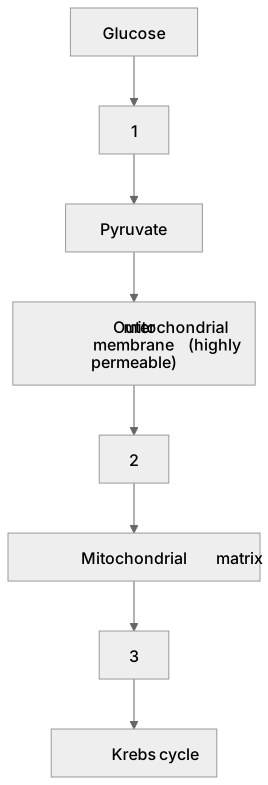
1Box 1
2Box 2
3Box 3
There is more to this lesson
The full lesson goes on to check your understanding and help you earn the marks. Create a free account to carry on, with your progress saved.
A week of Premium from your first lesson · Then the free plan continues · No card, no charge
Test your understanding of Respiration (A-level only): If respiration is aerobic, pyruvate from glycolysis enters the mitochondrial matrix by active transport.
Active recall beats re-reading. Take an instant quiz now to test what you’ve learned and lock it into long-term memory.
A week of Premium from your first lesson · Then the free plan continues · No card, no charge