AQA · A-Level · Biology
Course version: 7402 · Version from Sept 2016
Aerobic respiration in such detail as to show that: pyruvate is oxidised…
Full specification wording
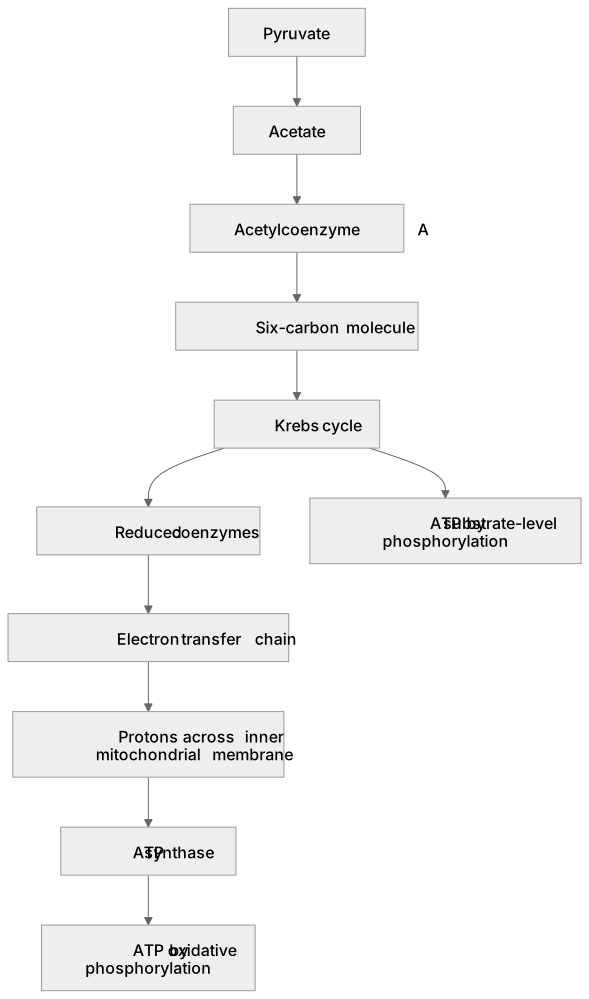
Respiration (A-level only): Aerobic respiration in such detail as to show that: pyruvate is oxidised to acetate, producing reduced NAD in the process acetate combines with coenzyme A in the link reaction to produce acetylcoenzyme A acetylcoenzyme A reacts with a four-carbon molecule, releasing coenzyme A and producing a six-carbon molecule that enters the Krebs cycle in a series of oxidation-reduction reactions, the Krebs cycle generates reduced coenzymes and ATP by substrate-level phosphorylation, and carbon dioxide is lost synthesis of ATP by oxidative phosphorylation is associated with the transfer of electrons down the electron transfer chain and passage of protons across inner mitochondrial membranes and is catalysed by ATP synthase embedded in these membranes (chemiosomotic theory) other respiratory substrates include the breakdown products of lipids and amino acids, which enter the Krebs cycle.
In the matrix, pyruvate is oxidised to acetate, producing reduced NAD and releasing carbon dioxide.
Checked against the AQA 7402 specification (opens in a new tab) on .
- Point 7 of 8
- 4 key terms
Study notes
From the checked teaching notes for this specification point.
The idea
In the matrix, pyruvate is oxidised to acetate, producing reduced NAD and releasing carbon dioxide. Acetate combines with coenzyme A to form acetylcoenzyme A. This reacts with a 4-carbon molecule to form a 6-carbon molecule, entering the Krebs cycle. Through redox reactions, it is decarboxylated and dehydrogenated back to the 4-carbon molecule, producing ATP by substrate-level phosphorylation and reduced coenzymes. These release electrons to the electron transfer chain. Energy released pumps protons across the inner membrane. Protons diffuse back via ATP synthase, driving ATP synthesis (chemiosmosis). Oxygen is the final electron acceptor, forming water. Breakdown products of lipids and amino acids can also enter the Krebs cycle as alternative respiratory substrates.
What earns the marks
- Pyruvate being oxidised to acetate, producing reduced NAD and releasing carbon dioxide.
- The Krebs cycle generating reduced coenzymes, losing carbon dioxide and producing ATP by substrate-level phosphorylation.
- Protons diffusing across the inner membrane through ATP synthase to synthesise ATP (chemiosmosis).
- Oxygen acting as the final electron acceptor to form water.
- Stating that breakdown products of lipids and amino acids can enter the Krebs cycle.
Common mistakes and how to put them right
Writing reduced NADP instead of reduced NAD in a respiration answer, which examiners reject.
Omitting water as the product formed when oxygen accepts electrons and protons at the end of the chain.
Describing the Krebs cycle ATP as coming from oxidative phosphorylation instead of substrate-level phosphorylation.
Exam tips
- Count the carbons through every step, because that catches most Krebs cycle errors before you write them down.
- Clearly distinguish between substrate-level phosphorylation in the Krebs cycle and oxidative phosphorylation via ATP synthase.
Try the lesson
The start of the Respiration (A-level only): Aerobic respiration in such detail as to show that: pyruvate is oxidised to acetate, producing reduced NAD in the process acetate combines with coenzyme A in the link reaction to produce acetylcoenzyme A acetylcoenzyme A reacts with a four-carbon molecule, releasing coenzyme A and producing a six-carbon molecule that enters the Krebs cycle in a series of oxidation-reduction reactions, the Krebs cycle generates reduced coenzymes and ATP by substrate-level phosphorylation, and carbon dioxide is lost synthesis of ATP by oxidative phosphorylation is associated with the transfer of electrons down the electron transfer chain and passage of protons across inner mitochondrial membranes and is catalysed by ATP synthase embedded in these membranes (chemiosomotic theory) other respiratory substrates include the breakdown products of lipids and amino acids, which enter the Krebs cycle. lesson, made from checked teaching notes for this specification point.
Have a go first
In the link reaction, pyruvate is oxidised to acetate. Which molecule is produced as a result of this oxidation?
Listen
In the matrix, pyruvate is oxidised to acetate, producing reduced NAD and releasing carbon dioxide. Acetate combines with coenzyme A to form acetylcoenzyme A. This reacts with a 4-carbon molecule to form a 6-carbon molecule, entering the Krebs cycle. Through redox reactions, it is decarboxylated and dehydrogenated back to the 4-carbon molecule, producing ATP by substrate-level phosphorylation and reduced coenzymes. These release electrons to the electron transfer chain. Energy released pumps protons across the inner membrane. Protons diffuse back via ATP synthase, driving ATP synthesis (chemiosmosis). Oxygen is the final electron acceptor, forming water. Breakdown products of lipids and amino acids can also enter the Krebs cycle as alternative respiratory substrates. A strong answer earns marks for these points. pyruvate being oxidised to acetate, producing reduced NAD and releasing carbon dioxide. the Krebs cycle generating reduced coenzymes, losing carbon dioxide and producing ATP by substrate-level phosphorylation. protons diffusing across the inner membrane through ATP synthase to synthesise ATP (chemiosmosis). oxygen acting as the final electron acceptor to form water. Exam tip: Count the carbons through every step, because that catches most Krebs cycle errors before you write them down.
See it
Key words
Say what each word means before you turn the card.
link reaction
Try answering aloud or in your head before turning the card.
Krebs cycle
Try answering aloud or in your head before turning the card.
oxidative phosphorylation
Try answering aloud or in your head before turning the card.
alternative respiratory substrates
Try answering aloud or in your head before turning the card.
See every definition
- link reaction
- Pyruvate is oxidised to acetate, producing reduced NAD, and acetate combines with coenzyme A to produce acetylcoenzyme A.
- Krebs cycle
- Acetylcoenzyme A reacts with a four-carbon molecule, releasing coenzyme A and producing a six-carbon molecule that enters a series of oxidation-reduction reactions generating reduced coenzymes and ATP by substrate-level phosphorylation, with carbon dioxide lost.
- oxidative phosphorylation
- Synthesis of ATP associated with the transfer of electrons down the electron transfer chain and passage of protons across inner mitochondrial membranes, catalysed by ATP synthase embedded in these membranes.
- alternative respiratory substrates
- Other respiratory substrates include the breakdown products of lipids and amino acids, which enter the Krebs cycle.
Label the diagram
Some boxes have lost their names. Pick the right name for each number.
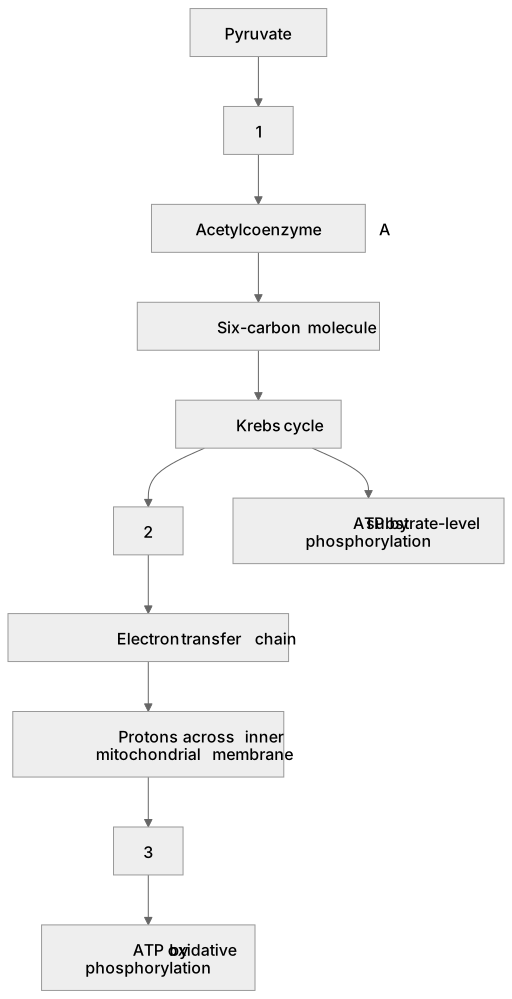
1Box 1
2Box 2
3Box 3
There is more to this lesson
The full lesson goes on to check your understanding and help you earn the marks. Create a free account to carry on, with your progress saved.
A week of Premium from your first lesson · Then the free plan continues · No card, no charge
Test your understanding of Respiration (A-level only): Aerobic respiration in such detail as to show that: pyruvate is oxidised to acetate, producing reduced NAD in the process acetate combines with coenzyme A in the link reaction to produce acetylcoenzyme A acetylcoenzyme A reacts with a four-carbon molecule, releasing coenzyme A and producing a six-carbon molecule that enters the Krebs cycle in a series of oxidation-reduction reactions, the Krebs cycle generates reduced coenzymes and ATP by substrate-level phosphorylation, and carbon dioxide is lost synthesis of ATP by oxidative phosphorylation is associated with the transfer of electrons down the electron transfer chain and passage of protons across inner mitochondrial membranes and is catalysed by ATP synthase embedded in these membranes (chemiosomotic theory) other respiratory substrates include the breakdown products of lipids and amino acids, which enter the Krebs cycle.
Active recall beats re-reading. Take an instant quiz now to test what you’ve learned and lock it into long-term memory.
A week of Premium from your first lesson · Then the free plan continues · No card, no charge