AQA · A-Level · Biology
Course version: 7402 · Version from Sept 2016
Required practical 9: Investigation into the effect of a named variable on…
Full specification wording
Respiration (A-level only): Required practical 9: Investigation into the effect of a named variable on the rate of respiration of cultures of single-celled organisms.
The organism is usually yeast, and the named variable might be temperature, substrate concentration or the type of sugar supplied.
Checked against the AQA 7402 specification (opens in a new tab) on .
- Point 8 of 8
- 2 key terms
Study notes
From the checked teaching notes for this specification point.
The idea
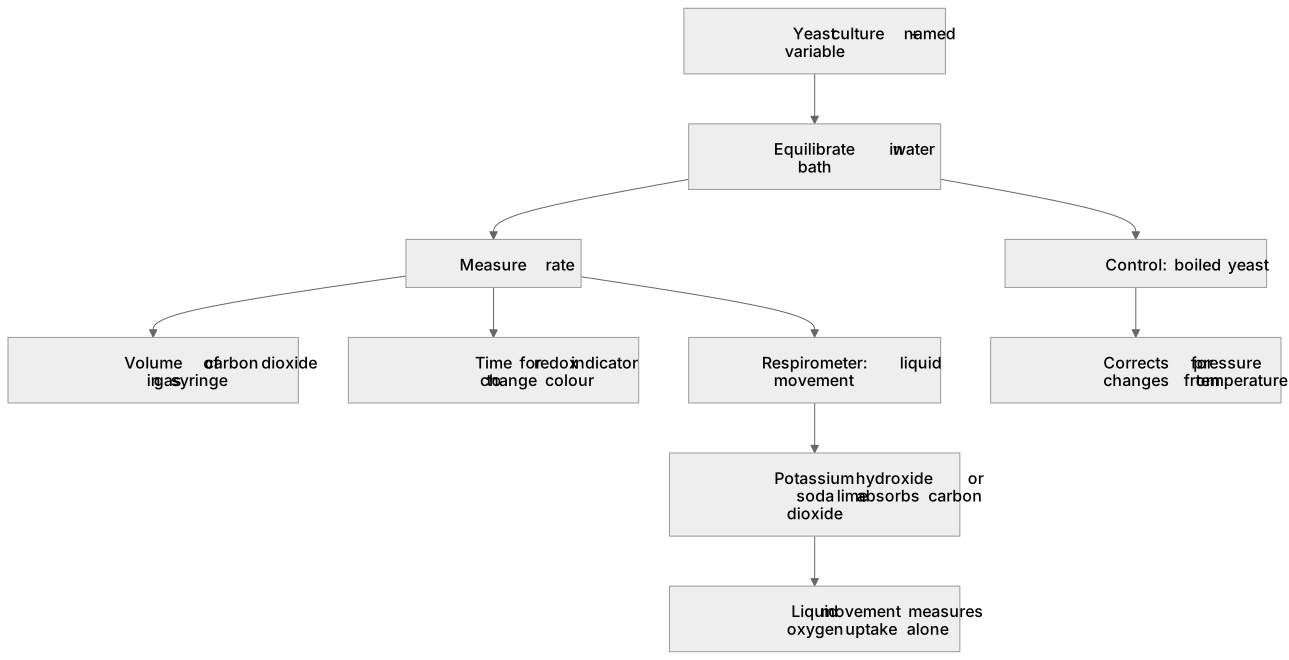
The organism is usually yeast, and the named variable might be temperature, substrate concentration or the type of sugar supplied. Rate can be measured by the volume of carbon dioxide produced, collected in a gas syringe, or by the time taken for a redox indicator such as methylene blue or TTC to change colour as it is reduced by hydrogen from the respiring cells. In a respirometer, carbon dioxide is absorbed by potassium hydroxide or soda lime, so the liquid movement in the manometer measures oxygen uptake alone, not carbon dioxide release. A control tube containing boiled yeast corrects for pressure changes caused by temperature. Controlled variables include the volume and concentration of the yeast suspension, the volume of substrate, pH, and the time allowed for equilibration in the water bath before readings begin.
What earns the marks
- A valid measure of rate, such as volume of gas produced per unit time or the reciprocal of the time taken to decolourise the indicator.
- Naming controlled variables, including yeast concentration, substrate volume, pH and temperature where it is not the independent variable.
- Using a water bath and allowing the apparatus to equilibrate before readings are taken.
- A control such as boiled or dead yeast, to show the change is caused by living cells.
- Repeating readings and calculating a mean.
- Stating that in a respirometer, carbon dioxide is absorbed by potassium hydroxide or soda lime so that liquid movement measures oxygen uptake alone.
Common mistakes and how to put them right
Taking a single reading with no repeats, so that no mean can be calculated.
Put it right: Repeat each condition and calculate a mean.
Starting the timer before the apparatus has reached the temperature of the water bath.
Put it right: Allow equilibration in the water bath before taking readings.
Leaving potassium hydroxide out of a respirometer, so that carbon dioxide released masks the oxygen taken up.
Put it right: Include potassium hydroxide or soda lime to absorb carbon dioxide so liquid movement measures oxygen uptake alone.
Judging a colour change by eye with no colour standard, then treating the end point as precise.
Put it right: Use a colorimeter or a colour standard to make the end point objective.
Treating the decolourisation of methylene blue as proof of aerobic respiration specifically, when it shows dehydrogenase activity.
Put it right: Describe it as a measure of dehydrogenase activity, not proof of aerobic respiration.
Exam tips
- Say how you will calculate the rate before you describe the method, because the units tell the examiner what you measured.
- Name the control and say what it controls for; a boiled yeast tube is the usual answer.
- If asked to improve the investigation, offer more repeats, narrower intervals between values of the independent variable, and a colorimeter in place of judging colour by eye.
Try the lesson
The start of the Respiration (A-level only): Required practical 9: Investigation into the effect of a named variable on the rate of respiration of cultures of single-celled organisms. lesson, made from checked teaching notes for this specification point.
Have a go first
A student is planning an investigation into the rate of respiration of a single-celled organism (yeast) in a liquid culture. Which of the following would be the most appropriate independent variable to alter, and what is the biological rationale?
Listen
The organism is usually yeast, and the named variable might be temperature, substrate concentration or the type of sugar supplied. Rate can be measured by the volume of carbon dioxide produced, collected in a gas syringe, or by the time taken for a redox indicator such as methylene blue or TTC to change colour as it is reduced by hydrogen from the respiring cells. In a respirometer, carbon dioxide is absorbed by potassium hydroxide or soda lime, so the liquid movement in the manometer measures oxygen uptake alone, not carbon dioxide release. A control tube containing boiled yeast corrects for pressure changes caused by temperature. Controlled variables include the volume and concentration of the yeast suspension, the volume of substrate, pH, and the time allowed for equilibration in the water bath before readings begin. A strong answer earns marks for these points. a valid measure of rate, such as volume of gas produced per unit time or the reciprocal of the time taken to decolourise the indicator. naming controlled variables, including yeast concentration, substrate volume, pH and temperature where it is not the independent variable. using a water bath and allowing the apparatus to equilibrate before readings are taken. a control such as boiled or dead yeast, to show the change is caused by living cells. A common slip: Taking a single reading with no repeats, so that no mean can be calculated. Instead, repeat each condition and calculate a mean. Exam tip: Say how you will calculate the rate before you describe the method, because the units tell the examiner what you measured.
See it
Key words
Say what each word means before you turn the card.
respirometer
Try answering aloud or in your head before turning the card.
redox indicator
Try answering aloud or in your head before turning the card.
See every definition
- respirometer
- Apparatus in which carbon dioxide is absorbed by potassium hydroxide or soda lime, so the liquid movement in the manometer measures oxygen uptake alone.
- redox indicator
- Substance such as methylene blue or TTC that changes colour as it is reduced by hydrogen from the respiring cells.
Label the diagram
Some boxes have lost their names. Pick the right name for each number.
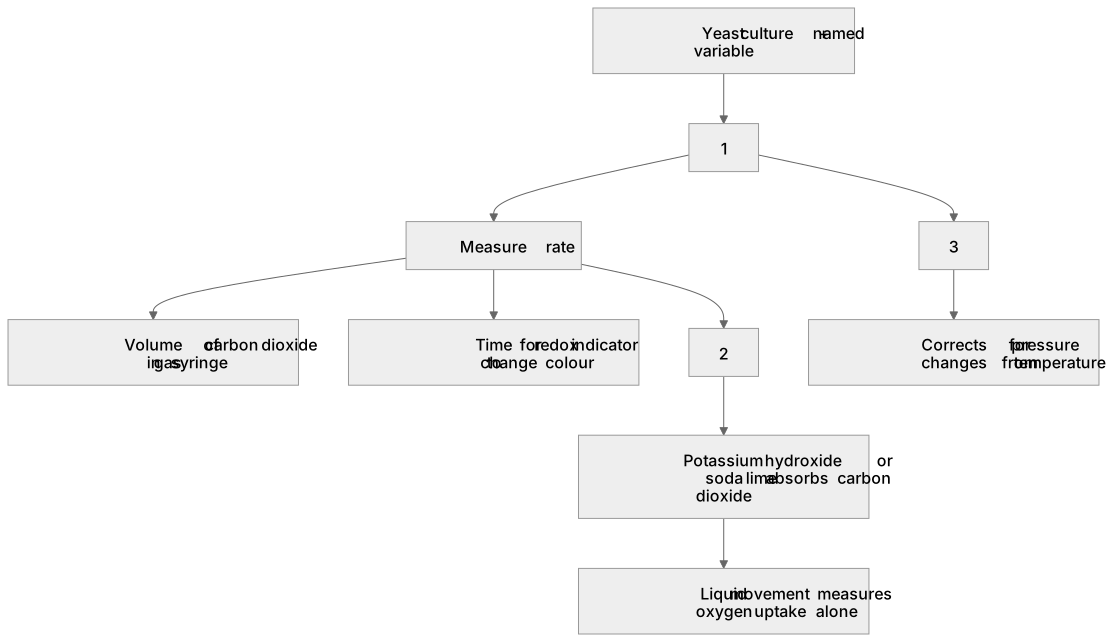
1Box 1
2Box 2
3Box 3
There is more to this lesson
The full lesson goes on to check your understanding and help you earn the marks. Create a free account to carry on, with your progress saved.
A week of Premium from your first lesson · Then the free plan continues · No card, no charge
Test your understanding of Respiration (A-level only): Required practical 9: Investigation into the effect of a named variable on the rate of respiration of cultures of single-celled organisms.
Active recall beats re-reading. Take an instant quiz now to test what you’ve learned and lock it into long-term memory.
A week of Premium from your first lesson · Then the free plan continues · No card, no charge