AQA · A-Level · Biology
Course version: 7402 · Version from Sept 2016
) The roles of ATP and phosphocreatine in muscle contraction.
Full specification wording
Skeletal muscles are stimulated to contract by nerves and act as: ) The roles of ATP and phosphocreatine in muscle contraction.
ATP is the immediate energy source for muscle contraction.
Checked against the AQA 7402 specification (opens in a new tab) on .
- Point 5 of 6
- 3 key terms
Study notes
From the checked teaching notes for this specification point.
The idea
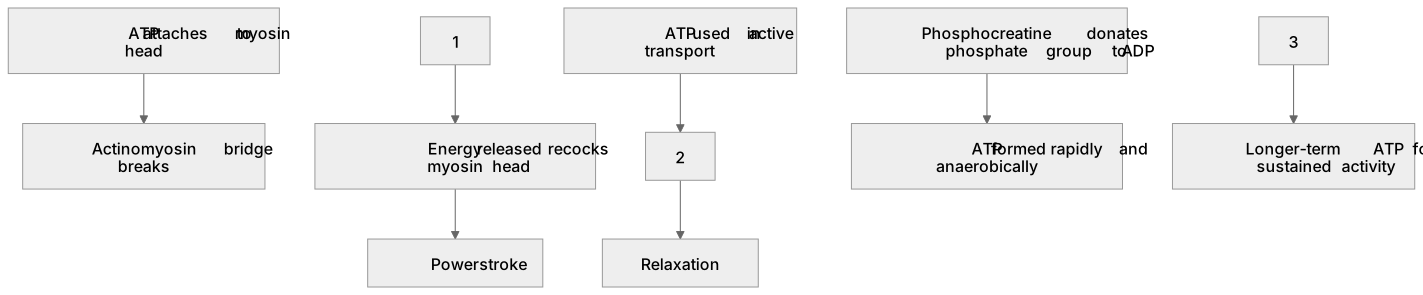
ATP is the immediate energy source for muscle contraction. It has three distinct roles: binding of ATP to the myosin head causes detachment from actin; hydrolysis of ATP to ADP and Pi releases energy that recocks the myosin head before the next power stroke; and ATP is used to actively transport calcium ions back into the sarcoplasmic reticulum during relaxation. ATP concentration in the muscle fibre is limited, so it must be regenerated continuously. Phosphocreatine is the immediate reserve: it donates its phosphate group to ADP to form ATP rapidly and anaerobically, for example during a short sprint. This does not produce lactate. Aerobic respiration provides longer-term ATP for sustained activity.
What earns the marks
- ATP attaches to the myosin head to break the actinomyosin bridge, allowing detachment.
- ATP hydrolysis to ADP and Pi provides energy to recock the myosin head before the power stroke.
- ATP is used in the active transport of calcium ions back into the sarcoplasmic reticulum during relaxation.
- Phosphocreatine donates a phosphate group to ADP to form ATP rapidly and anaerobically.
- Phosphocreatine is a phosphate donor, not an energy source in its own right, and its use does not produce lactate.
Common mistakes and how to put them right
Treating phosphocreatine as an energy source in its own right.
Put it right: It acts as a phosphate donor to regenerate ATP.
Claiming phosphocreatine use produces lactate.
Put it right: It does not produce lactate.
Stating ATP hydrolysis bends the head during the stroke.
Put it right: Hydrolysis cocks the myosin head before the power stroke.
Confusing the roles of ATP.
Put it right: Binding causes detachment, hydrolysis recocks the head, and active transport returns calcium ions.
Exam tips
- Answer roles of ATP questions with a clear list of the three distinct jobs.
- When comparing energy sources, distinguish the immediate ATP store, the phosphocreatine reserve and aerobic respiration.
Try the lesson
The start of the Skeletal muscles are stimulated to contract by nerves and act as: ) The roles of ATP and phosphocreatine in muscle contraction. lesson, made from checked teaching notes for this specification point.
Have a go first
Which molecule is hydrolysed by the myosin head to provide the energy required for muscle contraction?
Listen
ATP is the immediate energy source for muscle contraction. It has three distinct roles: binding of ATP to the myosin head causes detachment from actin; hydrolysis of ATP to ADP and Pi releases energy that recocks the myosin head before the next power stroke; and ATP is used to actively transport calcium ions back into the sarcoplasmic reticulum during relaxation. ATP concentration in the muscle fibre is limited, so it must be regenerated continuously. Phosphocreatine is the immediate reserve: it donates its phosphate group to ADP to form ATP rapidly and anaerobically, for example during a short sprint. This does not produce lactate. Aerobic respiration provides longer-term ATP for sustained activity. A strong answer earns marks for these points. ATP attaches to the myosin head to break the actinomyosin bridge, allowing detachment. ATP hydrolysis to ADP and Pi provides energy to recock the myosin head before the power stroke. ATP is used in the active transport of calcium ions back into the sarcoplasmic reticulum during relaxation. Phosphocreatine donates a phosphate group to ADP to form ATP rapidly and anaerobically. A common slip: Treating phosphocreatine as an energy source in its own right. Instead, it acts as a phosphate donor to regenerate ATP. Exam tip: Answer roles of ATP questions with a clear list of the three distinct jobs.
See it

Key words
Say what each word means before you turn the card.
anaerobic regeneration of ATP by phosphocreatine
Try answering aloud or in your head before turning the card.
myosin head cocking
Try answering aloud or in your head before turning the card.
active transport of calcium ions
Try answering aloud or in your head before turning the card.
See every definition
- anaerobic regeneration of ATP by phosphocreatine
- The immediate reserve that donates its phosphate group to ADP to form ATP rapidly and anaerobically, for example during a short sprint, and does not produce lactate.
- myosin head cocking
- Hydrolysis of ATP to ADP and Pi releases energy that recocks the myosin head before the next power stroke.
- active transport of calcium ions
- ATP is used to actively transport calcium ions back into the sarcoplasmic reticulum during relaxation.
Label the diagram
Some boxes have lost their names. Pick the right name for each number.
1Box 1
2Box 2
3Box 3
There is more to this lesson
The full lesson goes on to check your understanding and help you earn the marks. Create a free account to carry on, with your progress saved.
A week of Premium from your first lesson · Then the free plan continues · No card, no charge
Test your understanding of Skeletal muscles are stimulated to contract by nerves and act as: ) The roles of ATP and phosphocreatine in muscle contraction.
Active recall beats re-reading. Take an instant quiz now to test what you’ve learned and lock it into long-term memory.
A week of Premium from your first lesson · Then the free plan continues · No card, no charge